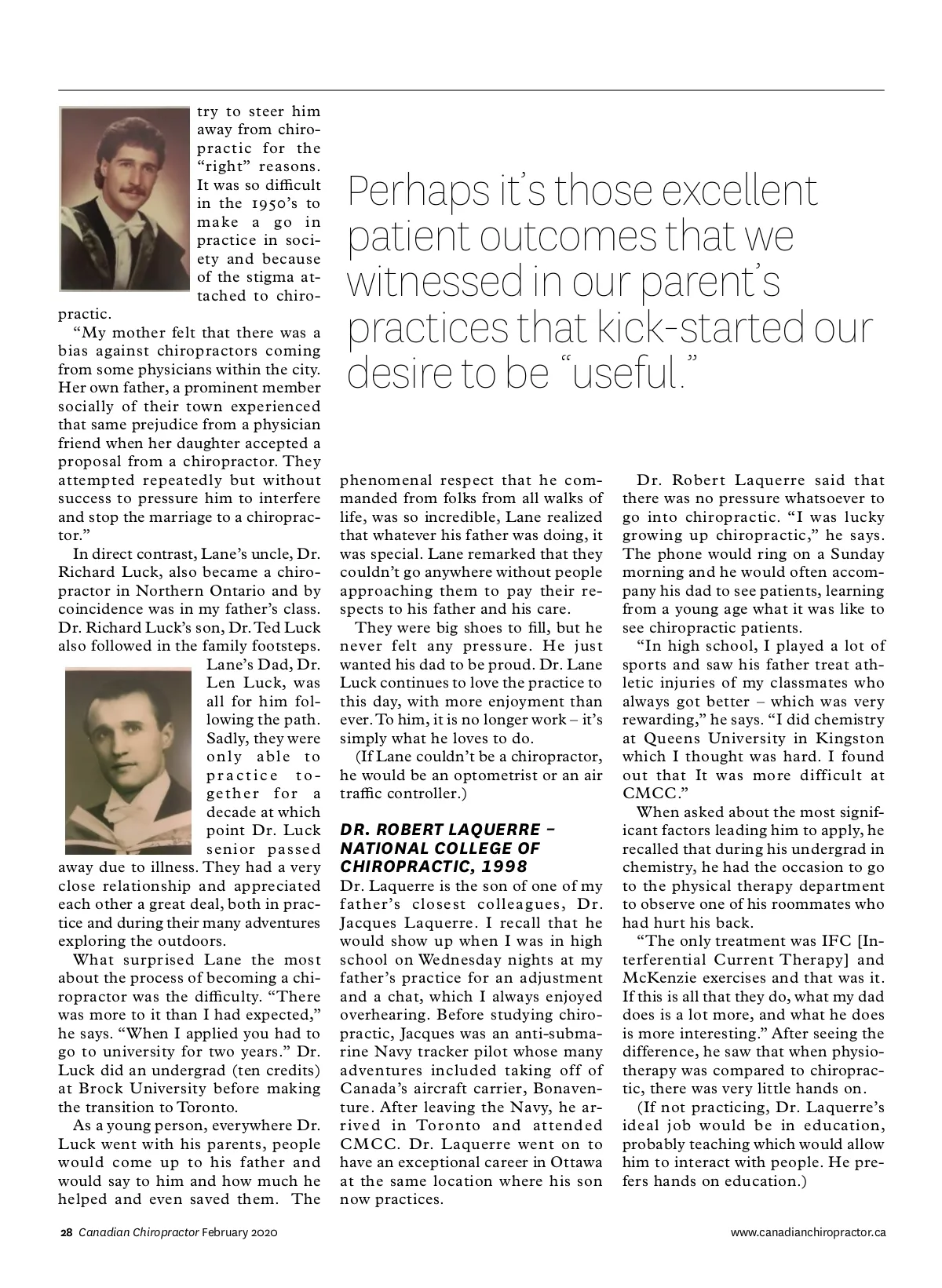
try to steer him away from chiro-practic for the “right” reasons. It was so difficult in the 1950’s to make a go in practice in soci-ety and because of the stigma at-tached to chiro-practic. “My mother felt that there was a bias against chiropractors coming from some physicians within the city. Her own father, a prominent member socially of their town experienced that same prejudice from a physician friend when her daughter accepted a proposal from a chiropractor. They attempted repeatedly but without success to pressure him to interfere and stop the marriage to a chiroprac-tor.” In direct contrast, Lane’s uncle, Dr. Richard Luck, also became a chiro-practor in Northern Ontario and by coincidence was in my father’s class. Dr. Richard Luck’s son, Dr. Ted Luck also followed in the family footsteps. Lane’s Dad, Dr. Len Luck, was all for him fol-lowing the path. Sadly, they were only able to practice to -gether for a decade at which point Dr. Luck senior passed away due to illness. They had a very close relationship and appreciated each other a great deal, both in prac-tice and during their many adventures exploring the outdoors. What surprised Lane the most about the process of becoming a chi-ropractor was the difficulty. “There was more to it than I had expected,” he says. “When I applied you had to go to university for two years.” Dr. Luck did an undergrad (ten credits) at Brock University before making the transition to Toronto. As a young person, everywhere Dr. Luck went with his parents, people would come up to his father and would say to him and how much he helped and even saved them. The 28 Canadian Chiropractor February 2020 Perhaps it’s those excellent patient outcomes that we witnessed in our parent’s practices that kick-started our desire to be “useful.” phenomenal respect that he com-manded from folks from all walks of life, was so incredible, Lane realized that whatever his father was doing, it was special. Lane remarked that they couldn’t go anywhere without people approaching them to pay their re-spects to his father and his care. They were big shoes to fill, but he never felt any pressure. He just wanted his dad to be proud. Dr. Lane Luck continues to love the practice to this day, with more enjoyment than ever. To him, it is no longer work – it’s simply what he loves to do. (If Lane couldn’t be a chiropractor, he would be an optometrist or an air traffic controller.) Dr. Robert Laquerre said that there was no pressure whatsoever to go into chiropractic. “I was lucky growing up chiropractic,” he says. The phone would ring on a Sunday morning and he would often accom-pany his dad to see patients, learning from a young age what it was like to see chiropractic patients. “In high school, I played a lot of sports and saw his father treat ath-letic injuries of my classmates who always got better – which was very rewarding,” he says. “I did chemistry at Queens University in Kingston which I thought was hard. I found out that It was more difficult at CMCC.” When asked about the most signif-icant factors leading him to apply, he recalled that during his undergrad in chemistry, he had the occasion to go to the physical therapy department to observe one of his roommates who had hurt his back. “The only treatment was IFC [In-terferential Current Therapy] and McKenzie exercises and that was it. If this is all that they do, what my dad does is a lot more, and what he does is more interesting.” After seeing the difference, he saw that when physio-therapy was compared to chiroprac-tic, there was very little hands on. (If not practicing, Dr. Laquerre’s ideal job would be in education, probably teaching which would allow him to interact with people. He pre-fers hands on education.) www.canadianchiropractor.ca DR. ROBERT LAQUERRE – NATIONAL COLLEGE OF CHIROPRACTIC, 1998 Dr. Laquerre is the son of one of my father’s closest colleagues, Dr. Jacques Laquerre. I recall that he would show up when I was in high school on Wednesday nights at my father’s practice for an adjustment and a chat, which I always enjoyed overhearing. Before studying chiro-practic, Jacques was an anti-subma-rine Navy tracker pilot whose many adventures included taking off of Canada’s aircraft carrier, Bonaven-ture. After leaving the Navy, he ar-rived in Toronto and attended CMCC. Dr. Laquerre went on to have an exceptional career in Ottawa at the same location where his son now practices.
Chiropractic + Naturopathic Doctor February 2020: Page 28