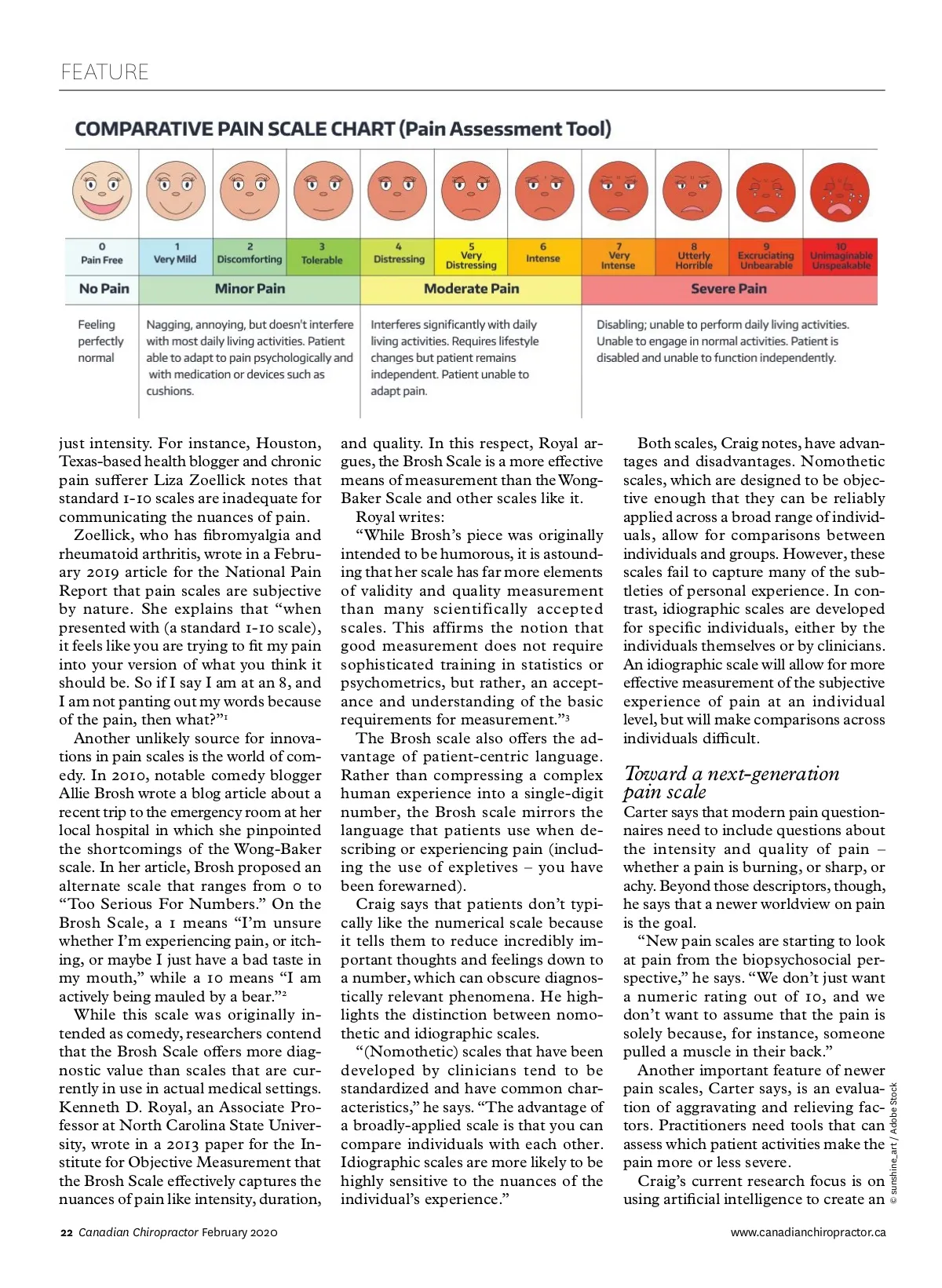
automated pain index. While most clinicians and researchers contend that self-report is the gold standard of pain measurement, Craig says that non-ver-bal cues should also play a role in pain assessment. “My own NIH-funded research with colleagues in the United States is exam-ining the fact that representations of pain are often biased,” Craig notes. “Patients who are in pain may over-or under-re-port, and observers are often biased in their interpretation of what the individual has to say. Right now, my colleagues and I are using behavioural expression to decode the pain experience for use in computer-based pattern recognition and machine learning.” An AI-derived pain scale is some-thing that researchers in bioinformatics and computer science have been work-ing toward for several years, and re-searchers at MIT’s Affective Comput-ing group are getting close to developing a working pain measure-ment system based on artificial intelli-gence. This system determines pain levels by AI analysis of brain activity through a portable neuroimager. Through machine learning, the re-searchers were able to achieve 87 per-cent accuracy with the apparatus. 4 An AI-based pain scale could solve many of the problems that pain scales have traditionally presented. But until the technology becomes sophisticated enough and affordable enough to per-form valid and reliable pain assess-ments at scale, practitioners can im-prove their pain assessments by incorporating multidimensional scales that go beyond mere numbers. The best pain scales, at least for now, are the scales that measure quality of life. Zoellick L. “My nemesis: The pain scale.” National Pain Report. Pub-lished online February 4, 2019. 2 Brosh A. “Boyfriend doesn’t have Ebola. Probably.” Hyperbole and a Half. Published online February 10, 2010. 3 Royal KD. “A more accurate pain scale?” Rasch Measurement Transac-tions, vol. 26 no. 4 (2013): 1398. 4 Matheson R. “Detecting patients’ pain levels via their brain signals.” MIT Media Lab. Published online Septem-ber 12, 2019. 1 REFERENCES Non-verbal cues should also play a role in pain assessment. HANDBOOK OF CHIROPRACTIC CARE, 2ND ED. The second edition of the Handbook of Clinical Chiropractic Care is a concise, quick-access handbook that covers the more common conditions seen in a chiropractic practice. Where possible, an evidence-based approach is presented, but it must be understood that a purely evidence-based practice is impossible to achieve in any form of health care. Instead the clinician must use the best available evidence, clinical experience, and a “pinch” of intuition to manage his/her patients. $188.95 Item #0763732493 877-267-3473 annexbookstore.com February 2020 Canadian Chiropractor 23 www.canadianchiropractor.ca CC_Bookstore_Feb20_CWM.indd 1 2020-01-20 3:33 PM
Chiropractic + Naturopathic Doctor February 2020: Page 23