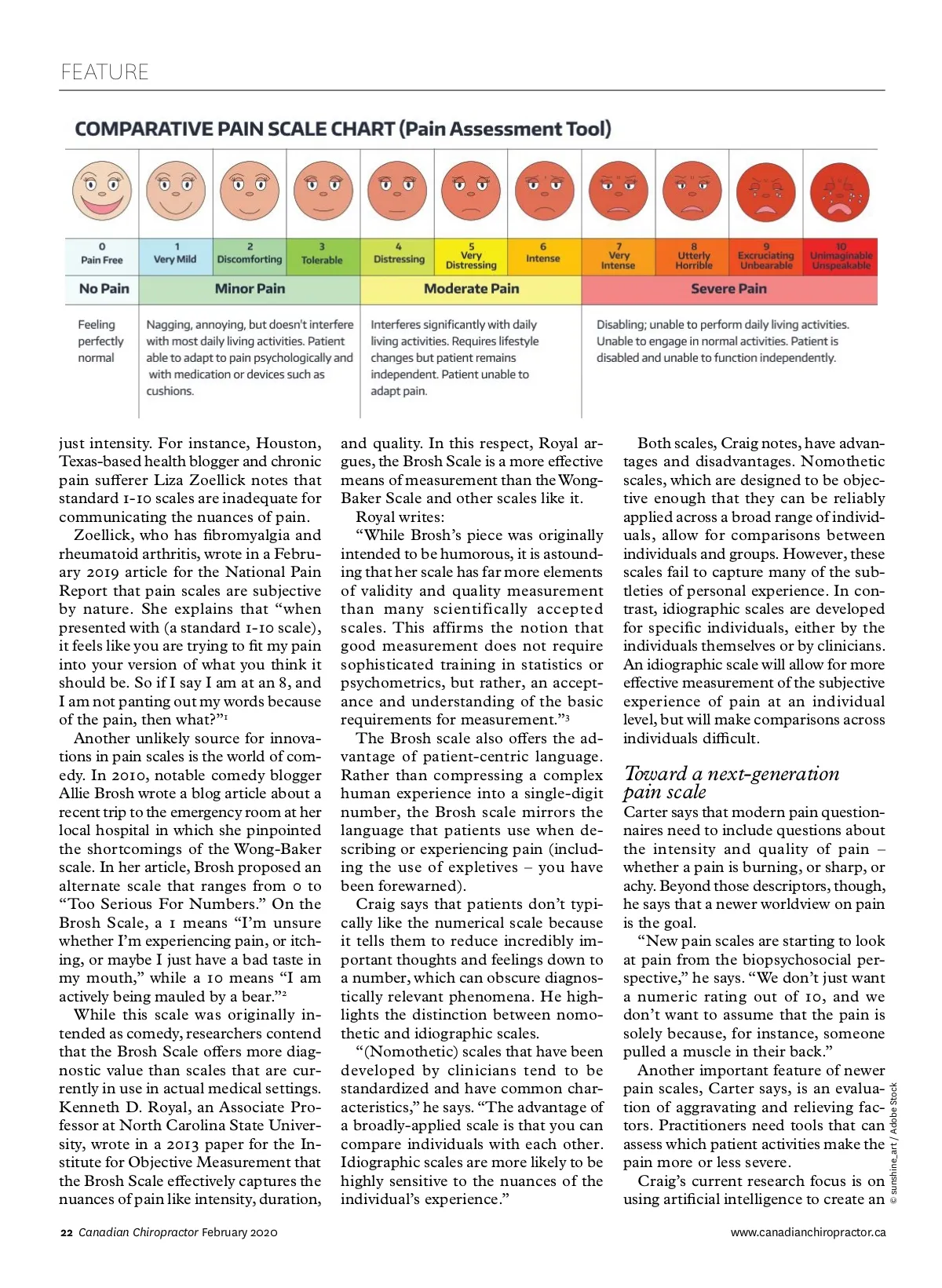
FEATURE just intensity. For instance, Houston, Texas-based health blogger and chronic pain sufferer Liza Zoellick notes that standard 1-10 scales are inadequate for communicating the nuances of pain. Zoellick, who has fibromyalgia and rheumatoid arthritis, wrote in a Febru-ary 2019 article for the National Pain Report that pain scales are subjective by nature. She explains that “when presented with (a standard 1-10 scale), it feels like you are trying to fit my pain into your version of what you think it should be. So if I say I am at an 8, and I am not panting out my words because of the pain, then what?” 1 Another unlikely source for innova-tions in pain scales is the world of com-edy. In 2010, notable comedy blogger Allie Brosh wrote a blog article about a recent trip to the emergency room at her local hospital in which she pinpointed the shortcomings of the Wong-Baker scale. In her article, Brosh proposed an alternate scale that ranges from 0 to “Too Serious For Numbers.” On the Brosh Scale, a 1 means “I’m unsure whether I’m experiencing pain, or itch-ing, or maybe I just have a bad taste in my mouth,” while a 10 means “I am actively being mauled by a bear.” 2 While this scale was originally in-tended as comedy, researchers contend that the Brosh Scale offers more diag-nostic value than scales that are cur-rently in use in actual medical settings. Kenneth D. Royal, an Associate Pro-fessor at North Carolina State Univer-sity, wrote in a 2013 paper for the In-stitute for Objective Measurement that the Brosh Scale effectively captures the nuances of pain like intensity, duration, 22 Canadian Chiropractor February 2020 and quality. In this respect, Royal ar-gues, the Brosh Scale is a more effective means of measurement than the Wong-Baker Scale and other scales like it. Royal writes: “While Brosh’s piece was originally intended to be humorous, it is astound-ing that her scale has far more elements of validity and quality measurement than many scientifically accepted scales. This affirms the notion that good measurement does not require sophisticated training in statistics or psychometrics, but rather, an accept-ance and understanding of the basic requirements for measurement.” 3 The Brosh scale also offers the ad-vantage of patient-centric language. Rather than compressing a complex human experience into a single-digit number, the Brosh scale mirrors the language that patients use when de-scribing or experiencing pain (includ-ing the use of expletives – you have been forewarned). Craig says that patients don’t typi-cally like the numerical scale because it tells them to reduce incredibly im-portant thoughts and feelings down to a number, which can obscure diagnos-tically relevant phenomena. He high-lights the distinction between nomo-thetic and idiographic scales. “(Nomothetic) scales that have been developed by clinicians tend to be standardized and have common char-acteristics,” he says. “The advantage of a broadly-applied scale is that you can compare individuals with each other. Idiographic scales are more likely to be highly sensitive to the nuances of the individual’s experience.” Both scales, Craig notes, have advan-tages and disadvantages. Nomothetic scales, which are designed to be objec-tive enough that they can be reliably applied across a broad range of individ-uals, allow for comparisons between individuals and groups. However, these scales fail to capture many of the sub-tleties of personal experience. In con-trast, idiographic scales are developed for specific individuals, either by the individuals themselves or by clinicians. An idiographic scale will allow for more effective measurement of the subjective experience of pain at an individual level, but will make comparisons across individuals difficult. Toward a next-generation pain scale Carter says that modern pain question-naires need to include questions about the intensity and quality of pain – whether a pain is burning, or sharp, or achy. Beyond those descriptors, though, he says that a newer worldview on pain is the goal. “New pain scales are starting to look at pain from the biopsychosocial per-spective,” he says. “We don’t just want a numeric rating out of 10, and we don’t want to assume that the pain is solely because, for instance, someone pulled a muscle in their back.” Another important feature of newer pain scales, Carter says, is an evalua-tion of aggravating and relieving fac-tors. Practitioners need tools that can assess which patient activities make the pain more or less severe. Craig’s current research focus is on using artificial intelligence to create an www.canadianchiropractor.ca © sunshine_art / Adobe Stock
Chiropractic + Naturopathic Doctor February 2020: Page 22