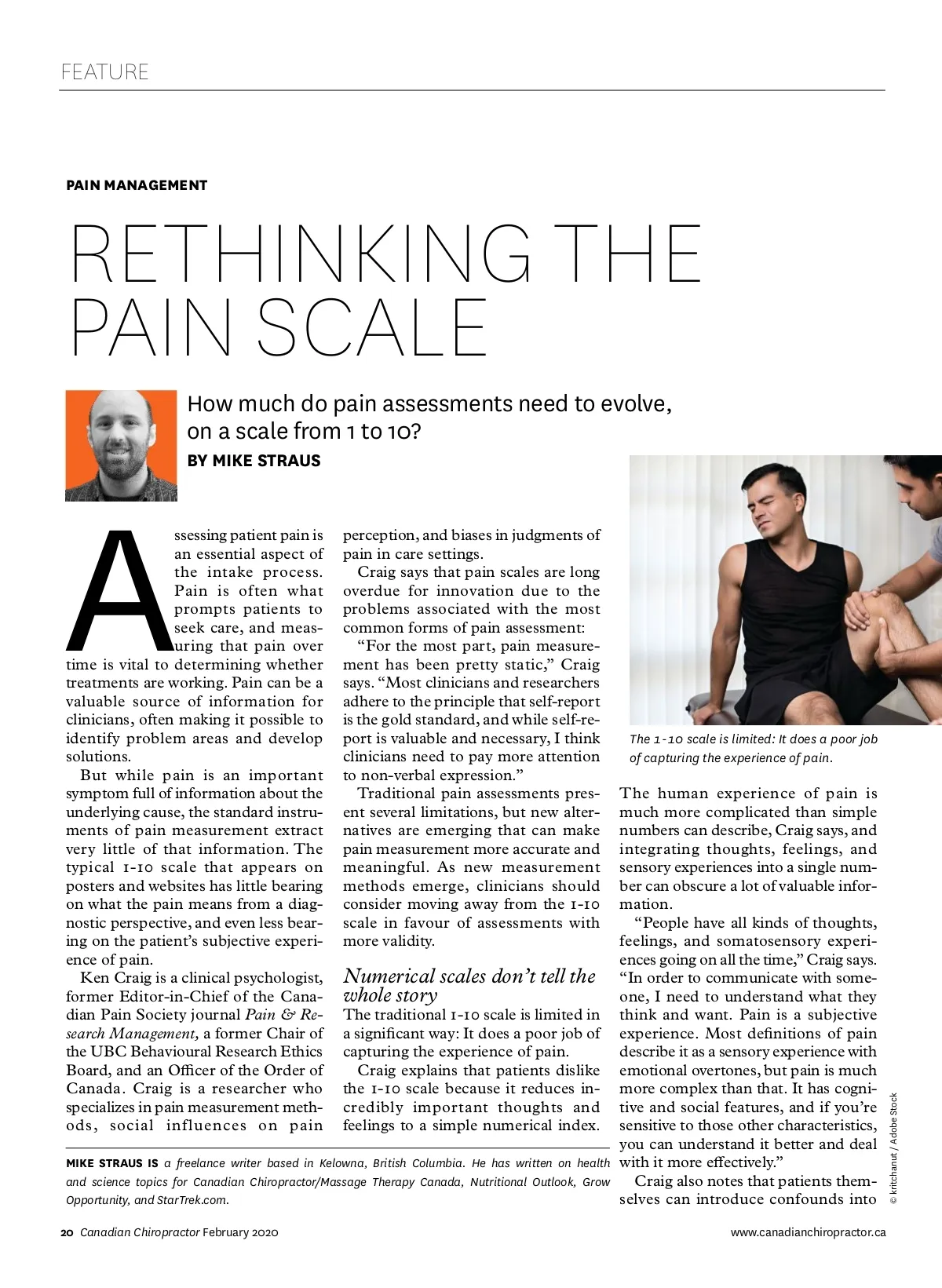
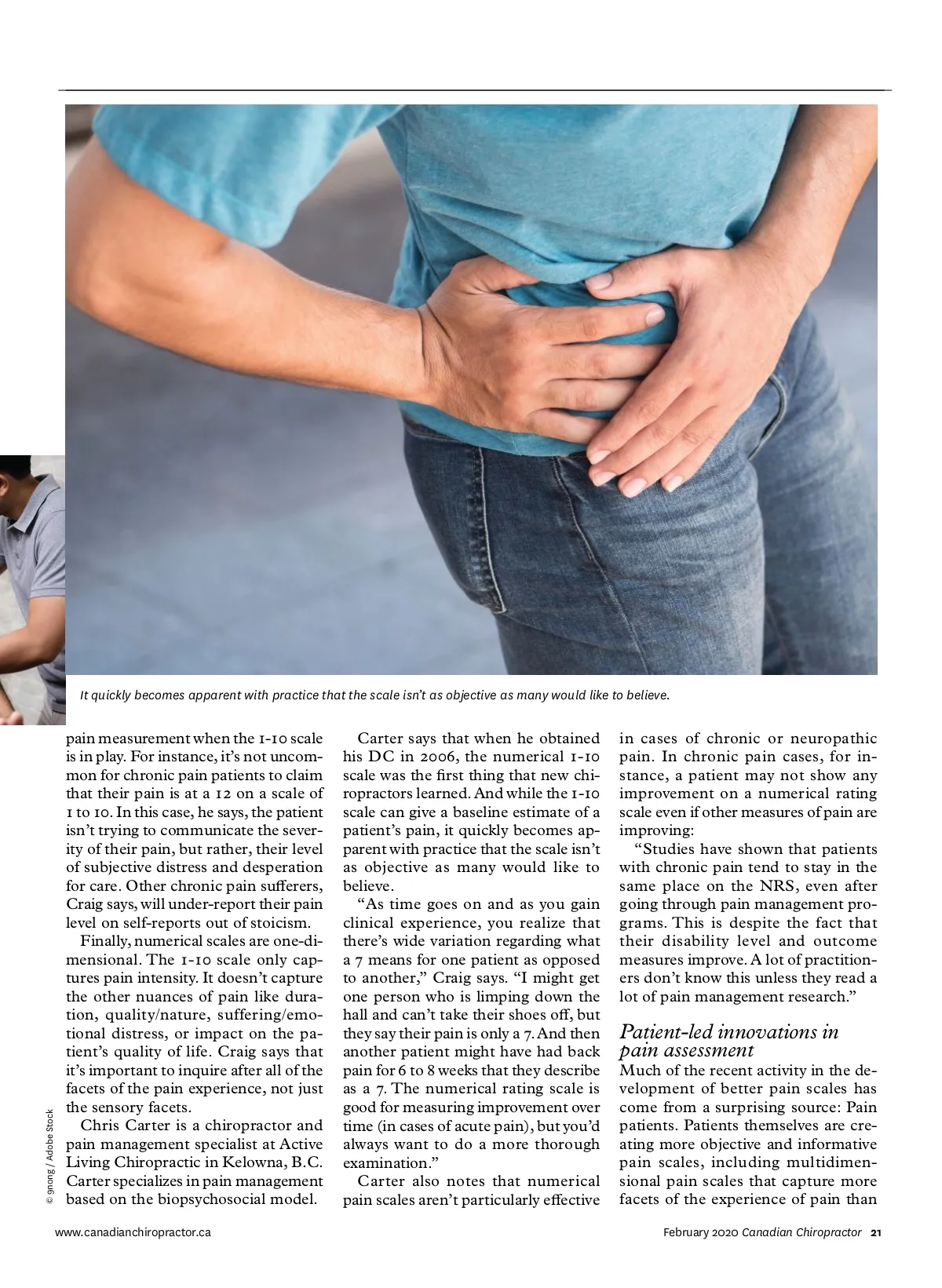
It quickly becomes apparent with practice that the scale isn’t as objective as many would like to believe. pain measurement when the 1-10 scale is in play. For instance, it’s not uncom-mon for chronic pain patients to claim that their pain is at a 12 on a scale of 1 to 10. In this case, he says, the patient isn’t trying to communicate the sever-ity of their pain, but rather, their level of subjective distress and desperation for care. Other chronic pain sufferers, Craig says, will under-report their pain level on self-reports out of stoicism. Finally, numerical scales are one-di-mensional. The 1-10 scale only cap-tures pain intensity. It doesn’t capture the other nuances of pain like dura-tion, quality/nature, suffering/emo-tional distress, or impact on the pa-tient’s quality of life. Craig says that it’s important to inquire after all of the facets of the pain experience, not just the sensory facets. Chris Carter is a chiropractor and pain management specialist at Active Living Chiropractic in Kelowna, B.C. Carter specializes in pain management based on the biopsychosocial model. www.canadianchiropractor.ca Carter says that when he obtained his DC in 2006, the numerical 1-10 scale was the first thing that new chi-ropractors learned. And while the 1-10 scale can give a baseline estimate of a patient’s pain, it quickly becomes ap-parent with practice that the scale isn’t as objective as many would like to believe. “As time goes on and as you gain clinical experience, you realize that there’s wide variation regarding what a 7 means for one patient as opposed to another,” Craig says. “I might get one person who is limping down the hall and can’t take their shoes off, but they say their pain is only a 7. And then another patient might have had back pain for 6 to 8 weeks that they describe as a 7. The numerical rating scale is good for measuring improvement over time (in cases of acute pain), but you’d always want to do a more thorough examination.” Carter also notes that numerical pain scales aren’t particularly effective in cases of chronic or neuropathic pain. In chronic pain cases, for in-stance, a patient may not show any improvement on a numerical rating scale even if other measures of pain are improving: “Studies have shown that patients with chronic pain tend to stay in the same place on the NRS, even after going through pain management pro-grams. This is despite the fact that their disability level and outcome measures improve. A lot of practition-ers don’t know this unless they read a lot of pain management research.” Patient-led innovations in pain assessment Much of the recent activity in the de-velopment of better pain scales has come from a surprising source: Pain patients. Patients themselves are cre-ating more objective and informative pain scales, including multidimen-sional pain scales that capture more facets of the experience of pain than February 2020 Canadian Chiropractor 21 © 9nong / Adobe Stock
Chiropractic + Naturopathic Doctor February 2020: Page 21