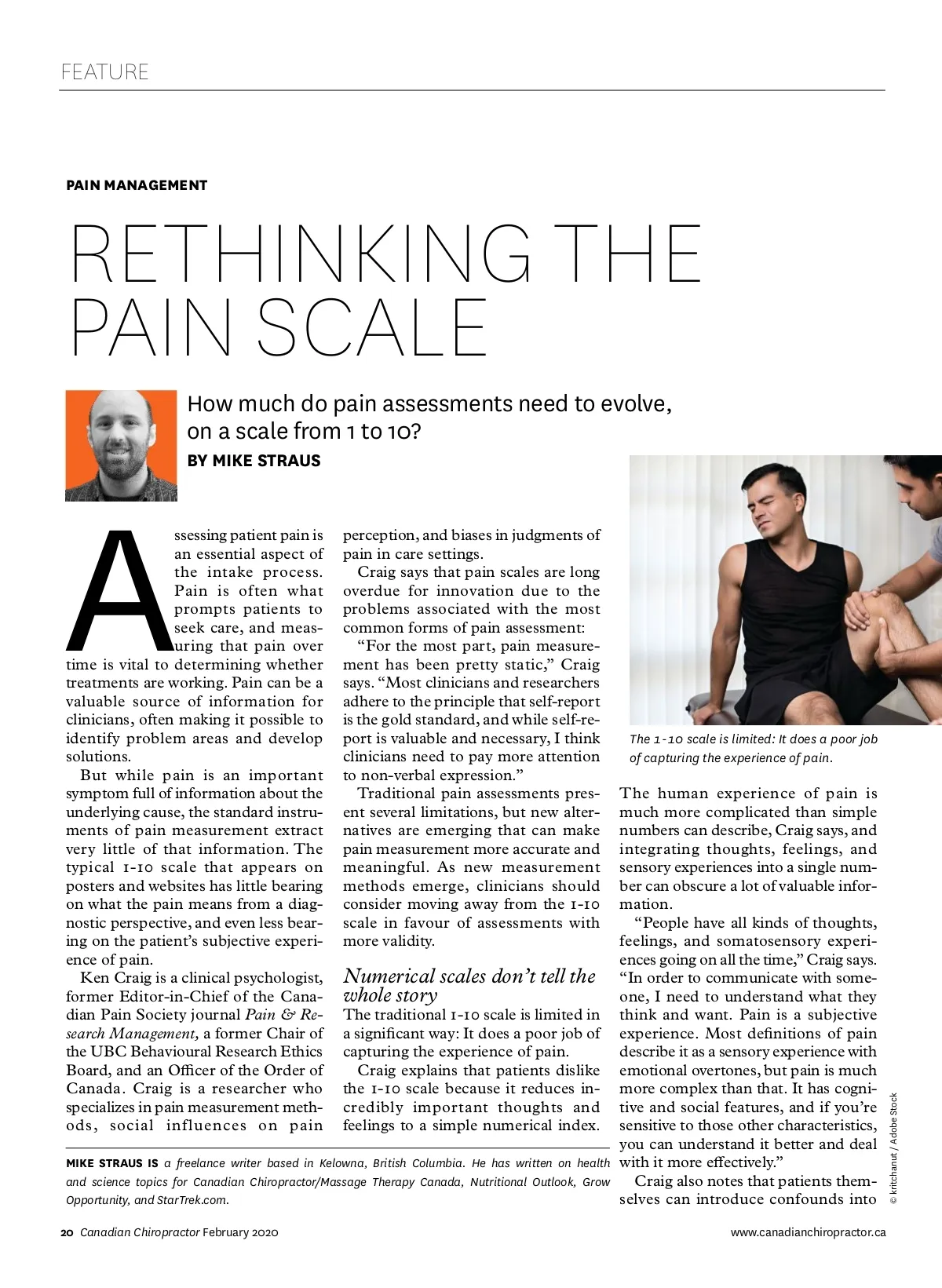
FEATURE PAIN MANAGEMENT RETHINKING THE PAIN SCALE How much do pain assessments need to evolve, on a scale from 1 to 10? A BY MIKE STRAUS The human experience of pain is much more complicated than simple numbers can describe, Craig says, and integrating thoughts, feelings, and sensory experiences into a single num-ber can obscure a lot of valuable infor-mation. “People have all kinds of thoughts, feelings, and somatosensory experi-ences going on all the time,” Craig says. Numerical scales don’t tell the “In order to communicate with some-whole story one, I need to understand what they The traditional 1-10 scale is limited in think and want. Pain is a subjective a significant way: It does a poor job of experience. Most definitions of pain capturing the experience of pain. describe it as a sensory experience with Craig explains that patients dislike emotional overtones, but pain is much the 1-10 scale because it reduces in-more complex than that. It has cogni-credibly important thoughts and tive and social features, and if you’re feelings to a simple numerical index. sensitive to those other characteristics, you can understand it better and deal MIKE STRAUS IS a freelance writer based in Kelowna, British Columbia. He has written on health with it more effectively.” and science topics for Canadian Chiropractor/Massage Therapy Canada, Nutritional Outlook, Grow Craig also notes that patients them-Opportunity, and StarTrek.com. selves can introduce confounds into 20 Canadian Chiropractor February 2020 www.canadianchiropractor.ca © kritchanut / Adobe Stock ssessing patient pain is an essential aspect of the intake process. Pain is often what prompts patients to seek care, and meas-uring that pain over time is vital to determining whether treatments are working. Pain can be a valuable source of information for clinicians, often making it possible to identify problem areas and develop solutions. But while pain is an important symptom full of information about the underlying cause, the standard instru-ments of pain measurement extract very little of that information. The typical 1-10 scale that appears on posters and websites has little bearing on what the pain means from a diag-nostic perspective, and even less bear-ing on the patient’s subjective experi-ence of pain. Ken Craig is a clinical psychologist, former Editor-in-Chief of the Cana-dian Pain Society journal Pain & Re-search Management, a former Chair of the UBC Behavioural Research Ethics Board, and an Officer of the Order of Canada. Craig is a researcher who specializes in pain measurement meth-ods, social influences on pain perception, and biases in judgments of pain in care settings. Craig says that pain scales are long overdue for innovation due to the problems associated with the most common forms of pain assessment: “For the most part, pain measure-ment has been pretty static,” Craig says. “Most clinicians and researchers adhere to the principle that self-report is the gold standard, and while self-re-port is valuable and necessary, I think clinicians need to pay more attention to non-verbal expression.” Traditional pain assessments pres-ent several limitations, but new alter-natives are emerging that can make pain measurement more accurate and meaningful. As new measurement methods emerge, clinicians should consider moving away from the 1-10 scale in favour of assessments with more validity. The 1-10 scale is limited: It does a poor job of capturing the experience of pain.
Chiropractic + Naturopathic Doctor February 2020: Page 20