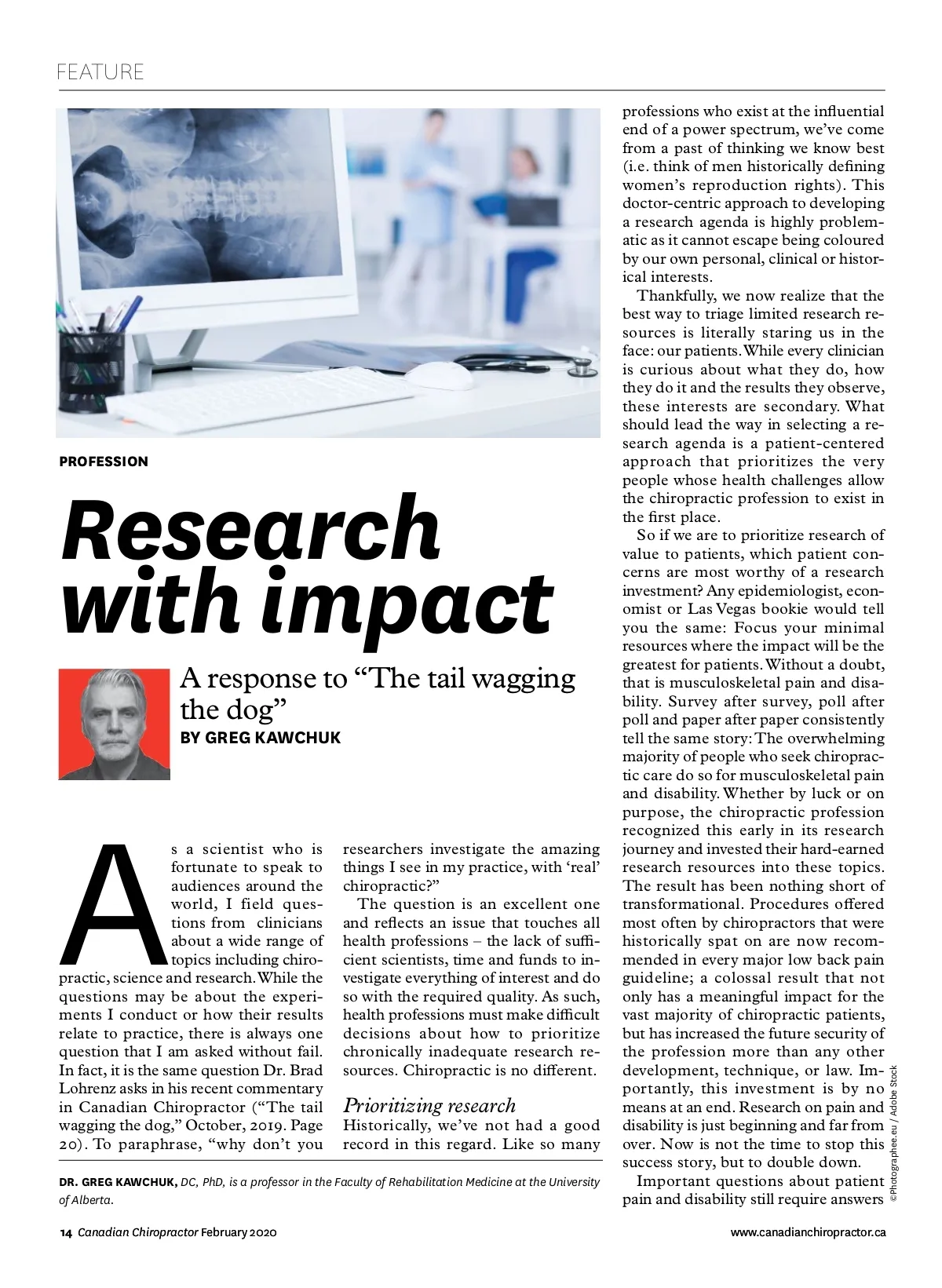
FEATURE professions who exist at the influential end of a power spectrum, we’ve come from a past of thinking we know best (i.e. think of men historically defining women’s reproduction rights). This doctor-centric approach to developing a research agenda is highly problem-atic as it cannot escape being coloured by our own personal, clinical or histor-ical interests. Thankfully, we now realize that the best way to triage limited research re-sources is literally staring us in the face: our patients. While every clinician is curious about what they do, how they do it and the results they observe, these interests are secondary. What should lead the way in selecting a re-search agenda is a patient-centered approach that prioritizes the very people whose health challenges allow the chiropractic profession to exist in the first place. So if we are to prioritize research of value to patients, which patient con-cerns are most worthy of a research investment? Any epidemiologist, econ-omist or Las Vegas bookie would tell you the same: Focus your minimal resources where the impact will be the greatest for patients. Without a doubt, that is musculoskeletal pain and disa-bility. Survey after survey, poll after poll and paper after paper consistently tell the same story: The overwhelming majority of people who seek chiroprac-tic care do so for musculoskeletal pain and disability. Whether by luck or on purpose, the chiropractic profession recognized this early in its research journey and invested their hard-earned research resources into these topics. The result has been nothing short of transformational. Procedures offered most often by chiropractors that were historically spat on are now recom-mended in every major low back pain guideline; a colossal result that not only has a meaningful impact for the vast majority of chiropractic patients, but has increased the future security of the profession more than any other development, technique, or law. Im-portantly, this investment is by no means at an end. Research on pain and disability is just beginning and far from over. Now is not the time to stop this success story, but to double down. Important questions about patient pain and disability still require answers www.canadianchiropractor.ca PROFESSION Research with impact A response to “The tail wagging the dog” BY GREG KAWCHUK A Prioritizing research Historically, we’ve not had a good record in this regard. Like so many DR. GREG KAWCHUK, DC, PhD, is a professor in the Faculty of Rehabilitation Medicine at the University of Alberta. 14 Canadian Chiropractor February 2020 ©Photographee.eu / Adobe Stock s a scientist who is fortunate to speak to audiences around the world, I field ques-tions from clinicians about a wide range of topics including chiro-practic, science and research. While the questions may be about the experi-ments I conduct or how their results relate to practice, there is always one question that I am asked without fail. In fact, it is the same question Dr. Brad Lohrenz asks in his recent commentary in Canadian Chiropractor (“The tail wagging the dog,” October, 2019. Page 20). To paraphrase, “why don’t you researchers investigate the amazing things I see in my practice, with ‘real’ chiropractic?” The question is an excellent one and reflects an issue that touches all health professions – the lack of suffi-cient scientists, time and funds to in-vestigate everything of interest and do so with the required quality. As such, health professions must make difficult decisions about how to prioritize chronically inadequate research re-sources. Chiropractic is no different.
Chiropractic + Naturopathic Doctor February 2020: Page 14