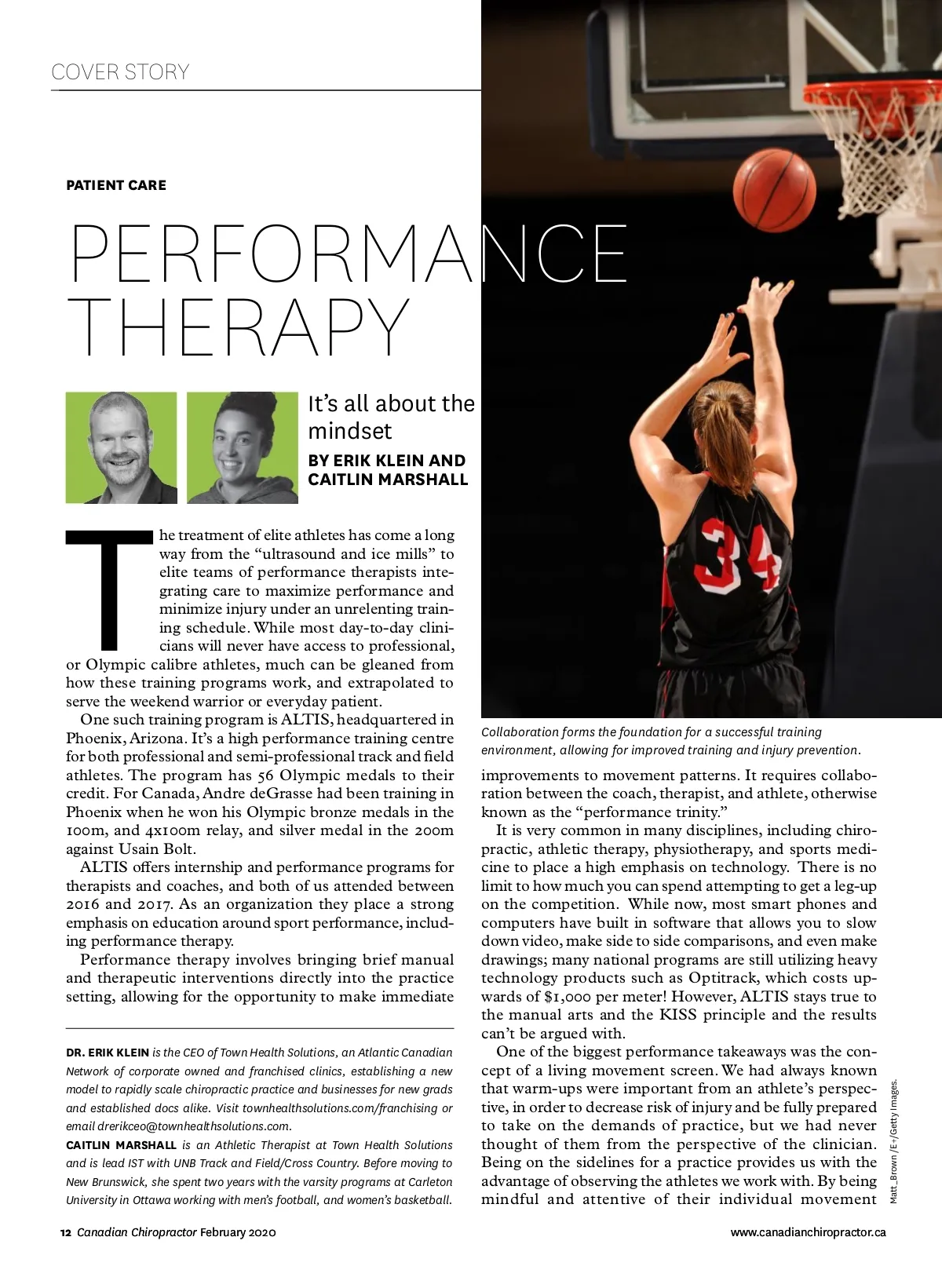
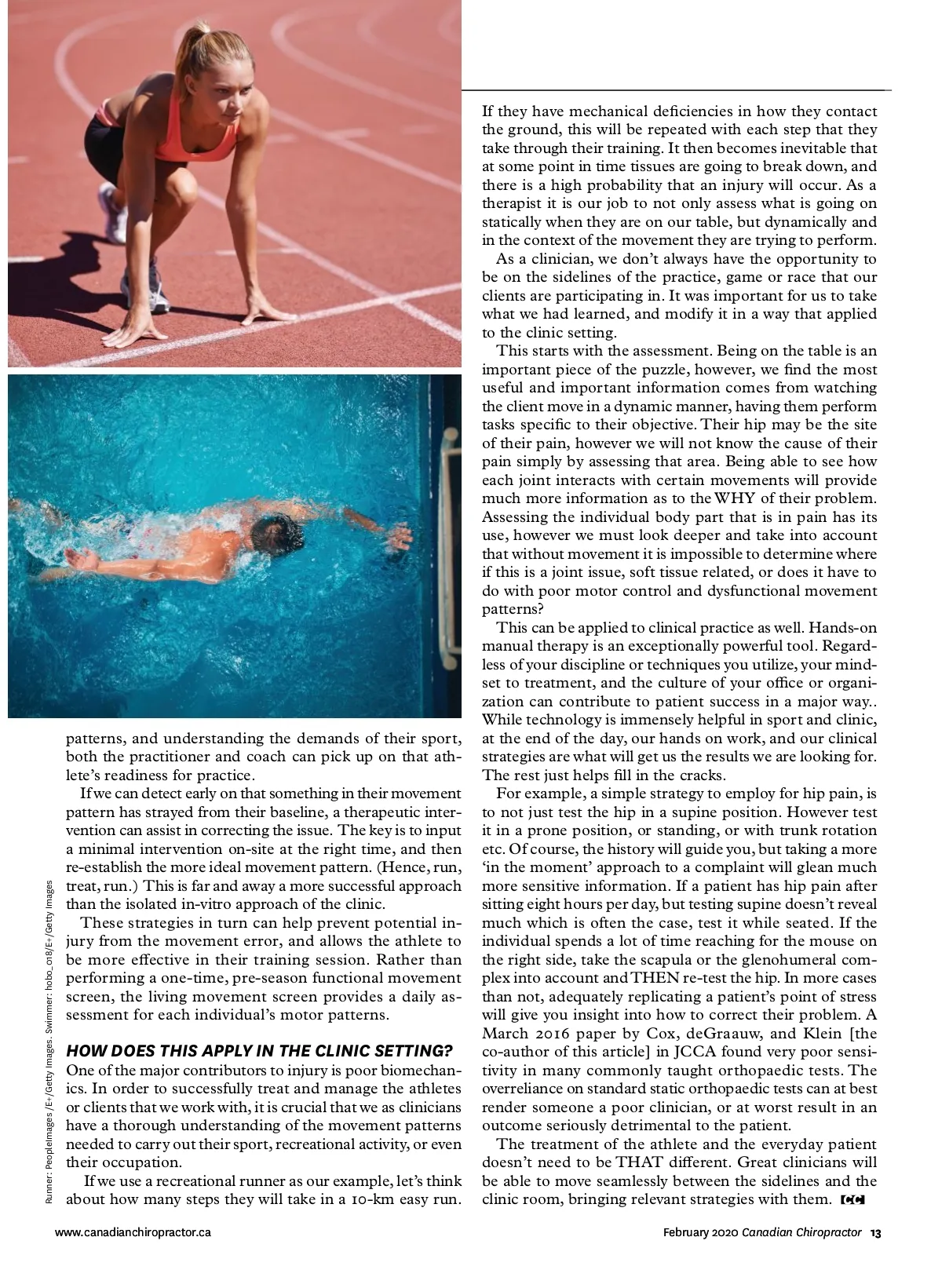
Runner: PeopleImages /E+/Getty Images. Swimmer: hobo_018/E+/Getty Images patterns, and understanding the demands of their sport, both the practitioner and coach can pick up on that ath-lete’s readiness for practice. If we can detect early on that something in their movement pattern has strayed from their baseline, a therapeutic inter-vention can assist in correcting the issue. The key is to input a minimal intervention on-site at the right time, and then re-establish the more ideal movement pattern. (Hence, run, treat, run.) This is far and away a more successful approach than the isolated in-vitro approach of the clinic. These strategies in turn can help prevent potential in-jury from the movement error, and allows the athlete to be more effective in their training session. Rather than performing a one-time, pre-season functional movement screen, the living movement screen provides a daily as-sessment for each individual’s motor patterns. HOW DOES THIS APPLY IN THE CLINIC SETTING? One of the major contributors to injury is poor biomechan-ics. In order to successfully treat and manage the athletes or clients that we work with, it is crucial that we as clinicians have a thorough understanding of the movement patterns needed to carry out their sport, recreational activity, or even their occupation. If we use a recreational runner as our example, let’s think about how many steps they will take in a 10-km easy run. www.canadianchiropractor.ca If they have mechanical deficiencies in how they contact the ground, this will be repeated with each step that they take through their training. It then becomes inevitable that at some point in time tissues are going to break down, and there is a high probability that an injury will occur. As a therapist it is our job to not only assess what is going on statically when they are on our table, but dynamically and in the context of the movement they are trying to perform. As a clinician, we don’t always have the opportunity to be on the sidelines of the practice, game or race that our clients are participating in. It was important for us to take what we had learned, and modify it in a way that applied to the clinic setting. This starts with the assessment. Being on the table is an important piece of the puzzle, however, we find the most useful and important information comes from watching the client move in a dynamic manner, having them perform tasks specific to their objective. Their hip may be the site of their pain, however we will not know the cause of their pain simply by assessing that area. Being able to see how each joint interacts with certain movements will provide much more information as to the WHY of their problem. Assessing the individual body part that is in pain has its use, however we must look deeper and take into account that without movement it is impossible to determine where if this is a joint issue, soft tissue related, or does it have to do with poor motor control and dysfunctional movement patterns? This can be applied to clinical practice as well. Hands-on manual therapy is an exceptionally powerful tool. Regard-less of your discipline or techniques you utilize, your mind-set to treatment, and the culture of your office or organi-zation can contribute to patient success in a major way.. While technology is immensely helpful in sport and clinic, at the end of the day, our hands on work, and our clinical strategies are what will get us the results we are looking for. The rest just helps fill in the cracks. For example, a simple strategy to employ for hip pain, is to not just test the hip in a supine position. However test it in a prone position, or standing, or with trunk rotation etc. Of course, the history will guide you, but taking a more ‘in the moment’ approach to a complaint will glean much more sensitive information. If a patient has hip pain after sitting eight hours per day, but testing supine doesn’t reveal much which is often the case, test it while seated. If the individual spends a lot of time reaching for the mouse on the right side, take the scapula or the glenohumeral com-plex into account and THEN re-test the hip. In more cases than not, adequately replicating a patient’s point of stress will give you insight into how to correct their problem. A March 2016 paper by Cox, deGraauw, and Klein [the co-author of this article] in JCCA found very poor sensi-tivity in many commonly taught orthopaedic tests. The overreliance on standard static orthopaedic tests can at best render someone a poor clinician, or at worst result in an outcome seriously detrimental to the patient. The treatment of the athlete and the everyday patient doesn’t need to be THAT different. Great clinicians will be able to move seamlessly between the sidelines and the clinic room, bringing relevant strategies with them. February 2020 Canadian Chiropractor 13
Chiropractic + Naturopathic Doctor February 2020: Page 13