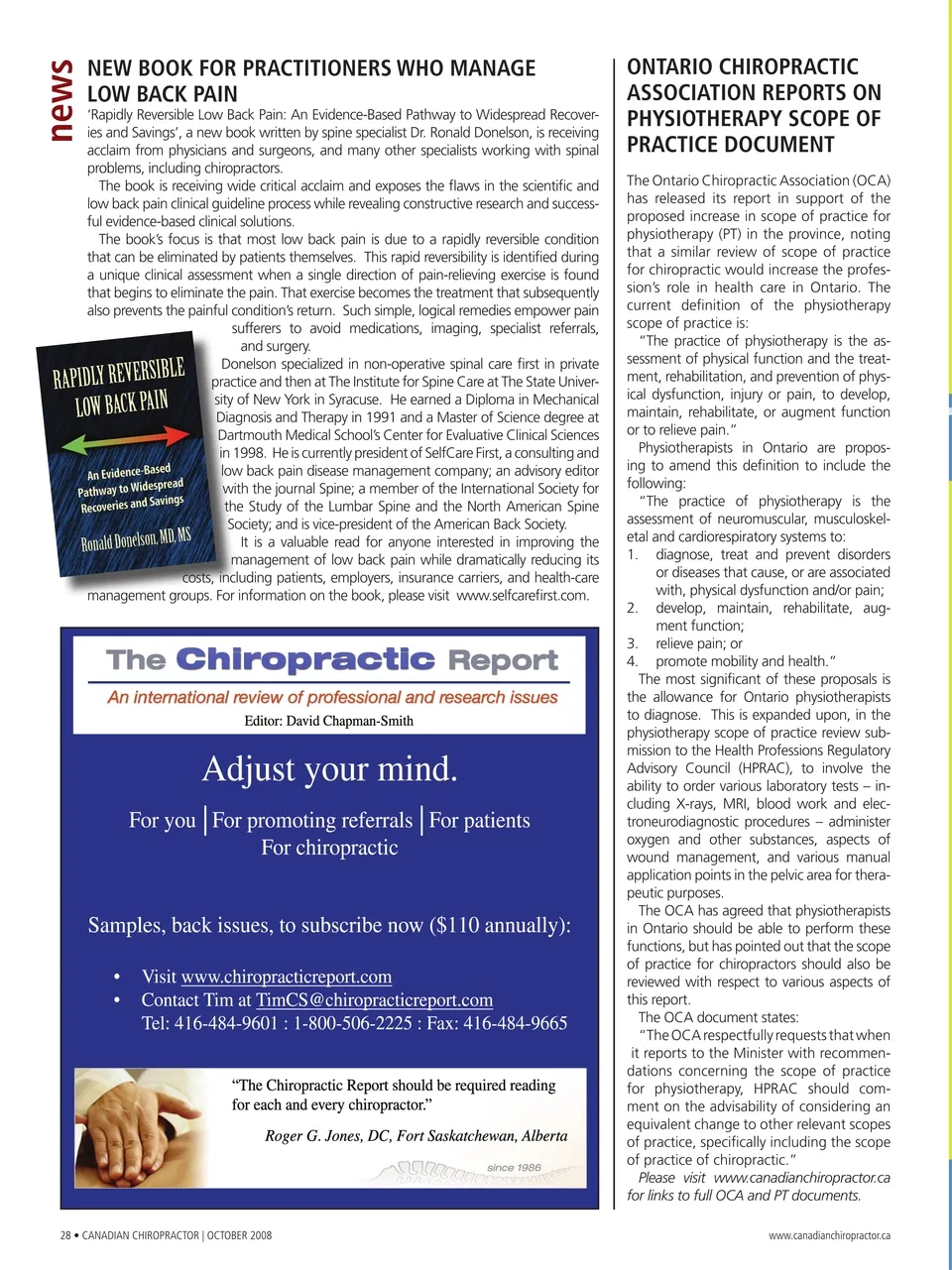
NEW BOOK FOR PRACTITIONERS WHO MANAGE LOW BACK PAIN ‘Rapidly Reversible Low Back Pain: An Evidence-Based Pathway to Widespread Recover- ies and Savings’, a new book written by spine specialist Dr. Ronald Donelson, is receiving acclaim from physicians and surgeons, and many other specialists working with spinal problems, including chiropractors. The book is receiving wide critical acclaim and exposes the fl aws in the scientific and low back pain clinical guideline process while revealing constructive research and success- ful evidence-based clinical solutions. The book’s focus is that most low back pain is due to a rapidly reversible condition that can be eliminated by patients themselves. This rapid reversibility is identified during a unique clinical assessment when a single direction of pain-relieving exercise is found that begins to eliminate the pain. That exercise becomes the treatment that subsequently also prevents the painful condition’s return. Such simple, logical remedies empower pain sufferers to avoid medications, imaging, specialist referrals, and surgery. s costs, inc management groups For Donelson specialized in non-operative spinal care fi rst in private practice and then at The Institute for Spine Care at The State Univer- sity of New York in Syracuse. He earned a Diploma in Mechanical Diagnosis and Therapy in 1991 and a Master of Science degree at Dartmouth Medical School’s Center for Evaluative Clinical Sciences in 1998. He is currently president of SelfCare First, a consulting and low back pain disease management company; an advisory editor with the journal Spine; a member of the International Society for the Study of the Lumbar Spine and the North American Spine Society; and is vice-president of the American Back Society. It is a valuable read for anyone interested in improving the management of low back pain while dramatically reducing its costs, including patients, employers, insurance carriers, and health-care Do prac sity Dia Dar in1 low wi th So m management groups. For information on the book, please visit www.selfcarefirst.com. ONTARIO CHIROPRACTIC ASSOCIATION REPORTS ON PHYSIOTHERAPY SCOPE OF PRACTICE DOCUMENT The Ontario Chiropractic Association (OCA) has released its report in support of the proposed increase in scope of practice for physiotherapy (PT) in the province, noting that a similar review of scope of practice for chiropractic would increase the profes- sion’s role in health care in Ontario. The current defi nition of the physiotherapy scope of practice is: “The practice of physiotherapy is the as- sessment of physical function and the treat- ment, rehabilitation, and prevention of phys- ical dysfunction, injury or pain, to develop, maintain, rehabilitate, or augment function or to relieve pain.” Physiotherapists in Ontario are propos- ing to amend this defi nition to include the following: “The practice of physiotherapy is the assessment of neuromuscular, musculoskel- etal and cardiorespiratory systems to: 1. diagnose, treat and prevent disorders or diseases that cause, or are associated with, physical dysfunction and/or pain; 2. develop, maintain, rehabilitate, aug- ment function; 3. relieve pain; or 4. promote mobility and health.” The most signifi cant of these proposals is the allowance for Ontario physiotherapists to diagnose. This is expanded upon, in the physiotherapy scope of practice review sub- mission to the Health Professions Regulatory Advisory Council (HPRAC), to involve the ability to order various laboratory tests – in- cluding X-rays, MRI, blood work and elec- troneurodiagnostic procedures – administer oxygen and other substances, aspects of wound management, and various manual application points in the pelvic area for thera- peutic purposes. The OCA has agreed that physiotherapists in Ontario should be able to perform these functions, but has pointed out that the scope of practice for chiropractors should also be reviewed with respect to various aspects of this report. The OCA document states: “The OCA respectfully requests that when it reports to the Minister with recommen- dations concerning the scope of practice for physiotherapy, HPRAC should com- ment on the advisability of considering an equivalent change to other relevant scopes of practice, specifically including the scope of practice of chiropractic.” Please visit www.canadianchiropractor.ca for links to full OCA and PT documents. 28 • CANADIAN CHIROPRACTOR | OCTOBER 2008 www.canadianchiropractor.ca news
Chiropractic + Naturopathic Doctor October 08: Page 28