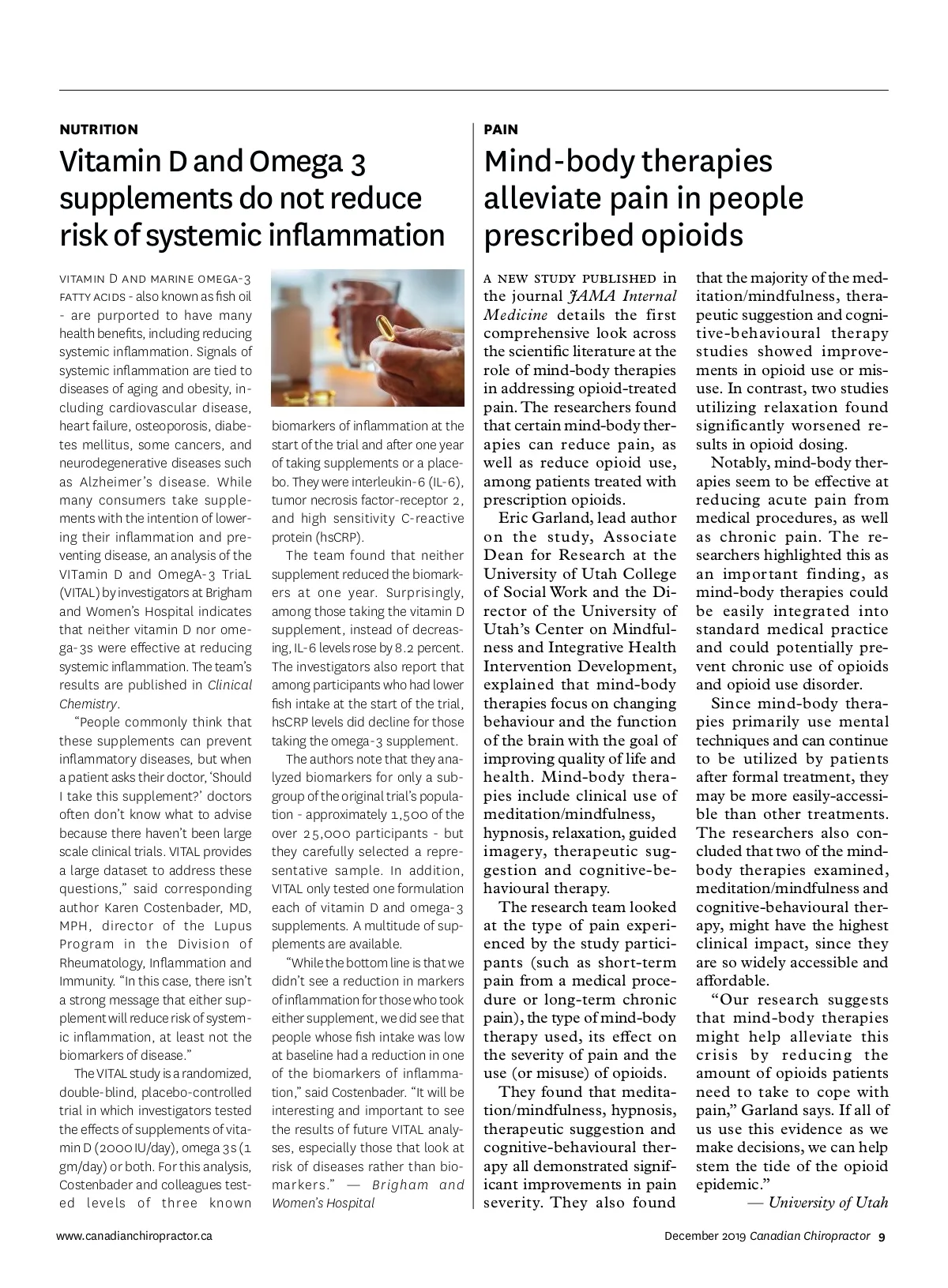
NUTRITION Vitamin D and Omega 3 supplements do not reduce risk of systemic inflammation vitamin D and marine omega-3 fatty acids -also known as fish oil -are purported to have many health benefits, including reducing systemic inflammation. Signals of systemic inflammation are tied to diseases of aging and obesity, in-cluding cardiovascular disease, heart failure, osteoporosis, diabe-tes mellitus, some cancers, and neurodegenerative diseases such as Alzheimer’s disease. While many consumers take supple-ments with the intention of lower-ing their inflammation and pre-venting disease, an analysis of the VITamin D and OmegA-3 TriaL (VITAL) by investigators at Brigham and Women’s Hospital indicates that neither vitamin D nor ome-ga-3s were effective at reducing systemic inflammation. The team’s results are published in Clinical Chemistry . “People commonly think that these supplements can prevent inflammatory diseases, but when a patient asks their doctor, ‘Should I take this supplement?’ doctors often don’t know what to advise because there haven’t been large scale clinical trials. VITAL provides a large dataset to address these questions,” said corresponding author Karen Costenbader, MD, MPH, director of the Lupus Program in the Division of Rheumatology, Inflammation and Immunity. “In this case, there isn’t a strong message that either sup-plement will reduce risk of system-ic inflammation, at least not the biomarkers of disease.” The VITAL study is a randomized, double-blind, placebo-controlled trial in which investigators tested the effects of supplements of vita-min D (2000 IU/day), omega 3s (1 gm/day) or both. For this analysis, Costenbader and colleagues test-ed levels of three known www.canadianchiropractor.ca PAIN Mind-body therapies alleviate pain in people prescribed opioids a new study published in the journal JAMA Internal Medicine details the first comprehensive look across the scientific literature at the role of mind-body therapies in addressing opioid-treated pain. The researchers found that certain mind-body ther-apies can reduce pain, as well as reduce opioid use, among patients treated with prescription opioids. Eric Garland, lead author on the study, Associate Dean for Research at the University of Utah College of Social Work and the Di-rector of the University of Utah’s Center on Mindful-ness and Integrative Health Intervention Development, explained that mind-body therapies focus on changing behaviour and the function of the brain with the goal of improving quality of life and health. Mind-body thera-pies include clinical use of meditation/mindfulness, hypnosis, relaxation, guided imagery, therapeutic sug-gestion and cognitive-be-havioural therapy. The research team looked at the type of pain experi-enced by the study partici-pants (such as short-term pain from a medical proce-dure or long-term chronic pain), the type of mind-body therapy used, its effect on the severity of pain and the use (or misuse) of opioids. They found that medita-tion/mindfulness, hypnosis, therapeutic suggestion and cognitive-behavioural ther-apy all demonstrated signif-icant improvements in pain severity. They also found that the majority of the med-itation/mindfulness, thera-peutic suggestion and cogni-tive-behavioural therapy studies showed improve-ments in opioid use or mis-use. In contrast, two studies utilizing relaxation found significantly worsened re-sults in opioid dosing. Notably, mind-body ther-apies seem to be effective at reducing acute pain from medical procedures, as well as chronic pain. The re-searchers highlighted this as an important finding, as mind-body therapies could be easily integrated into standard medical practice and could potentially pre-vent chronic use of opioids and opioid use disorder. Since mind-body thera-pies primarily use mental techniques and can continue to be utilized by patients after formal treatment, they may be more easily-accessi-ble than other treatments. The researchers also con-cluded that two of the mind-body therapies examined, meditation/mindfulness and cognitive-behavioural ther-apy, might have the highest clinical impact, since they are so widely accessible and affordable. “Our research suggests that mind-body therapies might help alleviate this crisis by reducing the amount of opioids patients need to take to cope with pain,” Garland says. If all of us use this evidence as we make decisions, we can help stem the tide of the opioid epidemic.” — University of Utah biomarkers of inflammation at the start of the trial and after one year of taking supplements or a place-bo. They were interleukin-6 (IL-6), tumor necrosis factor-receptor 2, and high sensitivity C-reactive protein (hsCRP). The team found that neither supplement reduced the biomark-ers at one year. Surprisingly, among those taking the vitamin D supplement, instead of decreas-ing, IL-6 levels rose by 8.2 percent. The investigators also report that among participants who had lower fish intake at the start of the trial, hsCRP levels did decline for those taking the omega-3 supplement. The authors note that they ana-lyzed biomarkers for only a sub-group of the original trial’s popula-tion -approximately 1,500 of the over 25,000 participants -but they carefully selected a repre-sentative sample. In addition, VITAL only tested one formulation each of vitamin D and omega-3 supplements. A multitude of sup-plements are available. “While the bottom line is that we didn’t see a reduction in markers of inflammation for those who took either supplement, we did see that people whose fish intake was low at baseline had a reduction in one of the biomarkers of inflamma-tion,” said Costenbader. “It will be interesting and important to see the results of future VITAL analy-ses, especially those that look at risk of diseases rather than bio-markers.” — Brigham and Women’s Hospital December 2019 Canadian Chiropractor 9
Chiropractic + Naturopathic Doctor December 2019: Page 9