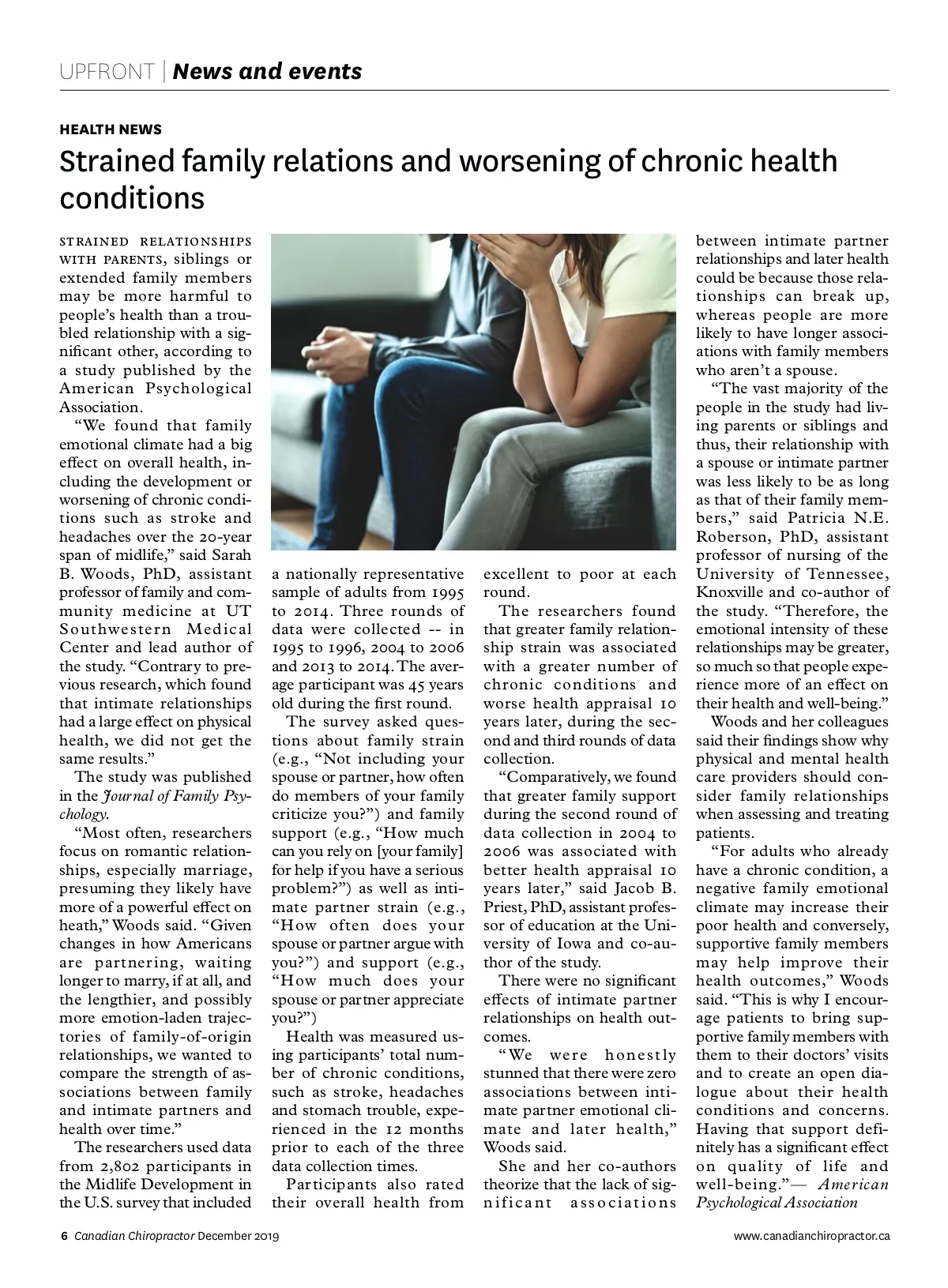
UPFRONT | News and events HEALTH NEWS Strained family relations and worsening of chronic health conditions strained relationships with parents, siblings or extended family members may be more harmful to people’s health than a trou-bled relationship with a sig-nificant other, according to a study published by the American Psychological Association. “We found that family emotional climate had a big effect on overall health, in-cluding the development or worsening of chronic condi-tions such as stroke and headaches over the 20-year span of midlife,” said Sarah B. Woods, PhD, assistant professor of family and com-munity medicine at UT Southwestern Medical Center and lead author of the study. “Contrary to pre-vious research, which found that intimate relationships had a large effect on physical health, we did not get the same results.” The study was published in the Journal of Family Psy-chology. “Most often, researchers focus on romantic relation-ships, especially marriage, presuming they likely have more of a powerful effect on heath,” Woods said. “Given changes in how Americans are partnering, waiting longer to marry, if at all, and the lengthier, and possibly more emotion-laden trajec-tories of family-of-origin relationships, we wanted to compare the strength of as-sociations between family and intimate partners and health over time.” The researchers used data from 2,802 participants in the Midlife Development in the U.S. survey that included between intimate partner relationships and later health could be because those rela-tionships can break up, whereas people are more likely to have longer associ-ations with family members who aren’t a spouse. “The vast majority of the people in the study had liv-ing parents or siblings and thus, their relationship with a spouse or intimate partner was less likely to be as long as that of their family mem-bers,” said Patricia N.E. Roberson, PhD, assistant professor of nursing of the University of Tennessee, Knoxville and co-author of the study. “Therefore, the emotional intensity of these relationships may be greater, so much so that people expe-rience more of an effect on their health and well-being.” Woods and her colleagues said their findings show why physical and mental health care providers should con-sider family relationships when assessing and treating patients. “For adults who already have a chronic condition, a negative family emotional climate may increase their poor health and conversely, supportive family members may help improve their health outcomes,” Woods said. “This is why I encour-age patients to bring sup-portive family members with them to their doctors’ visits and to create an open dia-logue about their health conditions and concerns. Having that support defi-nitely has a significant effect on quality of life and well-being.”— American Psychological Association www.canadianchiropractor.ca a nationally representative sample of adults from 1995 to 2014. Three rounds of data were collected --in 1995 to 1996, 2004 to 2006 and 2013 to 2014. The aver-age participant was 45 years old during the first round. The survey asked ques-tions about family strain (e.g., “Not including your spouse or partner, how often do members of your family criticize you?”) and family support (e.g., “How much can you rely on [your family] for help if you have a serious problem?”) as well as inti-mate partner strain (e.g., “How often does your spouse or partner argue with you?”) and support (e.g., “How much does your spouse or partner appreciate you?”) Health was measured us-ing participants’ total num-ber of chronic conditions, such as stroke, headaches and stomach trouble, expe-rienced in the 12 months prior to each of the three data collection times. Participants also rated their overall health from excellent to poor at each round. The researchers found that greater family relation-ship strain was associated with a greater number of chronic conditions and worse health appraisal 10 years later, during the sec-ond and third rounds of data collection. “Comparatively, we found that greater family support during the second round of data collection in 2004 to 2006 was associated with better health appraisal 10 years later,” said Jacob B. Priest, PhD, assistant profes-sor of education at the Uni-versity of Iowa and co-au-thor of the study. There were no significant effects of intimate partner relationships on health out-comes. “We were honestly stunned that there were zero associations between inti-mate partner emotional cli-mate and later health,” Woods said. She and her co-authors theorize that the lack of sig-nificant associations 6 Canadian Chiropractor December 2019
Chiropractic + Naturopathic Doctor December 2019: Page 6