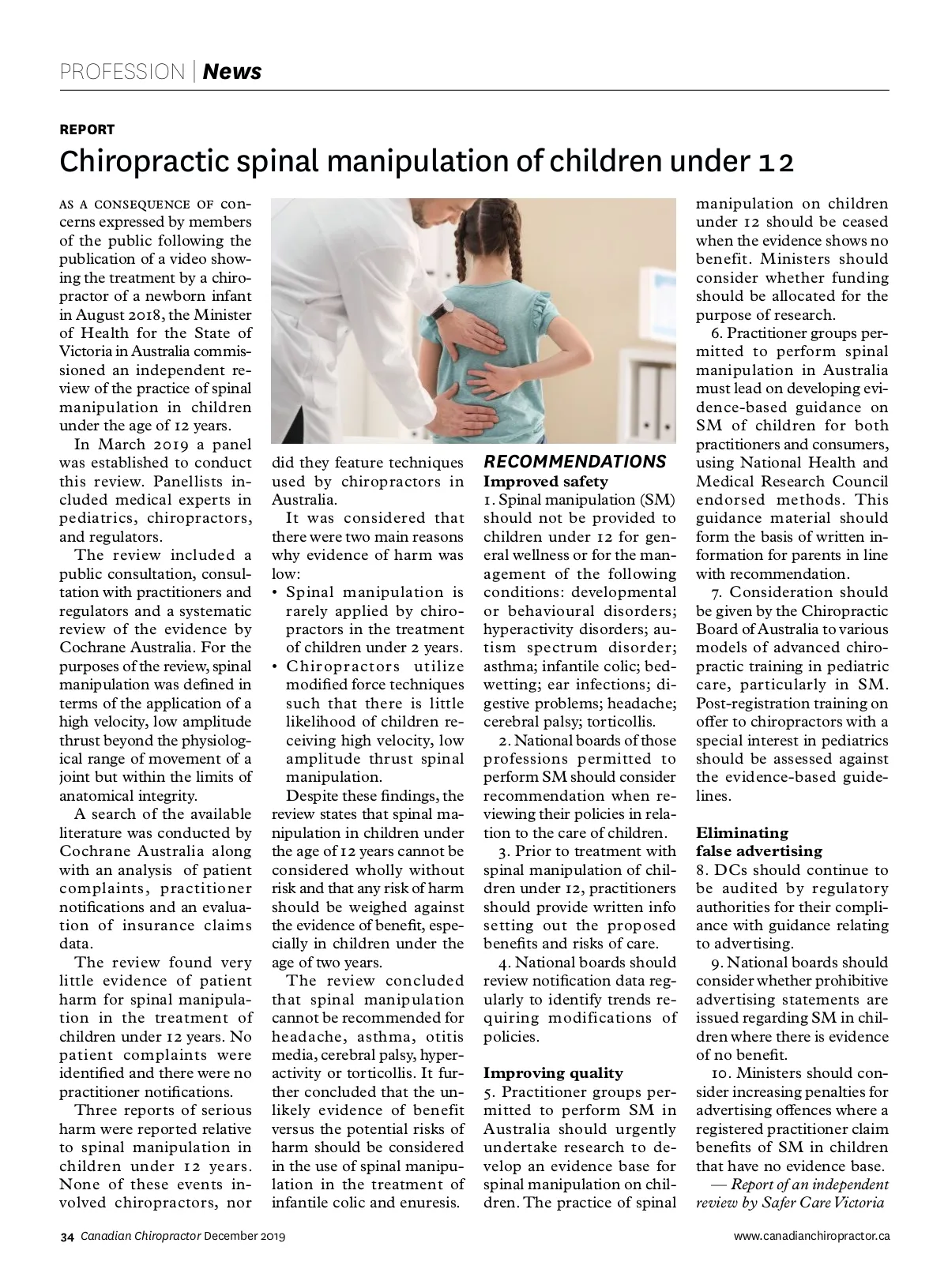
PROFESSION | News REPORT Chiropractic spinal manipulation of children under 12 as a consequence of con-cerns expressed by members of the public following the publication of a video show-ing the treatment by a chiro-practor of a newborn infant in August 2018, the Minister of Health for the State of Victoria in Australia commis-sioned an independent re-view of the practice of spinal manipulation in children under the age of 12 years. In March 2019 a panel was established to conduct this review. Panellists in-cluded medical experts in pediatrics, chiropractors, and regulators. The review included a public consultation, consul-tation with practitioners and regulators and a systematic review of the evidence by Cochrane Australia. For the purposes of the review, spinal manipulation was defined in terms of the application of a high velocity, low amplitude thrust beyond the physiolog-ical range of movement of a joint but within the limits of anatomical integrity. A search of the available literature was conducted by Cochrane Australia along with an analysis of patient complaints, practitioner notifications and an evalua-tion of insurance claims data. The review found very little evidence of patient harm for spinal manipula-tion in the treatment of children under 12 years. No patient complaints were identified and there were no practitioner notifications. Three reports of serious harm were reported relative to spinal manipulation in children under 12 years. None of these events in-volved chiropractors, nor manipulation on children under 12 should be ceased when the evidence shows no benefit. Ministers should consider whether funding should be allocated for the purpose of research. 6. Practitioner groups per-mitted to perform spinal manipulation in Australia must lead on developing evi-dence-based guidance on SM of children for both practitioners and consumers, using National Health and Medical Research Council endorsed methods. This guidance material should form the basis of written in-formation for parents in line with recommendation. 7. Consideration should be given by the Chiropractic Board of Australia to various models of advanced chiro-practic training in pediatric care, particularly in SM. Post-registration training on offer to chiropractors with a special interest in pediatrics should be assessed against the evidence-based guide-lines. Eliminating false advertising 8. DCs should continue to be audited by regulatory authorities for their compli-ance with guidance relating to advertising. 9. National boards should consider whether prohibitive advertising statements are issued regarding SM in chil-dren where there is evidence of no benefit. 10. Ministers should con-sider increasing penalties for advertising offences where a registered practitioner claim benefits of SM in children that have no evidence base. — Report of an independent review by Safer Care Victoria www.canadianchiropractor.ca did they feature techniques used by chiropractors in Australia. It was considered that there were two main reasons why evidence of harm was low: • Spinal manipulation is rarely applied by chiro-practors in the treatment of children under 2 years. • Chiropractors utilize modified force techniques such that there is little likelihood of children re-ceiving high velocity, low amplitude thrust spinal manipulation. Despite these findings, the review states that spinal ma-nipulation in children under the age of 12 years cannot be considered wholly without risk and that any risk of harm should be weighed against the evidence of benefit, espe-cially in children under the age of two years. The review concluded that spinal manipulation cannot be recommended for headache, asthma, otitis media, cerebral palsy, hyper-activity or torticollis. It fur-ther concluded that the un-likely evidence of benefit versus the potential risks of harm should be considered in the use of spinal manipu-lation in the treatment of infantile colic and enuresis. RECOMMENDATIONS Improved safety 1. Spinal manipulation (SM) should not be provided to children under 12 for gen-eral wellness or for the man-agement of the following conditions: developmental or behavioural disorders; hyperactivity disorders; au-tism spectrum disorder; asthma; infantile colic; bed-wetting; ear infections; di-gestive problems; headache; cerebral palsy; torticollis. 2. National boards of those professions permitted to perform SM should consider recommendation when re-viewing their policies in rela-tion to the care of children. 3. Prior to treatment with spinal manipulation of chil-dren under 12, practitioners should provide written info setting out the proposed benefits and risks of care. 4. National boards should review notification data reg-ularly to identify trends re-quiring modifications of policies. Improving quality 5. Practitioner groups per-mitted to perform SM in Australia should urgently undertake research to de-velop an evidence base for spinal manipulation on chil-dren. The practice of spinal 34 Canadian Chiropractor December 2019
Chiropractic + Naturopathic Doctor December 2019: Page 34