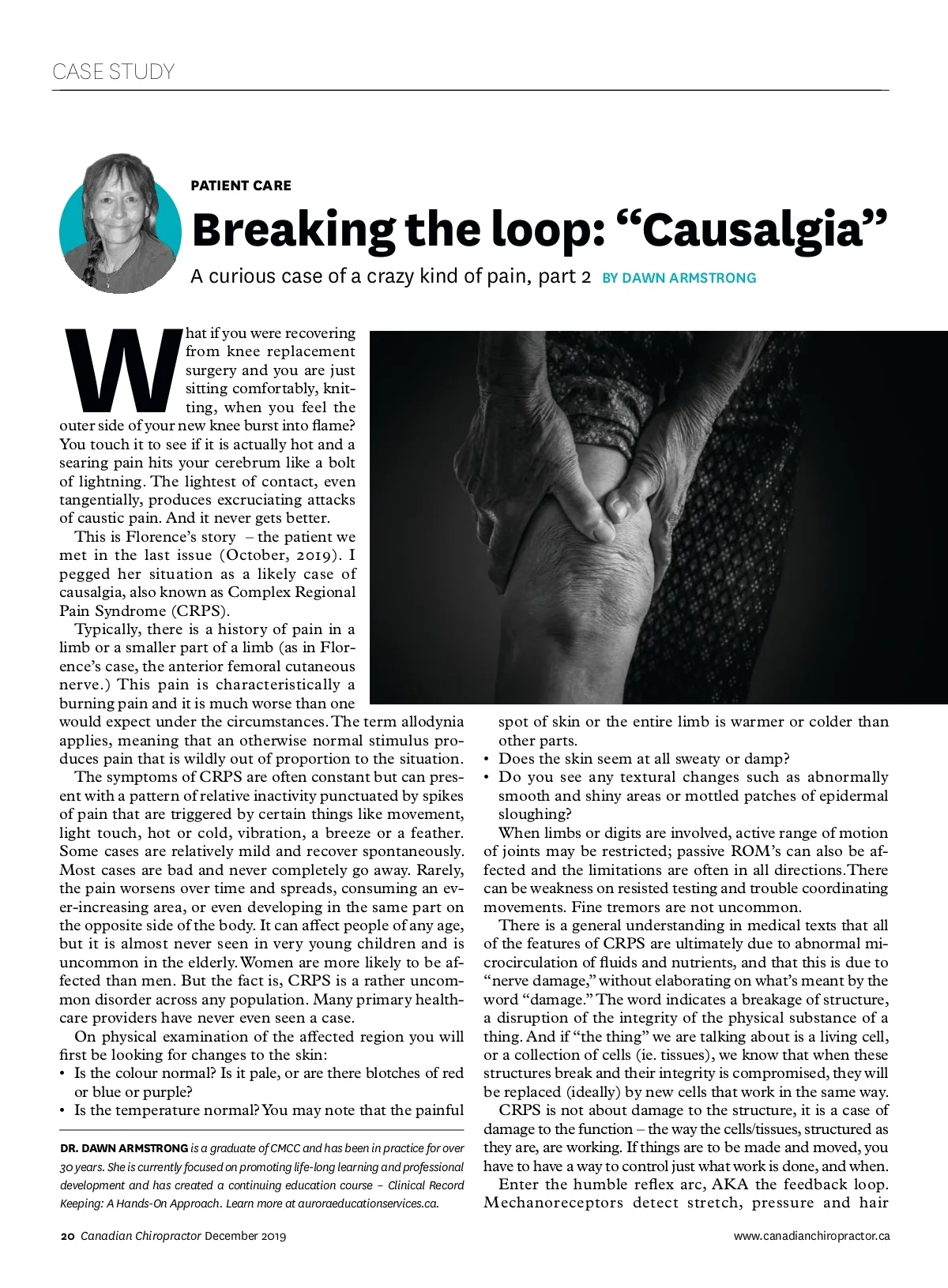
movement – all of the elements of the sense of touch. Nociceptors and ther-moreceptors respond to local changes in chemistry and temperature. For the fast pain receptors (A-delta), a single action potential (AP) produces a con-scious sense of sharp, prickly pain. One AP from a slow (C-type) sensory nerve is not perceived, while a volley of AP’s down these unmyelinated fibres results in a sense of intolerable pain. The for-mer tell us about the time and location of the injury, the latter define its extent. The motor nerves to the skin are predominately (if not exclusively) sym-pathetic motor fibres. These efferent autonomic nerves release signaling chemicals – neurotransmitters/vasoac-tive amines, which instigate action in target tissues such as muscle and glands (sweat/sebaceous). When action is initiated by increased sympathetic motor activity, observable things happen: Smooth muscle cells contract to make hair stand on end or blood vessels constrict; adventitial cells which envelope the capillaries act to alter the permeability of the vascular beds; glands are stimulated to increase synthetic and secretory functions. Afferent signals from nociceptors (fast and slow) and mechanoreceptors are linked via the central nervous system (in simple or not-so-simple ways) to sympathetic efferents which signal the effector tissues (smooth muscle cells, glands, adventitia) to act. Depending on the location of the sensors and the type of effector involved in the motor re-sponse, we can describe reflex loops as somato-somatic, viscero-visceral, soma-to-visceral and viscero-somatic. A vast majority of reflex/feedback loops are of the negative type. There are only a few examples of positive feed-back loops. When the end product in-cites more action and the system spirals into a self-perpetuating cycle, things can become extreme. (Like the way hyperthermia becomes heat stroke: the warmer the room, the more the vascu-lature to the skin opens up to dissipate excessive body heat, but the blood picks up more heat, the skin flushes even more and body temperature will rise to fatal levels without treatment.) And this, I propose, is the nature of CRPS – a somato-visceral reflex loop that is stuck and self-perpetuating. With reflex loops, it can be difficult to know www.canadianchiropractor.ca which came first – the painful stimulus or the hyperactivity of the sympathetic motor system – but the results are obvi-ous. Whatever the primary lesion (and there are times when none can be iden-tified) – be it a broken ankle or shoulder bursitis or surgery – we often see immo-bilization of the area, spontaneously because it hurts or deliberately because it is necessary. Perhaps it requires a physiologic pre-disposition, plus some stressful circumstances and some kind of ‘perfect storm’ of conditions, but there is an uptick in sympathetic nerv-ous system activity. When sympathetic activity is turned up too high, the effects are felt through-out the involved tissues. Increasing sympathetic motor impulses causes va-soconstriction of arterioles, which pro-duces ischemia and, simultaneously, makes the capillary beds more permea-ble. This “leakiness” affects the intersti-tial fluid compartment and impairs movements of nutrients and wastes, which explains the coolness and colour changes and altered texture that we can see. The dampness of the skin is because of increased motor messages to sweat glands. The effect on peripheral sensory re-ceptors is to exaggerate their sensitivity. The threshold of firing is lowered so they report a greater intensity of stimu-lus than is actually occurring. These effects can be local, regional or segmen-tal. The process of sensitization not only affects the sensory receptors of the pe-riphery, it happens centrally as well. Layers of integration and influence are provided by the brain and spinal cord essentially creating dysfunctional reflex loops that can be highly complicated. These facts reveal possible ways to help a patient like Florence. In order to stop a cycle of sensory-motor activity that is stuck in a self-perpetuating loop, we must interrupt it – break the loop. The most common medical treatment is pharmaceuticals to dampen the pain messages and relieve associated insom-nia. The most radical medical approach is a sympathectomy – where the affected motor nerves/ganglia are disconnected surgically or chemically. While pain management strategies can be helpful, if it can be done, fixing the source of the pain has to be the most sensible ap-proach. Amongst a list of many possible contributors in painful conditions, Dr. Claraco provides some insight for us: “a lack of sufficient non-noxious informa-tion from segments related to the kinetic chain – including proximal and distal joints, synergistic and antagonistic mus-cles.” This includes information on stretch, pressure, temperature, vibration and movement in general. We need to provide these kinds of non-painful stim-uli in order to change sympathetic motor output by changing the sensory input. Chiropractic care for a patient like Florence with CRPS could include: • Adjustments of areas of the spine and extremities where joint play has been compromised • Joint mobilization – passive ranges of motion with gradual increase to the range and speed of the movements; intermittent distraction • Strain/counterstrain – positional re-lease techniques can reset muscle spindles to restore better patterns of movement across related (and even remote) joints • TENS/IFC/neurostimulation to dis-rupt locked-in sensory-motor loops • Exercise – graded, from assisted ac-tive movements to resistance train-ing, in order to improve function Collaboration with other hands-on professionals may be in order. If you ever get a chance to help a patient with CRPS, make sure to prop-erly document the specifics of their case. The use of Patient-Based Out-comes Assessment Instruments, such as the McGill Pain Questionnaire is highly recommended if you want to objectively assess the effectiveness of treatment. You must have them com-plete the form before you provide any care and then again at regular intervals over the planned course of visits. For Florence, her back spasms cleared up when she changed her bed. I didn’t get the opportunity to treat her at all. She is still trying different pain medications; after four long years she finally has an appointment with a pain specialist. She continues to endure, stoic as ever and utterly devoted to care for her husband as best she can, in spite of her crazy knee pain. Sometimes the cases we see – even if they don’t work out as anticipated – can inspire us to review our under-standing of the nature of pain and give us hope that what we do can help. December 2019 Canadian Chiropractor 21
Chiropractic + Naturopathic Doctor December 2019: Page 21