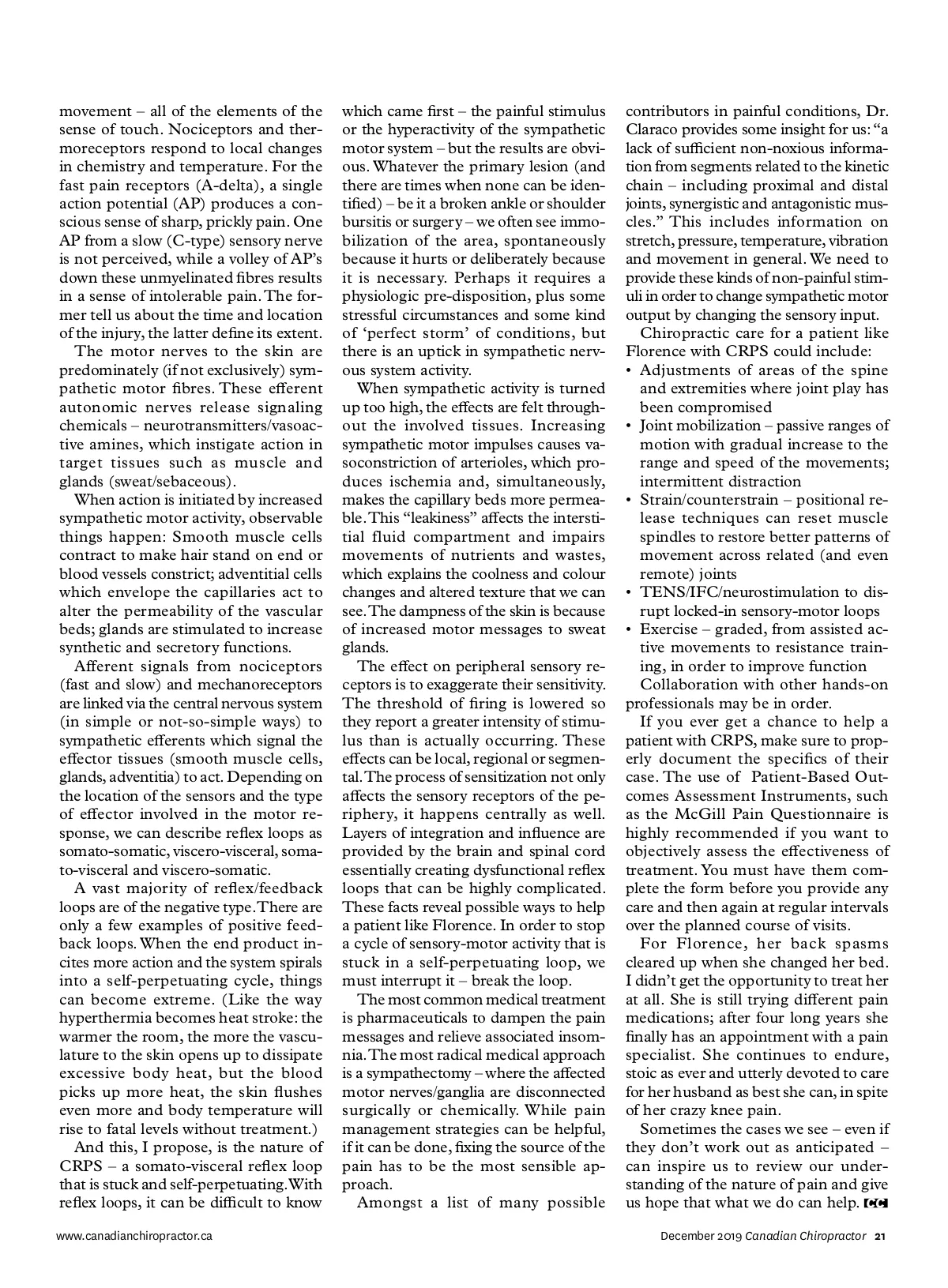
CASE STUDY PATIENT CARE Breaking the loop: “Causalgia” W A curious case of a crazy kind of pain, part 2 BY DAWN ARMSTRONG hat if you were recovering from knee replacement surgery and you are just sitting comfortably, knit-ting, when you feel the outer side of your new knee burst into flame? You touch it to see if it is actually hot and a searing pain hits your cerebrum like a bolt of lightning. The lightest of contact, even tangentially, produces excruciating attacks of caustic pain. And it never gets better. This is Florence’s story – the patient we met in the last issue (October, 2019). I pegged her situation as a likely case of causalgia, also known as Complex Regional Pain Syndrome (CRPS). Typically, there is a history of pain in a limb or a smaller part of a limb (as in Flor-ence’s case, the anterior femoral cutaneous nerve.) This pain is characteristically a burning pain and it is much worse than one would expect under the circumstances. The term allodynia applies, meaning that an otherwise normal stimulus pro-duces pain that is wildly out of proportion to the situation. The symptoms of CRPS are often constant but can pres-ent with a pattern of relative inactivity punctuated by spikes of pain that are triggered by certain things like movement, light touch, hot or cold, vibration, a breeze or a feather. Some cases are relatively mild and recover spontaneously. Most cases are bad and never completely go away. Rarely, the pain worsens over time and spreads, consuming an ev-er-increasing area, or even developing in the same part on the opposite side of the body. It can affect people of any age, but it is almost never seen in very young children and is uncommon in the elderly. Women are more likely to be af-fected than men. But the fact is, CRPS is a rather uncom-mon disorder across any population. Many primary health-care providers have never even seen a case. On physical examination of the affected region you will first be looking for changes to the skin: • Is the colour normal? Is it pale, or are there blotches of red or blue or purple? • Is the temperature normal? You may note that the painful DR. DAWN ARMSTRONG is a graduate of CMCC and has been in practice for over 30 years. She is currently focused on promoting life-long learning and professional development and has created a continuing education course – Clinical Record Keeping: A Hands-On Approach. Learn more at auroraeducationservices.ca. 20 Canadian Chiropractor December 2019 spot of skin or the entire limb is warmer or colder than other parts. • Does the skin seem at all sweaty or damp? • Do you see any textural changes such as abnormally smooth and shiny areas or mottled patches of epidermal sloughing? When limbs or digits are involved, active range of motion of joints may be restricted; passive ROM’s can also be af-fected and the limitations are often in all directions.There can be weakness on resisted testing and trouble coordinating movements. Fine tremors are not uncommon. There is a general understanding in medical texts that all of the features of CRPS are ultimately due to abnormal mi-crocirculation of fluids and nutrients, and that this is due to “nerve damage,” without elaborating on what’s meant by the word “damage.” The word indicates a breakage of structure, a disruption of the integrity of the physical substance of a thing. And if “the thing” we are talking about is a living cell, or a collection of cells (ie. tissues), we know that when these structures break and their integrity is compromised, they will be replaced (ideally) by new cells that work in the same way. CRPS is not about damage to the structure, it is a case of damage to the function – the way the cells/tissues, structured as they are, are working. If things are to be made and moved, you have to have a way to control just what work is done, and when. Enter the humble reflex arc, AKA the feedback loop. Mechanoreceptors detect stretch, pressure and hair www.canadianchiropractor.ca
Chiropractic + Naturopathic Doctor December 2019: Page 20