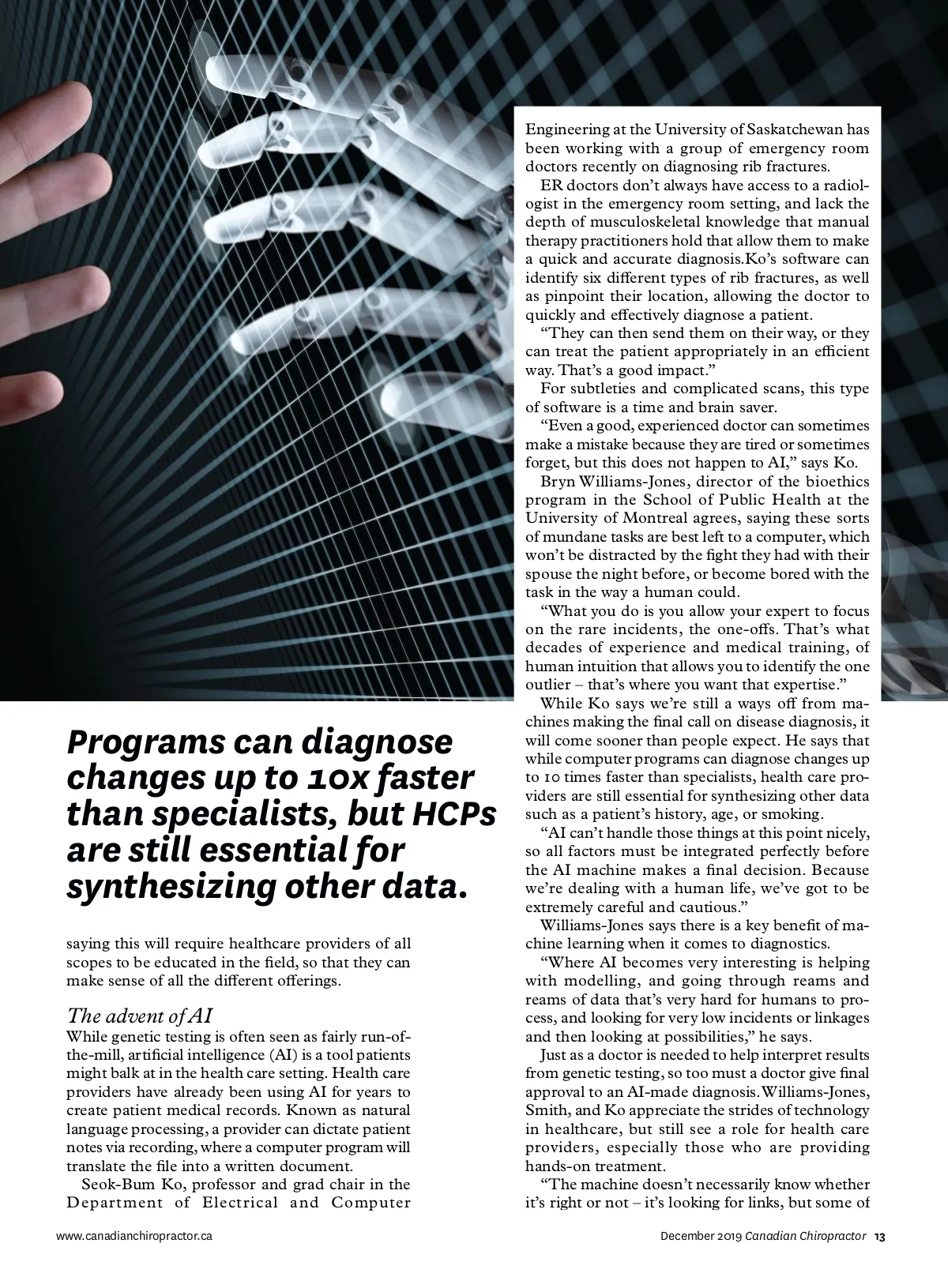
Programs can diagnose changes up to 10x faster than specialists, but HCPs are still essential for synthesizing other data. saying this will require healthcare providers of all scopes to be educated in the field, so that they can make sense of all the different offerings. The advent of AI While genetic testing is often seen as fairly run-of-the-mill, artificial intelligence (AI) is a tool patients might balk at in the health care setting. Health care providers have already been using AI for years to create patient medical records. Known as natural language processing, a provider can dictate patient notes via recording, where a computer program will translate the file into a written document. Seok-Bum Ko, professor and grad chair in the Department of Electrical and Computer www.canadianchiropractor.ca Engineering at the University of Saskatchewan has been working with a group of emergency room doctors recently on diagnosing rib fractures. ER doctors don’t always have access to a radiol-ogist in the emergency room setting, and lack the depth of musculoskeletal knowledge that manual therapy practitioners hold that allow them to make a quick and accurate diagnosis.Ko’s software can identify six different types of rib fractures, as well as pinpoint their location, allowing the doctor to quickly and effectively diagnose a patient. “They can then send them on their way, or they can treat the patient appropriately in an efficient way. That’s a good impact.” For subtleties and complicated scans, this type of software is a time and brain saver. “Even a good, experienced doctor can sometimes make a mistake because they are tired or sometimes forget, but this does not happen to AI,” says Ko. Bryn Williams-Jones, director of the bioethics program in the School of Public Health at the University of Montreal agrees, saying these sorts of mundane tasks are best left to a computer, which won’t be distracted by the fight they had with their spouse the night before, or become bored with the task in the way a human could. “What you do is you allow your expert to focus on the rare incidents, the one-offs. That’s what decades of experience and medical training, of human intuition that allows you to identify the one outlier – that’s where you want that expertise.” While Ko says we’re still a ways off from ma-chines making the final call on disease diagnosis, it will come sooner than people expect. He says that while computer programs can diagnose changes up to 10 times faster than specialists, health care pro-viders are still essential for synthesizing other data such as a patient’s history, age, or smoking. “AI can’t handle those things at this point nicely, so all factors must be integrated perfectly before the AI machine makes a final decision. Because we’re dealing with a human life, we’ve got to be extremely careful and cautious.” Williams-Jones says there is a key benefit of ma-chine learning when it comes to diagnostics. “Where AI becomes very interesting is helping with modelling, and going through reams and reams of data that’s very hard for humans to pro-cess, and looking for very low incidents or linkages and then looking at possibilities,” he says. Just as a doctor is needed to help interpret results from genetic testing, so too must a doctor give final approval to an AI-made diagnosis. Williams-Jones, Smith, and Ko appreciate the strides of technology in healthcare, but still see a role for health care providers, especially those who are providing hands-on treatment. “The machine doesn’t necessarily know whether it’s right or not – it’s looking for links, but some of December 2019 Canadian Chiropractor 13
Chiropractic + Naturopathic Doctor December 2019: Page 13