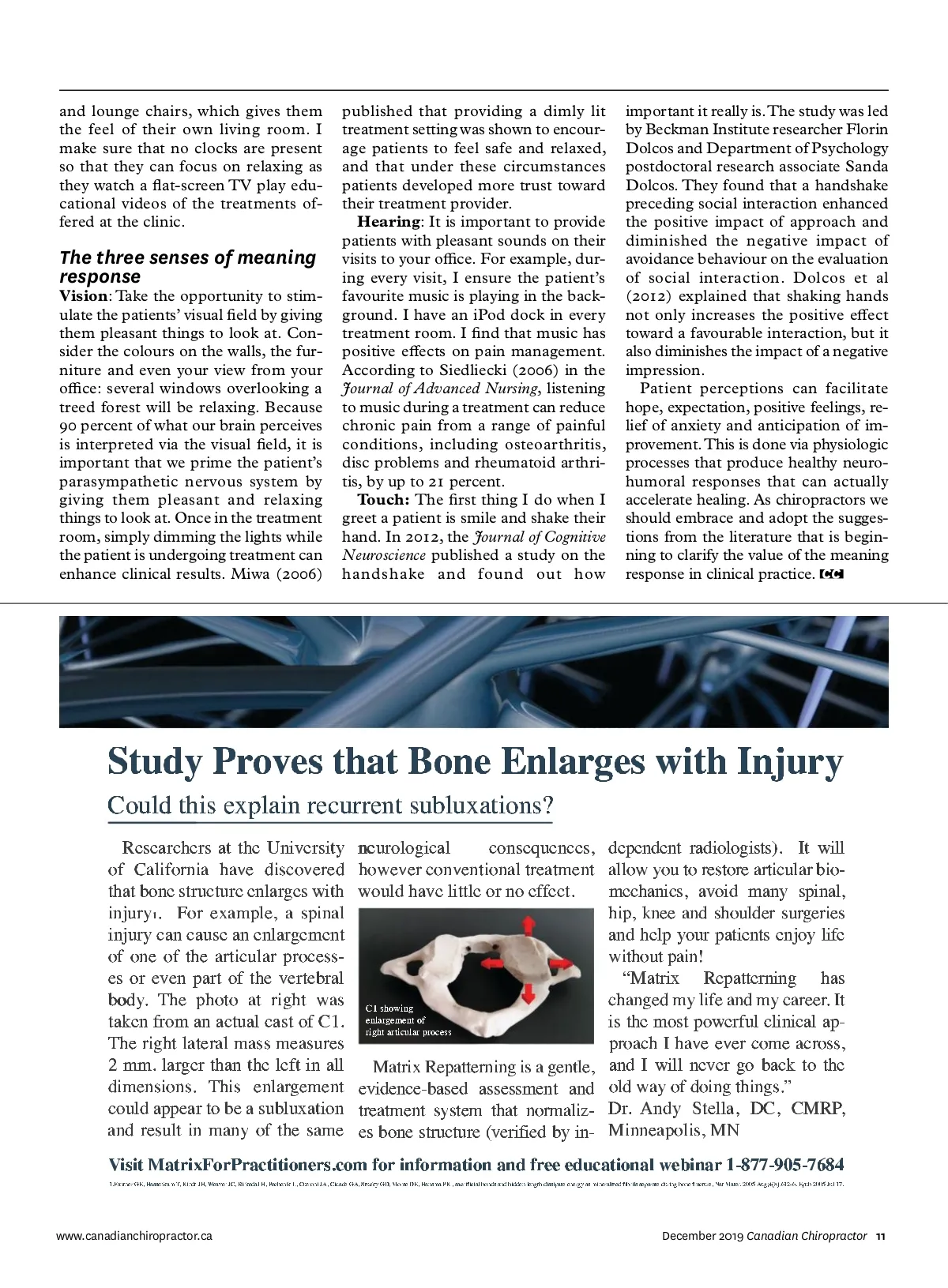
and lounge chairs, which gives them the feel of their own living room. I make sure that no clocks are present so that they can focus on relaxing as they watch a flat-screen TV play edu-cational videos of the treatments of-fered at the clinic. The three senses of meaning response Vision : Take the opportunity to stim-ulate the patients’ visual field by giving them pleasant things to look at. Con-sider the colours on the walls, the fur-niture and even your view from your office: several windows overlooking a treed forest will be relaxing. Because 90 percent of what our brain perceives is interpreted via the visual field, it is important that we prime the patient’s parasympathetic nervous system by giving them pleasant and relaxing things to look at. Once in the treatment room, simply dimming the lights while the patient is undergoing treatment can enhance clinical results. Miwa (2006) published that providing a dimly lit treatment setting was shown to encour-age patients to feel safe and relaxed, and that under these circumstances patients developed more trust toward their treatment provider. Hearing : It is important to provide patients with pleasant sounds on their visits to your office. For example, dur-ing every visit, I ensure the patient’s favourite music is playing in the back-ground. I have an iPod dock in every treatment room. I find that music has positive effects on pain management. According to Siedliecki (2006) in the Journal of Advanced Nursing , listening to music during a treatment can reduce chronic pain from a range of painful conditions, including osteoarthritis, disc problems and rheumatoid arthri-tis, by up to 21 percent. Touch: The first thing I do when I greet a patient is smile and shake their hand. In 2012, the Journal of Cognitive Neuroscience published a study on the handshake and found out how important it really is. The study was led by Beckman Institute researcher Florin Dolcos and Department of Psychology postdoctoral research associate Sanda Dolcos. They found that a handshake preceding social interaction enhanced the positive impact of approach and diminished the negative impact of avoidance behaviour on the evaluation of social interaction. Dolcos et al (2012) explained that shaking hands not only increases the positive effect toward a favourable interaction, but it also diminishes the impact of a negative impression. Patient perceptions can facilitate hope, expectation, positive feelings, re-lief of anxiety and anticipation of im-provement. This is done via physiologic processes that produce healthy neuro-humoral responses that can actually accelerate healing. As chiropractors we should embrace and adopt the sugges-tions from the literature that is begin-ning to clarify the value of the meaning response in clinical practice. Study Proves that Bone Enlarges with Injury Could this explain recurrent subluxations? Researchers at the University of California have discovered that bone structure enlarges with injury 1 . For example, a spinal injury can cause an enlargement of one of the articular process-es or even part of the vertebral bod body. The photo at right was taken from an actual cast of C1. The right lateral mass measures 2 mm. larger than the left in all dimensions. This enlargement could appear to be a subluxation and result in many of the same neurological consequences, dependent radiologists). It will neurologica however conventional treatment allow you to restore articular bio-mechanics, avoid many spinal, would have little or no effect. hip, knee and shoulder surgeries and help your patients enjoy life without pain! “Matrix Repatterning has changed my life and my career. It C1 showing enlargement of is the most powerful clinical ap-right articular process proach I have ever come across, Matrix Repatterning is a gentle, and I will never go back to the evidence-based assessment and old way of doing things.” treatment system that normaliz-Dr. Andy Stella, DC, CMRP, es bone structure (verified by in-Minneapolis, MN Visit MatrixForPractitioners.com for information and free educational webinar 1-877-905-7684 1.Fantner GE, Hassenkam T, Kindt JH, Weaver JC, Birkedal H, Pechenik L, Cutroni JA, Cidade GA, Stucky GD, Morse DE, Hansma PK , sacrificial bonds and hidden length dissipate energy as mineralized fibrils separate during bone fracture, Nat Mater. 2005 Aug;4(8):612-6. Epub 2005 Jul 17. www.canadianchiropractor.ca CC_Matrix Institute_halfpage_Dec19_CSA.indd 1 December 2019 Canadian Chiropractor 11 2019-11-06 3:25 PM
Chiropractic + Naturopathic Doctor December 2019: Page 11