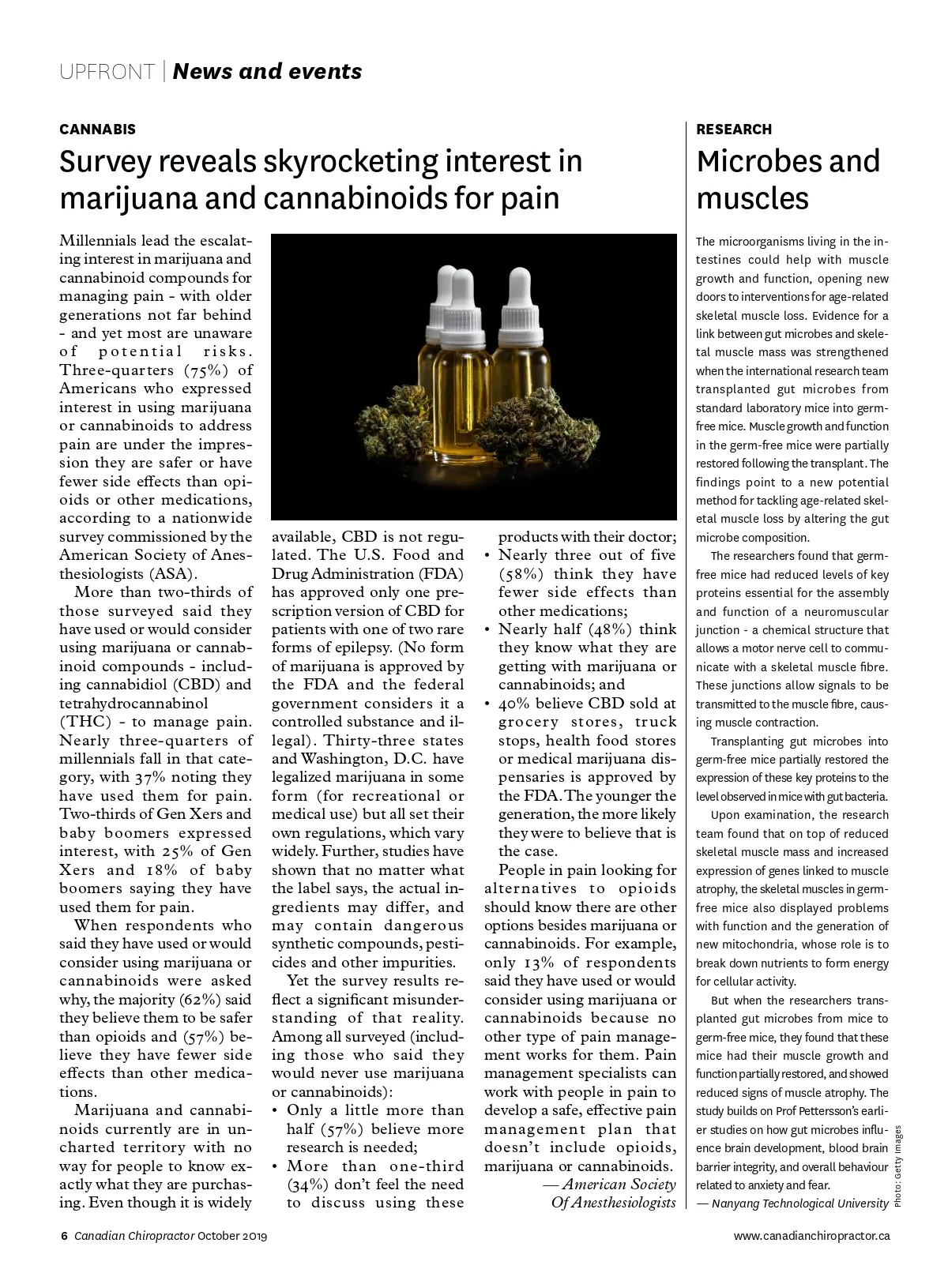
UPFRONT | News and events NEUROLOGY Lots of fun at Life West’s The WAVE Life West’s the WAVE took place August 16-18 this year in sunny California. The focus of the conference was on the Salutogenic model: “The Science, Art and Philosphy of Chiropractic.” Attendees heard from various speakers, including prior Canadian Chiropractor cover stars, Dr. Jimmy Nanda (“Chiropractic in India: Challenges, Opportunities & Lessons for U.S. Chiropractors”) and Dr. Ted Carrick (“Technique and Neurology for the Practicing Chiropractor”) Concussions linked to ED Former professional football players who have experienced concussion symptoms, including loss of con-sciousness, disorientation or nausea after a head injury, are more likely to report low testosterone and erectile dysfunction (ED), according to re-search published in JAMA Neurology. The research--based on a survey of more than 3,400 former NFL players representing the largest study cohort of former professional football play-ers to date--was conducted by inves-tigators at the Harvard T.H. Chan School of Public Health and Harvard Medical School as part of the ongoing Football Players Health Study at Harvard University. The researchers caution that their findings are observational--based on self-reported concussion symptoms and indirect measures of ED and low testosterone. The results do not prove a cause-effect link between concussion and ED, nor do they explain exactly how head trauma might precipitate the onset of ED, the investigators noted. However, the findings do re-veal an intriguing and powerful link between history of concussions and hormonal and sexual dysfunction, regardless of player age. Notably, the ED risk persisted even when research-ers accounted for other possible causes such as diabetes, heart dis-ease or sleep apnea, for example. Taken together, these findings warrant further study to tease out the precise mechanism behind it. One possible explanation, the re-search team said, could be injury to the brain’s pituitary gland that sparks a cascade of hormonal changes cul-minating in diminished testosterone and ED. This biological mechanism has emerged as a plausible explana-tion in earlier studies that echo the current findings, such as reports of higher ED prevalence and neurohor-monal dysfunction among people with head trauma and traumatic brain injury, including military veterans and civilians with head injuries. Men who reported the highest number of concussion symptoms were two and a half times more likely to report receiving either a recom-mendation for medication or to be currently taking medication for low testosterone, compared to men who reported the fewest concussion symptoms. Men with the most con-cussion symptoms were nearly two times more likely to report receiving a recommendation to take ED medi-cation or to be currently taking ED medication than those reporting the fewest symptoms. Players who re-ported losing consciousness following head injury had an elevated risk for ED even in the absence of other concus-sion-related symptoms. Notably, even former players with relatively few concussion symptoms had an elevated risk for low testoster-one, a finding that suggests there may be no safe threshold for head trauma, the team said. Of all participants, 18 percent re-ported low testosterone and nearly 23 percent reported ED. Slightly less than 10 percent of participants re-ported both. The link between history of con-cussion and ED was present among both the older and the younger play-ers--those under age 50 in this case--the analysis showed, and it persisted over time. “We found the same association of concussions with ED among both younger and older men in the study, and we found the same risk of ED among men who had last played twenty years ago,” said study senior author Andrea Roberts, a researcher at the Harvard T.H. Chan School of Public Health. “These findings sug-gest that increased risk of ED follow-ing head injury may occur at relative-ly young ages and may linger for decades thereafter.” Given that ED is both fairly com-mon and easily treatable, those who experience symptoms are encouraged to report them to their physicians, the researchers said. —Harvard Medical School 598 likes View all comments NUMBER CRUNCH Sanofi Canada Healthcare Survey 2019 Plan members answered: “To improve my health, I would like to:” exercise, physical activity 56% 34% manage stress levels Photo: freepik, Getty Images 46% eat healthy www.canadianchiropractor.ca 43% get enough sleep October 2019 Canadian Chiropractor 7
Chiropractic + Naturopathic Doctor October 2019: Page 7