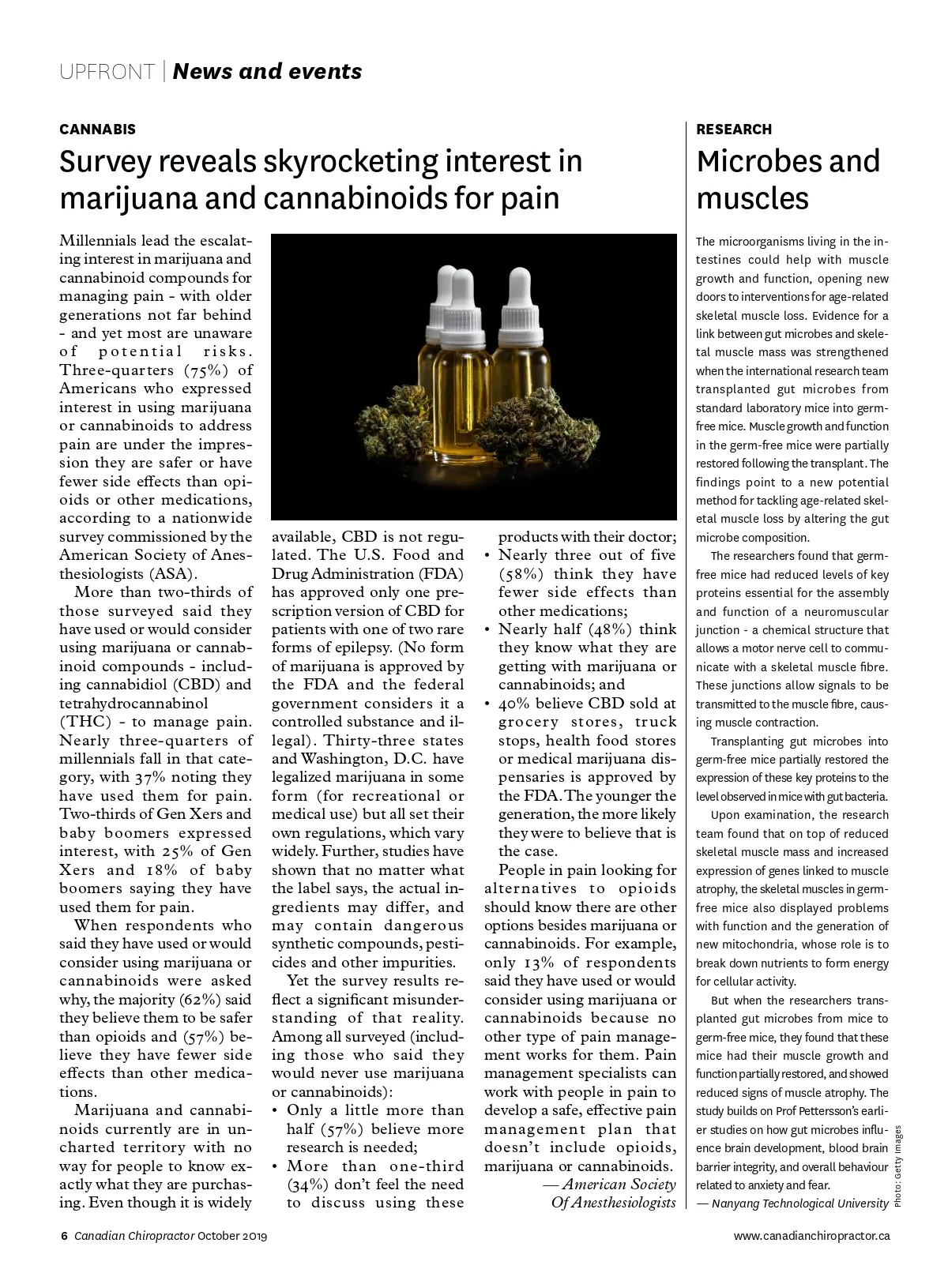
UPFRONT | News and events CANNABIS Survey reveals skyrocketing interest in marijuana and cannabinoids for pain Millennials lead the escalat-ing interest in marijuana and cannabinoid compounds for managing pain -with older generations not far behind -and yet most are unaware of potential risks. Three-quarters (75%) of Americans who expressed interest in using marijuana or cannabinoids to address pain are under the impres-sion they are safer or have fewer side effects than opi-oids or other medications, according to a nationwide survey commissioned by the American Society of Anes-thesiologists (ASA). More than two-thirds of those surveyed said they have used or would consider using marijuana or cannab-inoid compounds -includ-ing cannabidiol (CBD) and tetrahydrocannabinol (THC) -to manage pain. Nearly three-quarters of millennials fall in that cate-gory, with 37% noting they have used them for pain. Two-thirds of Gen Xers and baby boomers expressed interest, with 25% of Gen Xers and 18% of baby boomers saying they have used them for pain. When respondents who said they have used or would consider using marijuana or cannabinoids were asked why, the majority (62%) said they believe them to be safer than opioids and (57%) be-lieve they have fewer side effects than other medica-tions. Marijuana and cannabi-noids currently are in un-charted territory with no way for people to know ex-actly what they are purchas-ing. Even though it is widely 6 Canadian Chiropractor October 2019 RESEARCH Microbes and muscles The microorganisms living in the in-testines could help with muscle growth and function, opening new doors to interventions for age-related skeletal muscle loss. Evidence for a link between gut microbes and skele-tal muscle mass was strengthened when the international research team transplanted gut microbes from standard laboratory mice into germ-free mice. Muscle growth and function in the germ-free mice were partially restored following the transplant. The findings point to a new potential method for tackling age-related skel-etal muscle loss by altering the gut microbe composition. The researchers found that germ-free mice had reduced levels of key proteins essential for the assembly and function of a neuromuscular junction -a chemical structure that allows a motor nerve cell to commu-nicate with a skeletal muscle fibre. These junctions allow signals to be transmitted to the muscle fibre, caus-ing muscle contraction. Transplanting gut microbes into germ-free mice partially restored the expression of these key proteins to the level observed in mice with gut bacteria. Upon examination, the research team found that on top of reduced skeletal muscle mass and increased expression of genes linked to muscle atrophy, the skeletal muscles in germ-free mice also displayed problems with function and the generation of new mitochondria, whose role is to break down nutrients to form energy for cellular activity. But when the researchers trans-planted gut microbes from mice to germ-free mice, they found that these mice had their muscle growth and function partially restored, and showed reduced signs of muscle atrophy. The study builds on Prof Pettersson’s earli-er studies on how gut microbes influ-ence brain development, blood brain barrier integrity, and overall behaviour related to anxiety and fear. — Nanyang Technological University www.canadianchiropractor.ca available, CBD is not regu-lated. The U.S. Food and Drug Administration (FDA) has approved only one pre-scription version of CBD for patients with one of two rare forms of epilepsy. (No form of marijuana is approved by the FDA and the federal government considers it a controlled substance and il-legal). Thirty-three states and Washington, D.C. have legalized marijuana in some form (for recreational or medical use) but all set their own regulations, which vary widely. Further, studies have shown that no matter what the label says, the actual in-gredients may differ, and may contain dangerous synthetic compounds, pesti-cides and other impurities. Yet the survey results re-flect a significant misunder-standing of that reality. Among all surveyed (includ-ing those who said they would never use marijuana or cannabinoids): • Only a little more than half (57%) believe more research is needed; • More than one-third (34%) don’t feel the need to discuss using these products with their doctor; • Nearly three out of five (58%) think they have fewer side effects than other medications; • Nearly half (48%) think they know what they are getting with marijuana or cannabinoids; and • 40% believe CBD sold at grocery stores, truck stops, health food stores or medical marijuana dis-pensaries is approved by the FDA. The younger the generation, the more likely they were to believe that is the case. People in pain looking for alternatives to opioids should know there are other options besides marijuana or cannabinoids. For example, only 13% of respondents said they have used or would consider using marijuana or cannabinoids because no other type of pain manage-ment works for them. Pain management specialists can work with people in pain to develop a safe, effective pain management plan that doesn’t include opioids, marijuana or cannabinoids. — American Society Of Anesthesiologists Photo: Getty Images
Chiropractic + Naturopathic Doctor October 2019: Page 6