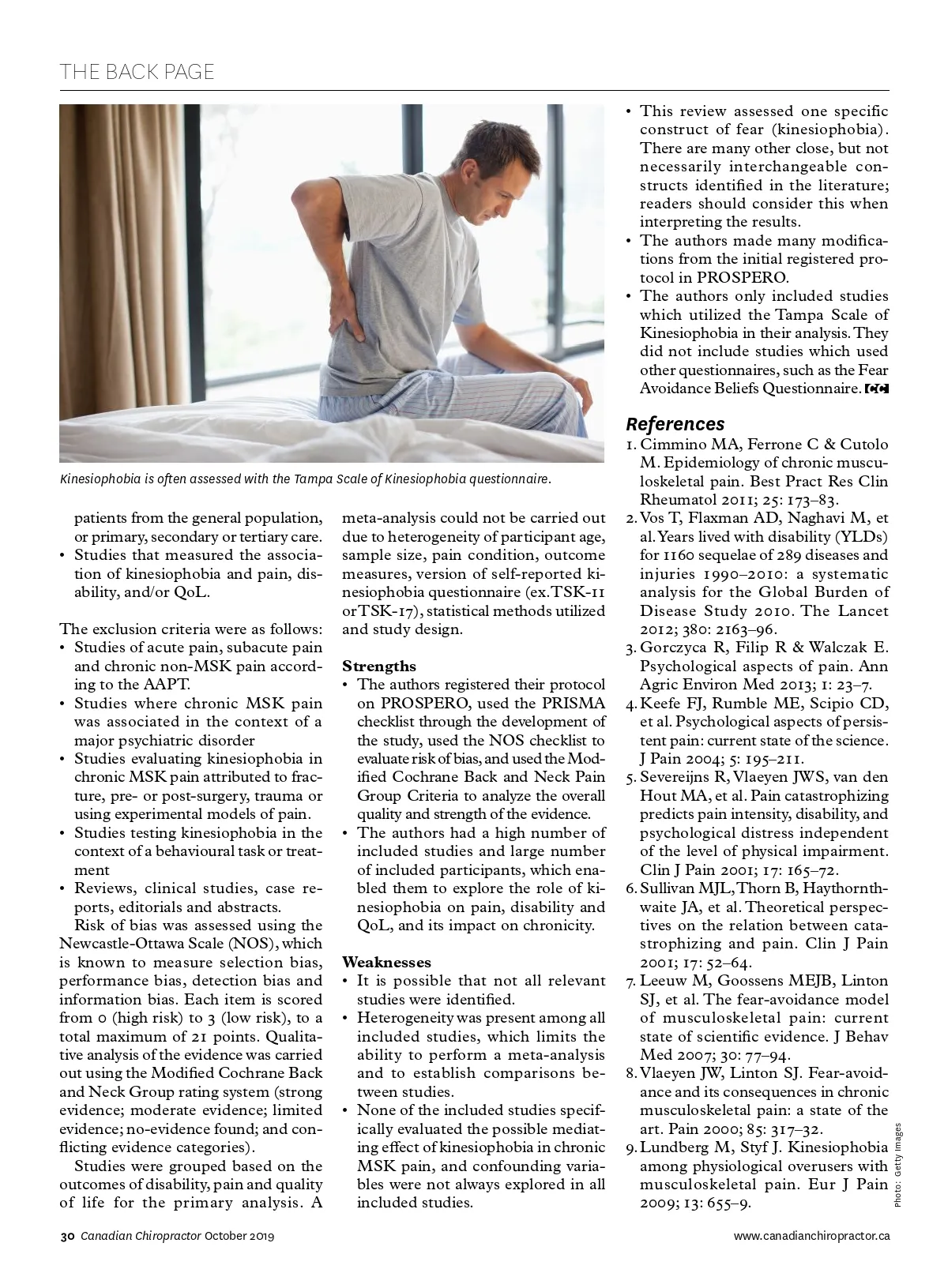
THE BACK PAGE • This review assessed one specific construct of fear (kinesiophobia). There are many other close, but not necessarily interchangeable con-structs identified in the literature; readers should consider this when interpreting the results. • The authors made many modifica-tions from the initial registered pro-tocol in PROSPERO. • The authors only included studies which utilized the Tampa Scale of Kinesiophobia in their analysis. They did not include studies which used other questionnaires, such as the Fear Avoidance Beliefs Questionnaire. References Kinesiophobia is often assessed with the Tampa Scale of Kinesiophobia questionnaire. patients from the general population, or primary, secondary or tertiary care. • Studies that measured the associa-tion of kinesiophobia and pain, dis-ability, and/or QoL. The exclusion criteria were as follows: • Studies of acute pain, subacute pain and chronic non-MSK pain accord-ing to the AAPT. • Studies where chronic MSK pain was associated in the context of a major psychiatric disorder • Studies evaluating kinesiophobia in chronic MSK pain attributed to frac-ture, pre-or post-surgery, trauma or using experimental models of pain. • Studies testing kinesiophobia in the context of a behavioural task or treat-ment • Reviews, clinical studies, case re-ports, editorials and abstracts. Risk of bias was assessed using the Newcastle-Ottawa Scale (NOS), which is known to measure selection bias, performance bias, detection bias and information bias. Each item is scored from 0 (high risk) to 3 (low risk), to a total maximum of 21 points. Qualita-tive analysis of the evidence was carried out using the Modified Cochrane Back and Neck Group rating system (strong evidence; moderate evidence; limited evidence; no-evidence found; and con-flicting evidence categories). Studies were grouped based on the outcomes of disability, pain and quality of life for the primary analysis. A 30 Canadian Chiropractor October 2019 meta-analysis could not be carried out due to heterogeneity of participant age, sample size, pain condition, outcome measures, version of self-reported ki-nesiophobia questionnaire (ex. TSK-11 or TSK-17), statistical methods utilized and study design. Strengths • The authors registered their protocol on PROSPERO, used the PRISMA checklist through the development of the study, used the NOS checklist to evaluate risk of bias, and used the Mod-ified Cochrane Back and Neck Pain Group Criteria to analyze the overall quality and strength of the evidence. • The authors had a high number of included studies and large number of included participants, which ena-bled them to explore the role of ki-nesiophobia on pain, disability and QoL, and its impact on chronicity. Weaknesses • It is possible that not all relevant studies were identified. • Heterogeneity was present among all included studies, which limits the ability to perform a meta-analysis and to establish comparisons be-tween studies. • None of the included studies specif-ically evaluated the possible mediat-ing effect of kinesiophobia in chronic MSK pain, and confounding varia-bles were not always explored in all included studies. 1. Cimmino MA, Ferrone C & Cutolo M. Epidemiology of chronic muscu-loskeletal pain. Best Pract Res Clin Rheumatol 2011; 25: 173–83. 2. Vos T, Flaxman AD, Naghavi M, et al. Years lived with disability (YLDs) for 1160 sequelae of 289 diseases and injuries 1990–2010: a systematic analysis for the Global Burden of Disease Study 2010. The Lancet 2012; 380: 2163–96. 3. Gorczyca R, Filip R & Walczak E. Psychological aspects of pain. Ann Agric Environ Med 2013; 1: 23–7. 4. Keefe FJ, Rumble ME, Scipio CD, et al. Psychological aspects of persis-tent pain: current state of the science. J Pain 2004; 5: 195–211. 5. Severeijns R, Vlaeyen JWS, van den Hout MA, et al. Pain catastrophizing predicts pain intensity, disability, and psychological distress independent of the level of physical impairment. Clin J Pain 2001; 17: 165–72. 6. Sullivan MJL, Thorn B, Haythornth-waite JA, et al. Theoretical perspec-tives on the relation between cata-strophizing and pain. Clin J Pain 2001; 17: 52–64. 7. Leeuw M, Goossens MEJB, Linton SJ, et al. The fear-avoidance model of musculoskeletal pain: current state of scientific evidence. J Behav Med 2007; 30: 77–94. 8. Vlaeyen JW, Linton SJ. Fear-avoid-ance and its consequences in chronic musculoskeletal pain: a state of the art. Pain 2000; 85: 317–32. 9. Lundberg M, Styf J. Kinesiophobia among physiological overusers with musculoskeletal pain. Eur J Pain 2009; 13: 655–9. www.canadianchiropractor.ca Photo: Getty Images
Chiropractic + Naturopathic Doctor October 2019: Page 30