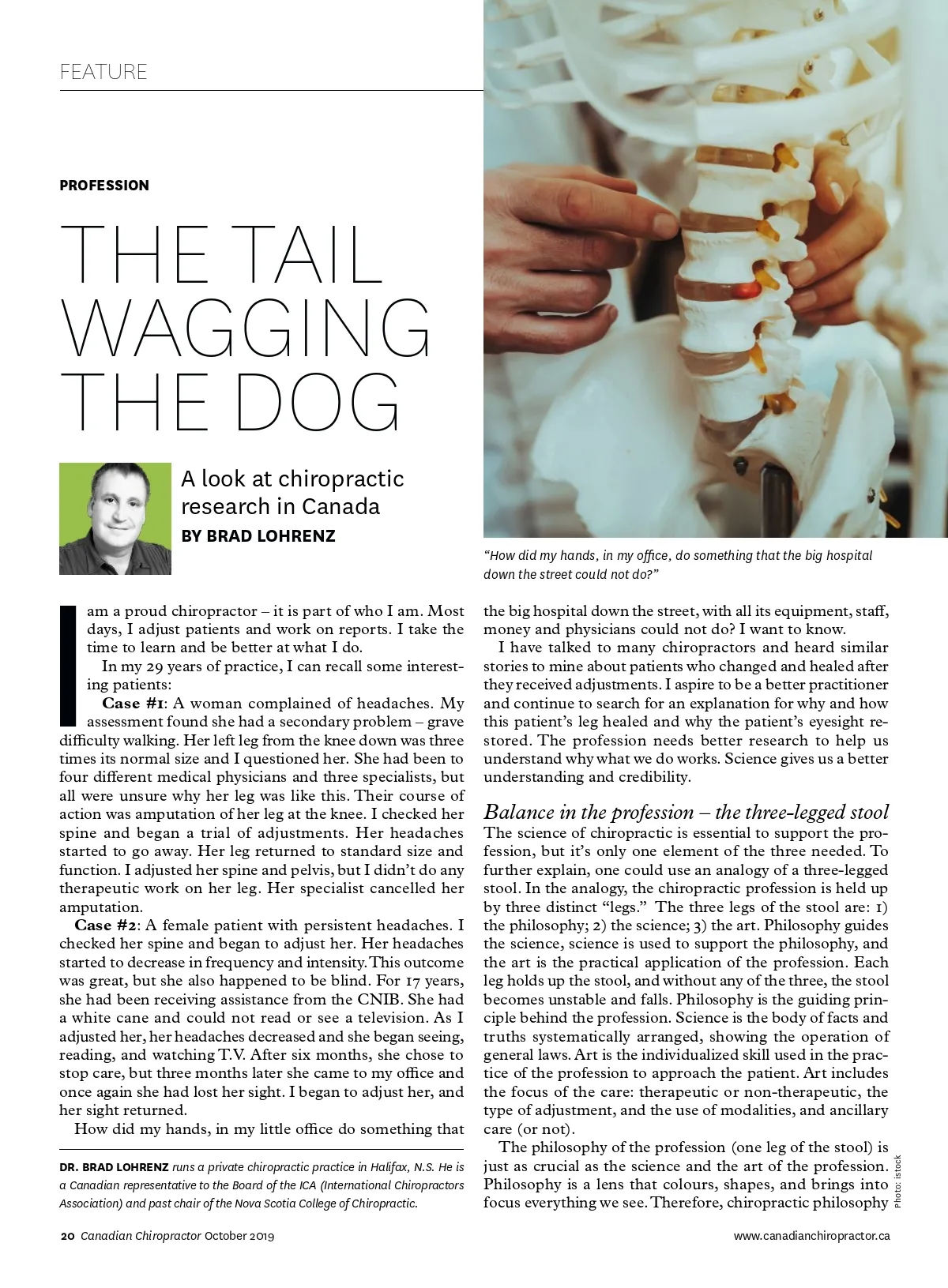
FEATURE PROFESSION THE TAIL WAGGING THE DOG A look at chiropractic research in Canada I BY BRAD LOHRENZ “How did my hands, in my office, do something that the big hospital down the street could not do?” am a proud chiropractor – it is part of who I am. Most days, I adjust patients and work on reports. I take the time to learn and be better at what I do. In my 29 years of practice, I can recall some interest-ing patients: Case #1 : A woman complained of headaches. My assessment found she had a secondary problem – grave difficulty walking. Her left leg from the knee down was three times its normal size and I questioned her. She had been to four different medical physicians and three specialists, but all were unsure why her leg was like this. Their course of action was amputation of her leg at the knee. I checked her spine and began a trial of adjustments. Her headaches started to go away. Her leg returned to standard size and function. I adjusted her spine and pelvis, but I didn’t do any therapeutic work on her leg. Her specialist cancelled her amputation. Case #2 : A female patient with persistent headaches. I checked her spine and began to adjust her. Her headaches started to decrease in frequency and intensity. This outcome was great, but she also happened to be blind. For 17 years, she had been receiving assistance from the CNIB. She had a white cane and could not read or see a television. As I adjusted her, her headaches decreased and she began seeing, reading, and watching T.V. After six months, she chose to stop care, but three months later she came to my office and once again she had lost her sight. I began to adjust her, and her sight returned. How did my hands, in my little office do something that DR. BRAD LOHRENZ runs a private chiropractic practice in Halifax, N.S. He is a Canadian representative to the Board of the ICA (International Chiropractors Association) and past chair of the Nova Scotia College of Chiropractic. 20 Canadian Chiropractor October 2019 the big hospital down the street, with all its equipment, staff, money and physicians could not do? I want to know. I have talked to many chiropractors and heard similar stories to mine about patients who changed and healed after they received adjustments. I aspire to be a better practitioner and continue to search for an explanation for why and how this patient’s leg healed and why the patient’s eyesight re-stored. The profession needs better research to help us understand why what we do works. Science gives us a better understanding and credibility. Balance in the profession – the three-legged stool The science of chiropractic is essential to support the pro-fession, but it’s only one element of the three needed. To further explain, one could use an analogy of a three-legged stool. In the analogy, the chiropractic profession is held up by three distinct “legs.” The three legs of the stool are: 1) the philosophy; 2) the science; 3) the art. Philosophy guides the science, science is used to support the philosophy, and the art is the practical application of the profession. Each leg holds up the stool, and without any of the three, the stool becomes unstable and falls. Philosophy is the guiding prin-ciple behind the profession. Science is the body of facts and truths systematically arranged, showing the operation of general laws. Art is the individualized skill used in the prac-tice of the profession to approach the patient. Art includes the focus of the care: therapeutic or non-therapeutic, the type of adjustment, and the use of modalities, and ancillary care (or not). The philosophy of the profession (one leg of the stool) is just as crucial as the science and the art of the profession. Philosophy is a lens that colours, shapes, and brings into focus everything we see. Therefore, chiropractic philosophy www.canadianchiropractor.ca Photo: istock
Chiropractic + Naturopathic Doctor October 2019: Page 20