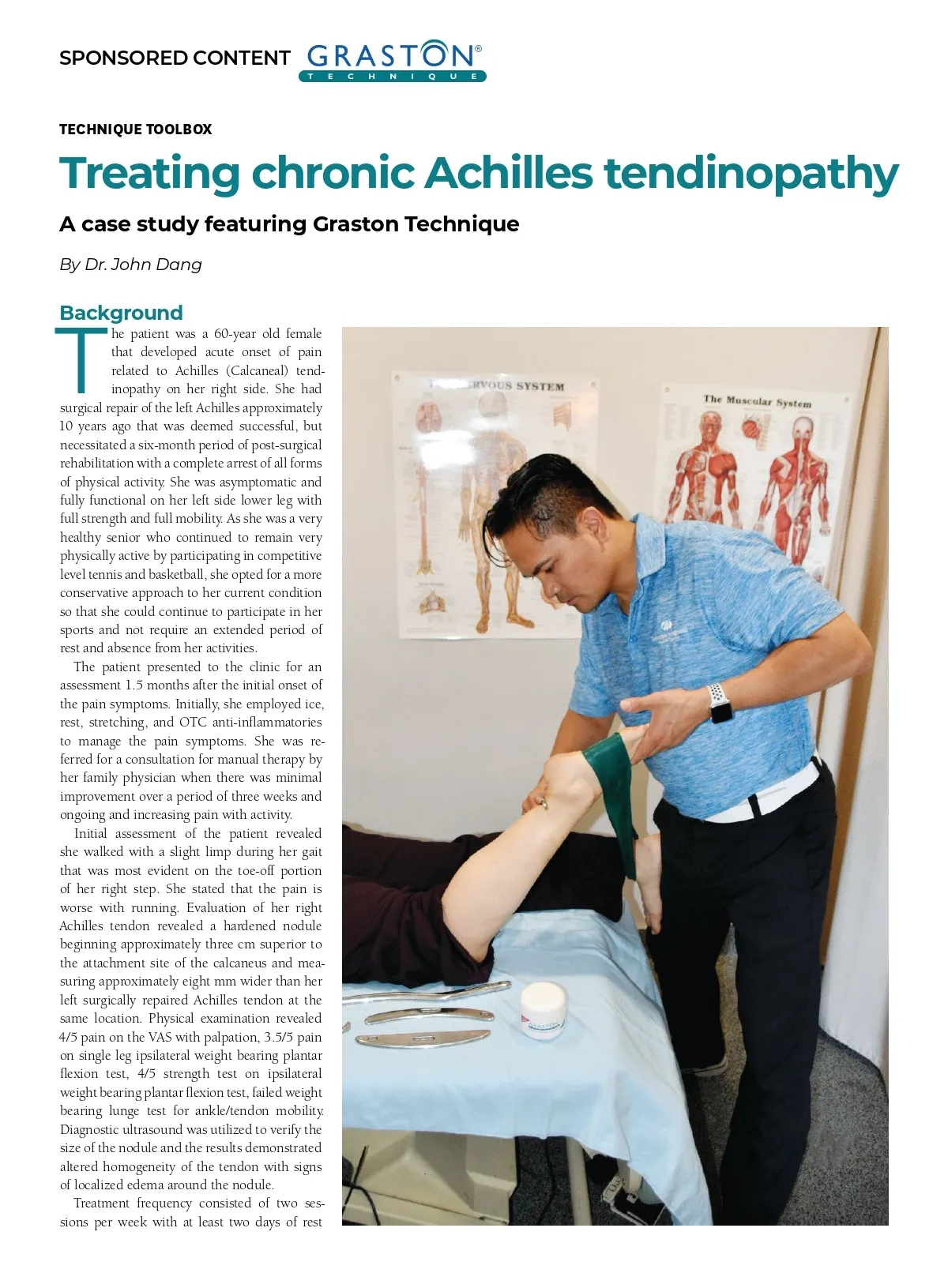
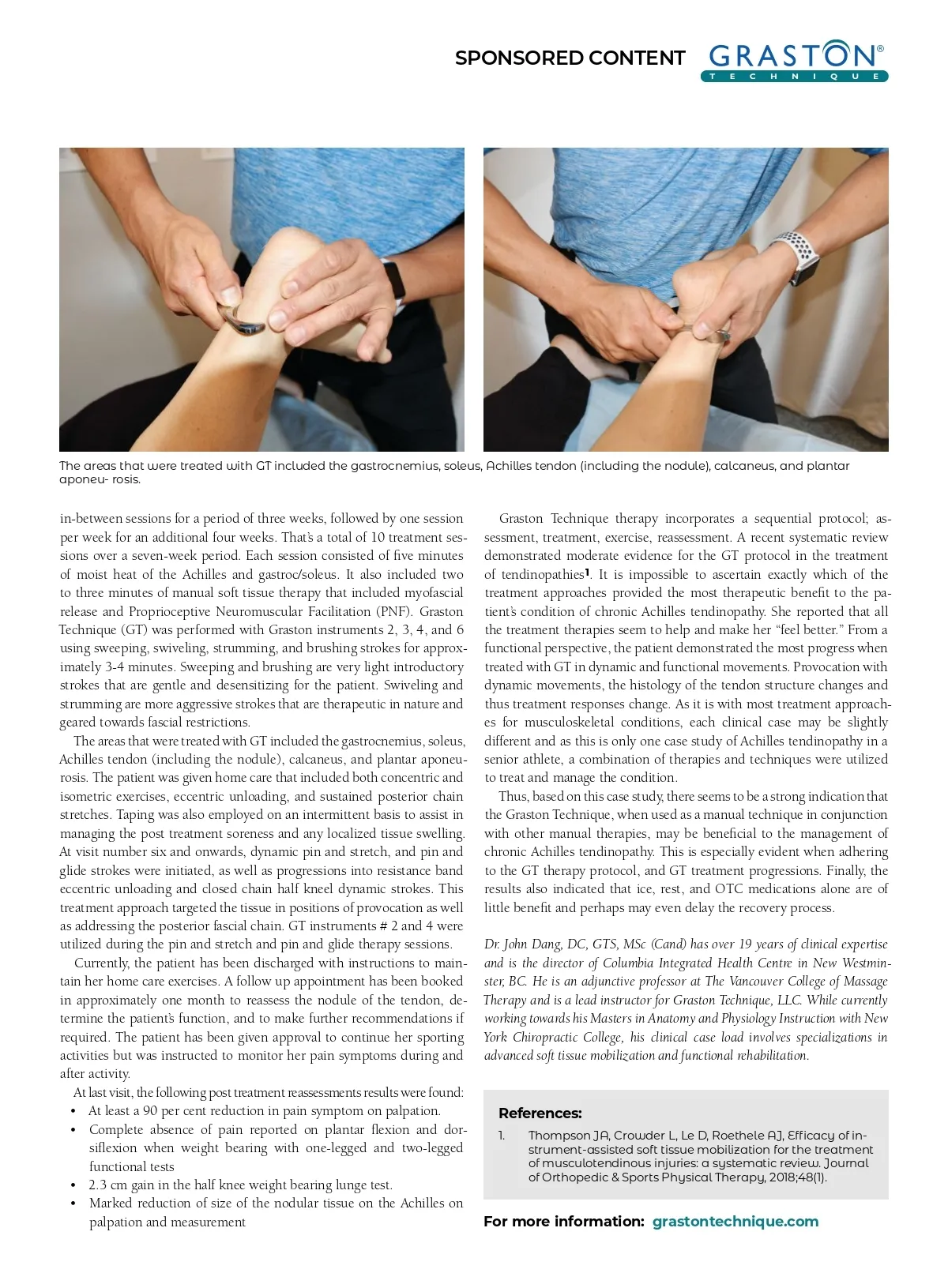
SPONSORED CONTENT The areas that were treated with GT included the gastrocnemius, soleus, Achilles tendon (including the nodule), calcaneus, and plantar aponeu-rosis. in-between sessions for a period of three weeks, followed by one session per week for an additional four weeks. That’s a total of 10 treatment ses-sions over a seven-week period. Each session consisted of five minutes of moist heat of the Achilles and gastroc/soleus. It also included two to three minutes of manual soft tissue therapy that included myofascial release and Proprioceptive Neuromuscular Facilitation (PNF). Graston Technique (GT) was performed with Graston instruments 2, 3, 4, and 6 using sweeping, swiveling, strumming, and brushing strokes for approx-imately 3-4 minutes. Sweeping and brushing are very light introductory strokes that are gentle and desensitizing for the patient. Swiveling and strumming are more aggressive strokes that are therapeutic in nature and geared towards fascial restrictions. The areas that were treated with GT included the gastrocnemius, soleus, Achilles tendon (including the nodule), calcaneus, and plantar aponeu-rosis. The patient was given home care that included both concentric and isometric exercises, eccentric unloading, and sustained posterior chain stretches. Taping was also employed on an intermittent basis to assist in managing the post treatment soreness and any localized tissue swelling. At visit number six and onwards, dynamic pin and stretch, and pin and glide strokes were initiated, as well as progressions into resistance band eccentric unloading and closed chain half kneel dynamic strokes. This treatment approach targeted the tissue in positions of provocation as well as addressing the posterior fascial chain. GT instruments # 2 and 4 were utilized during the pin and stretch and pin and glide therapy sessions. Currently, the patient has been discharged with instructions to main-tain her home care exercises. A follow up appointment has been booked in approximately one month to reassess the nodule of the tendon, de-termine the patient’s function, and to make further recommendations if required. The patient has been given approval to continue her sporting activities but was instructed to monitor her pain symptoms during and after activity. At last visit, the following post treatment reassessments results were found: • At least a 90 per cent reduction in pain symptom on palpation. • Complete absence of pain reported on plantar flexion and dor-siflexion when weight bearing with one-legged and two-legged functional tests • 2.3 cm gain in the half knee weight bearing lunge test. • Marked reduction of size of the nodular tissue on the Achilles on palpation and measurement Graston Technique therapy incorporates a sequential protocol; as-sessment, treatment, exercise, reassessment. A recent systematic review demonstrated moderate evidence for the GT protocol in the treatment of tendinopathies 1 . It is impossible to ascertain exactly which of the treatment approaches provided the most therapeutic benefit to the pa-tient’s condition of chronic Achilles tendinopathy. She reported that all the treatment therapies seem to help and make her “feel better.” From a functional perspective, the patient demonstrated the most progress when treated with GT in dynamic and functional movements. Provocation with dynamic movements, the histology of the tendon structure changes and thus treatment responses change. As it is with most treatment approach-es for musculoskeletal conditions, each clinical case may be slightly different and as this is only one case study of Achilles tendinopathy in a senior athlete, a combination of therapies and techniques were utilized to treat and manage the condition. Thus, based on this case study, there seems to be a strong indication that the Graston Technique, when used as a manual technique in conjunction with other manual therapies, may be beneficial to the management of chronic Achilles tendinopathy. This is especially evident when adhering to the GT therapy protocol, and GT treatment progressions. Finally, the results also indicated that ice, rest, and OTC medications alone are of little benefit and perhaps may even delay the recovery process. Dr. John Dang, DC, GTS, MSc (Cand) has over 19 years of clinical expertise and is the director of Columbia Integrated Health Centre in New Westmin-ster, BC. He is an adjunctive professor at The Vancouver College of Massage Therapy and is a lead instructor for Graston Technique, LLC. While currently working towards his Masters in Anatomy and Physiology Instruction with New York Chiropractic College, his clinical case load involves specializations in advanced soft tissue mobilization and functional rehabilitation. References: 1. Thompson JA, Crowder L, Le D, Roethele AJ, Efficacy of in-strument-assisted soft tissue mobilization for the treatment of musculotendinous injuries: a systematic review. Journal of Orthopedic & Sports Physical Therapy, 2018;48(1). For more information: grastontechnique.com
Chiropractic + Naturopathic Doctor October 2019: Page 19