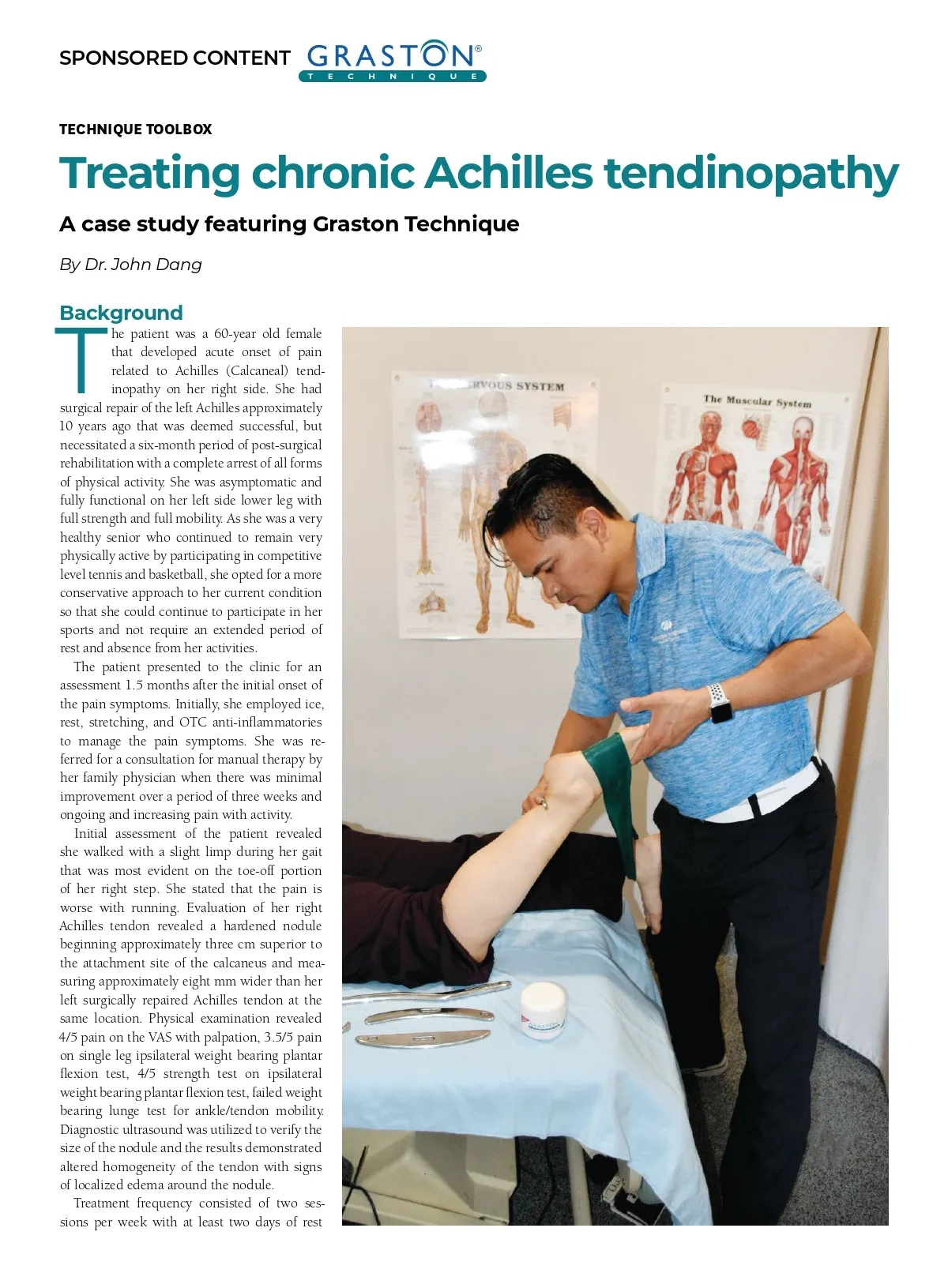
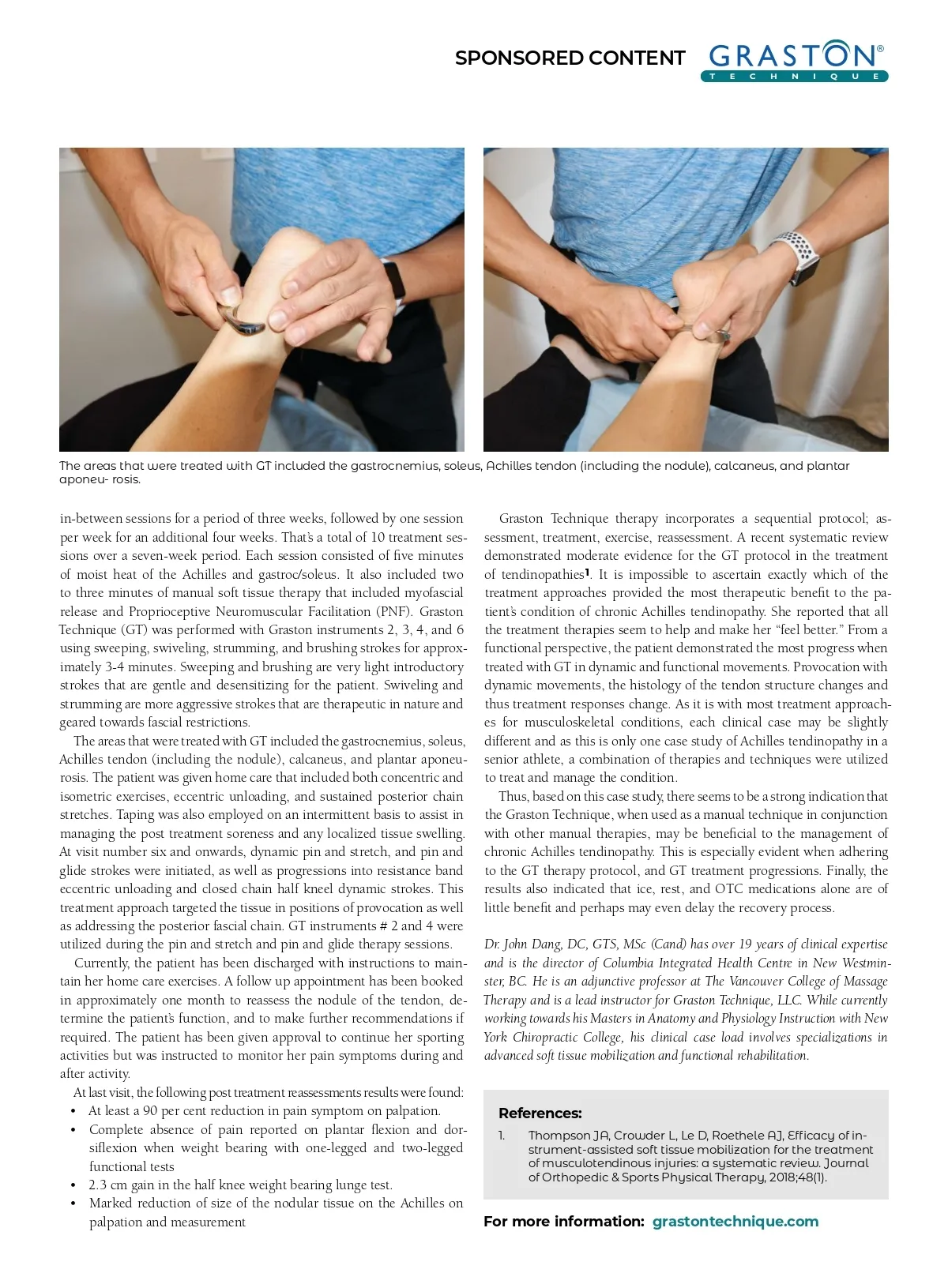
SPONSORED CONTENT TECHNIQUE TOOLBOX Treating chronic Achilles tendinopathy A case study featuring Graston Technique By Dr. John Dang T Background he patient was a 60-year old female that developed acute onset of pain related to Achilles (Calcaneal) tend-inopathy on her right side. She had surgical repair of the left Achilles approximately 10 years ago that was deemed successful, but necessitated a six-month period of post-surgical rehabilitation with a complete arrest of all forms of physical activity. She was asymptomatic and fully functional on her left side lower leg with full strength and full mobility. As she was a very healthy senior who continued to remain very physically active by participating in competitive level tennis and basketball, she opted for a more conservative approach to her current condition so that she could continue to participate in her sports and not require an extended period of rest and absence from her activities. The patient presented to the clinic for an assessment 1.5 months after the initial onset of the pain symptoms. Initially, she employed ice, rest, stretching, and OTC anti-inflammatories to manage the pain symptoms. She was re-ferred for a consultation for manual therapy by her family physician when there was minimal improvement over a period of three weeks and ongoing and increasing pain with activity. Initial assessment of the patient revealed she walked with a slight limp during her gait that was most evident on the toe-off portion of her right step. She stated that the pain is worse with running. Evaluation of her right Achilles tendon revealed a hardened nodule beginning approximately three cm superior to the attachment site of the calcaneus and mea-suring approximately eight mm wider than her left surgically repaired Achilles tendon at the same location. Physical examination revealed 4/5 pain on the VAS with palpation, 3.5/5 pain on single leg ipsilateral weight bearing plantar flexion test, 4/5 strength test on ipsilateral weight bearing plantar flexion test, failed weight bearing lunge test for ankle/tendon mobility. Diagnostic ultrasound was utilized to verify the size of the nodule and the results demonstrated altered homogeneity of the tendon with signs of localized edema around the nodule. Treatment frequency consisted of two ses-sions per week with at least two days of rest
Chiropractic + Naturopathic Doctor October 2019: Page 18