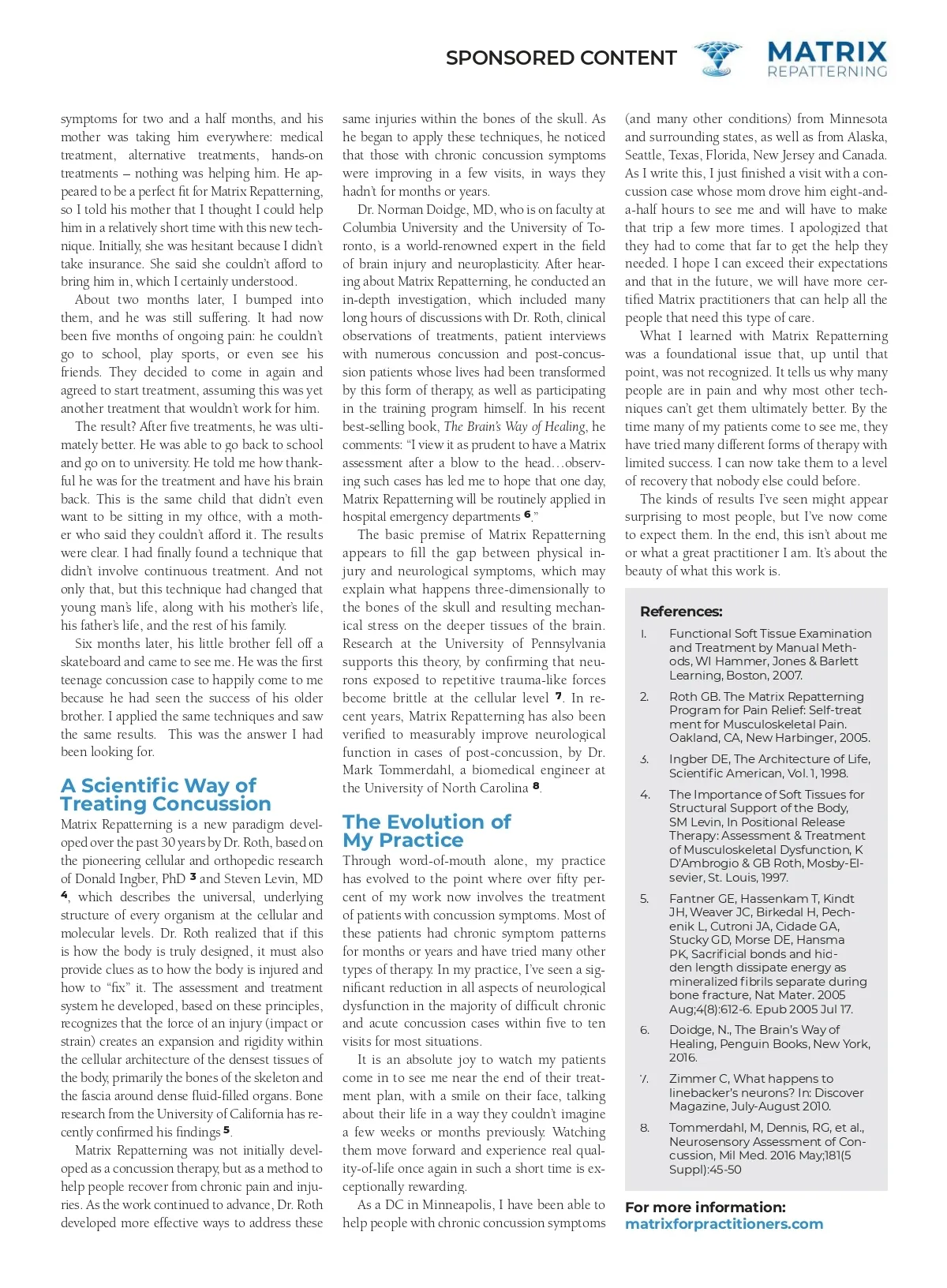
SPONSORED CONTENT There Really is Help for Concussions An Introduction to a Different Way of Looking at the Body By Andy Stella, DC, CMRP E ven though I love chiropractic and I was very good at adjusting, it always bothered me that a big part of our practice model is the idea of creating patients for life. I knew we could bring people to an improved level of function but, to keep them there, it seemed that we were obliged to see them endlessly. Like most of my colleagues, I would tell people they needed to come back, every week, then every two weeks, then every four weeks or six weeks or eight or ten weeks – whatever it was for that person, and that would keep them on that plateau. Without that, they always seemed to return to their old pattern. I went into this profession because I want to help people, as I am sure most chiropractors do, so it was hard for me to understand why people needed continuous treatment to stay pain-free. I saw so many cases where a patient would skip two or three of their maintenance treatments, and they’d be in pain again, or come back months or even a year later and be back where they started. I never encountered any conclusive answers to this question, so I just kept looking. In 2003, I attended a seminar presented by Dr. Warren Hammer 1 , a leader in soft tis-sue therapies in our profession. I was hungry to incorporate more fascial approaches in my soft-tissue therapy toolbox in my quest for bet-ter and longer-lasting results. Dr. Hammer told me about a chiropractor in Canada who was doing work with something he described as “3-dimensional tension release.” Three months later, I was in Toronto, attending an introducto-ry course on Matrix Repatterning. I was expecting to learn just another technique that I could put in my back pocket and use for specific situations. However, within the first hour of the seminar, I heard things I had never heard before. As I was listening to Dr. George Roth, the developer of Matrix Repatterning 2 . I realized that he answered the question that had been bugging me for so long. This course provided a rationale that made sense, and as I saw the faces of some of my patients in my head, it all clicked. I started to think, “Oh, maybe that’s why I can’t get these people past a certain point.” I had a case where I thought I would try Matrix Repatterning, because none of the tools I had learned up to that point, as well as nu-merous other therapies, including a visit to the Mayo Clinic, had worked for this patient. To my surprise and delight, that was my first successful case using the basic approach I had learned from my introductory seminar on Ma-trix Repatterning. I went on to take the full cer-tification course, and I have never looked back. Concussion Breakthrough About three years ago, I saw a 17-year-old who had suffered a concussion as a result of a car accident. At that time, he had been having
Chiropractic + Naturopathic Doctor October 2019: Page 16