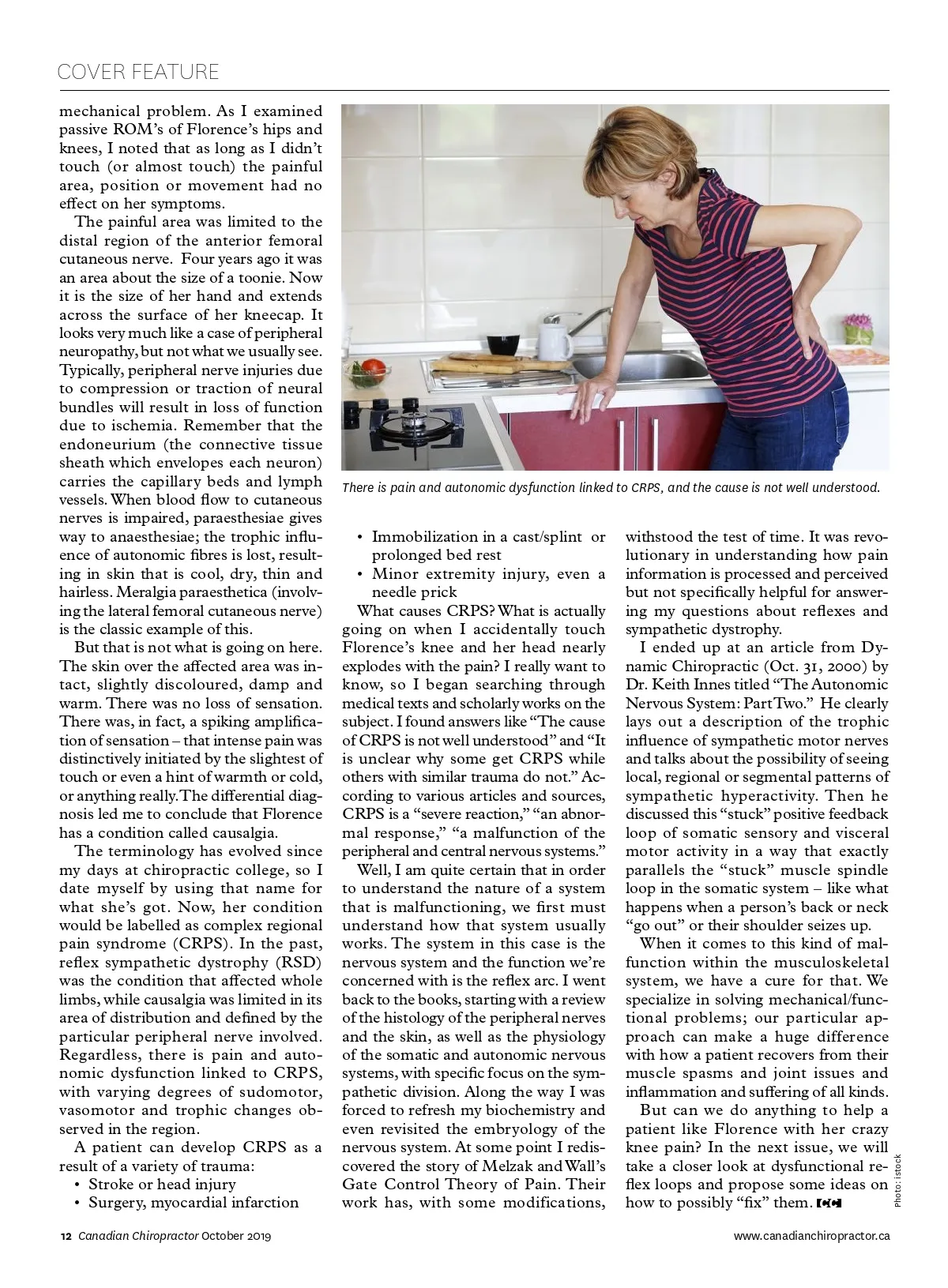
COVER FEATURE mechanical problem. As I examined passive ROM’s of Florence’s hips and knees, I noted that as long as I didn’t touch (or almost touch) the painful area, position or movement had no effect on her symptoms. The painful area was limited to the distal region of the anterior femoral cutaneous nerve. Four years ago it was an area about the size of a toonie. Now it is the size of her hand and extends across the surface of her kneecap. It looks very much like a case of peripheral neuropathy, but not what we usually see. Typically, peripheral nerve injuries due to compression or traction of neural bundles will result in loss of function due to ischemia. Remember that the endoneurium (the connective tissue sheath which envelopes each neuron) carries the capillary beds and lymph vessels. When blood flow to cutaneous nerves is impaired, paraesthesiae gives way to anaesthesiae; the trophic influ-ence of autonomic fibres is lost, result-ing in skin that is cool, dry, thin and hairless. Meralgia paraesthetica (involv-ing the lateral femoral cutaneous nerve) is the classic example of this. But that is not what is going on here. The skin over the affected area was in-tact, slightly discoloured, damp and warm. There was no loss of sensation. There was, in fact, a spiking amplifica-tion of sensation – that intense pain was distinctively initiated by the slightest of touch or even a hint of warmth or cold, or anything really. The differential diag-nosis led me to conclude that Florence has a condition called causalgia. The terminology has evolved since my days at chiropractic college, so I date myself by using that name for what she’s got. Now, her condition would be labelled as complex regional pain syndrome (CRPS). In the past, reflex sympathetic dystrophy (RSD) was the condition that affected whole limbs, while causalgia was limited in its area of distribution and defined by the particular peripheral nerve involved. Regardless, there is pain and auto-nomic dysfunction linked to CRPS, with varying degrees of sudomotor, vasomotor and trophic changes ob-served in the region. A patient can develop CRPS as a result of a variety of trauma: • Stroke or head injury • Surgery, myocardial infarction 12 Canadian Chiropractor October 2019 There is pain and autonomic dysfunction linked to CRPS, and the cause is not well understood. • Immobilization in a cast/splint or prolonged bed rest • Minor extremity injury, even a needle prick What causes CRPS? What is actually going on when I accidentally touch Florence’s knee and her head nearly explodes with the pain? I really want to know, so I began searching through medical texts and scholarly works on the subject. I found answers like “The cause of CRPS is not well understood” and “It is unclear why some get CRPS while others with similar trauma do not.” Ac-cording to various articles and sources, CRPS is a “severe reaction,” “an abnor-mal response,” “a malfunction of the peripheral and central nervous systems.” Well, I am quite certain that in order to understand the nature of a system that is malfunctioning, we first must understand how that system usually works. The system in this case is the nervous system and the function we’re concerned with is the reflex arc. I went back to the books, starting with a review of the histology of the peripheral nerves and the skin, as well as the physiology of the somatic and autonomic nervous systems, with specific focus on the sym-pathetic division. Along the way I was forced to refresh my biochemistry and even revisited the embryology of the nervous system. At some point I redis-covered the story of Melzak and Wall’s Gate Control Theory of Pain. Their work has, with some modifications, withstood the test of time. It was revo-lutionary in understanding how pain information is processed and perceived but not specifically helpful for answer-ing my questions about reflexes and sympathetic dystrophy. I ended up at an article from Dy-namic Chiropractic (Oct. 31, 2000) by Dr. Keith Innes titled “The Autonomic Nervous System: Part Two.” He clearly lays out a description of the trophic influence of sympathetic motor nerves and talks about the possibility of seeing local, regional or segmental patterns of sympathetic hyperactivity. Then he discussed this “stuck” positive feedback loop of somatic sensory and visceral motor activity in a way that exactly parallels the “stuck” muscle spindle loop in the somatic system – like what happens when a person’s back or neck “go out” or their shoulder seizes up. When it comes to this kind of mal-function within the musculoskeletal system, we have a cure for that. We specialize in solving mechanical/func-tional problems; our particular ap-proach can make a huge difference with how a patient recovers from their muscle spasms and joint issues and inflammation and suffering of all kinds. But can we do anything to help a patient like Florence with her crazy knee pain? In the next issue, we will take a closer look at dysfunctional re-flex loops and propose some ideas on how to possibly “fix” them. www.canadianchiropractor.ca Photo: istock
Chiropractic + Naturopathic Doctor October 2019: Page 12