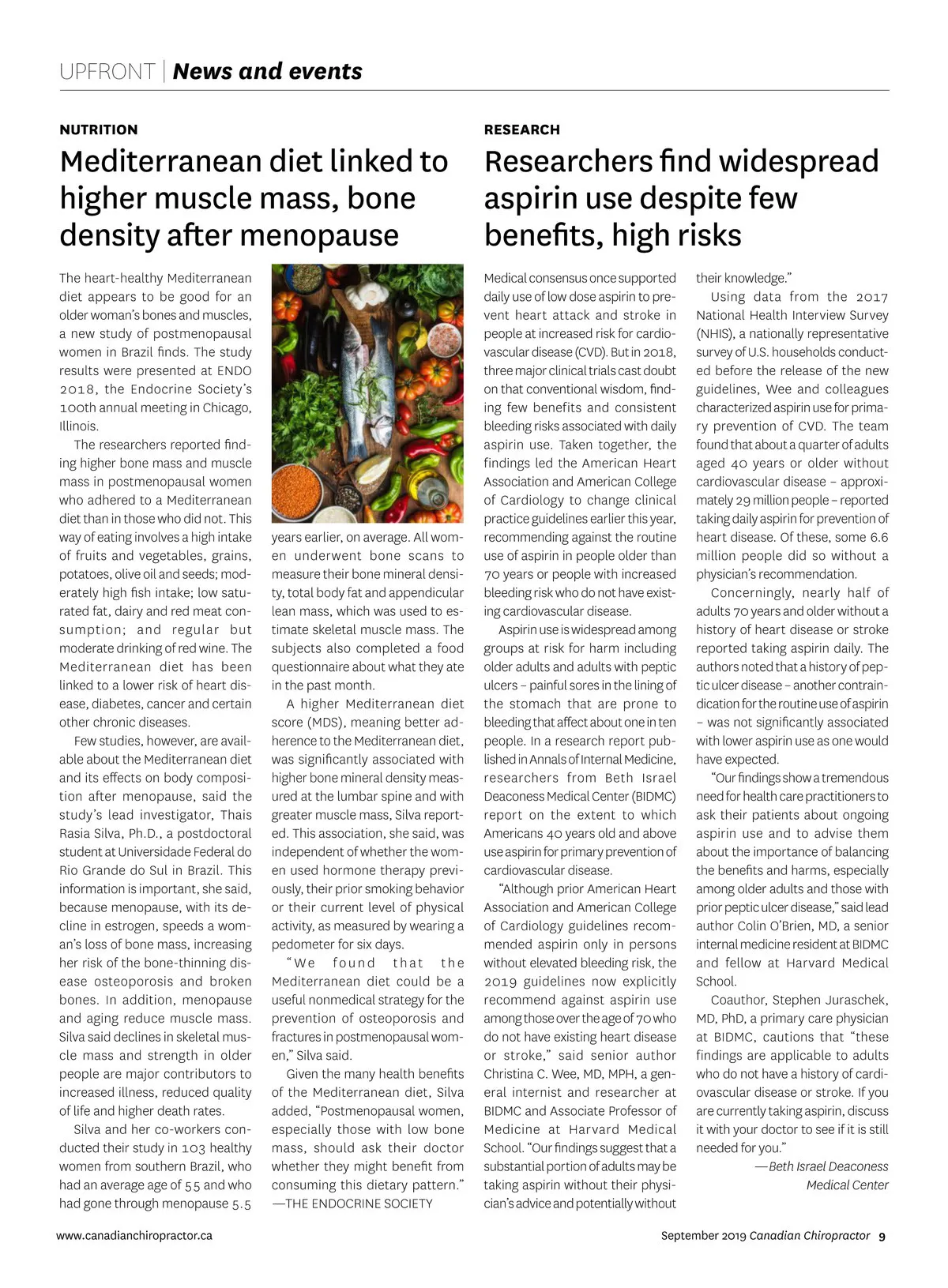
UPFRONT | News and events NUTRITION Mediterranean diet linked to higher muscle mass, bone density after menopause The heart-healthy Mediterranean diet appears to be good for an older woman’s bones and muscles, a new study of postmenopausal women in Brazil finds. The study results were presented at ENDO 2018, the Endocrine Society’s 100th annual meeting in Chicago, Illinois. The researchers reported find-ing higher bone mass and muscle mass in postmenopausal women who adhered to a Mediterranean diet than in those who did not. This way of eating involves a high intake of fruits and vegetables, grains, potatoes, olive oil and seeds; mod-erately high fish intake; low satu-rated fat, dairy and red meat con-sumption; and regular but moderate drinking of red wine. The Mediterranean diet has been linked to a lower risk of heart dis-ease, diabetes, cancer and certain other chronic diseases. Few studies, however, are avail-able about the Mediterranean diet and its effects on body composi-tion after menopause, said the study’s lead investigator, Thais Rasia Silva, Ph.D., a postdoctoral student at Universidade Federal do Rio Grande do Sul in Brazil. This information is important, she said, because menopause, with its de-cline in estrogen, speeds a wom-an’s loss of bone mass, increasing her risk of the bone-thinning dis-ease osteoporosis and broken bones. In addition, menopause and aging reduce muscle mass. Silva said declines in skeletal mus-cle mass and strength in older people are major contributors to increased illness, reduced quality of life and higher death rates. Silva and her co-workers con-ducted their study in 103 healthy women from southern Brazil, who had an average age of 55 and who had gone through menopause 5.5 www.canadianchiropractor.ca RESEARCH Researchers find widespread aspirin use despite few benefits, high risks Medical consensus once supported daily use of low dose aspirin to pre-vent heart attack and stroke in people at increased risk for cardio-vascular disease (CVD). But in 2018, three major clinical trials cast doubt on that conventional wisdom, find-ing few benefits and consistent bleeding risks associated with daily aspirin use. Taken together, the findings led the American Heart Association and American College of Cardiology to change clinical practice guidelines earlier this year, recommending against the routine use of aspirin in people older than 70 years or people with increased bleeding risk who do not have exist-ing cardiovascular disease. Aspirin use is widespread among groups at risk for harm including older adults and adults with peptic ulcers – painful sores in the lining of the stomach that are prone to bleeding that affect about one in ten people. In a research report pub-lished in Annals of Internal Medicine, researchers from Beth Israel Deaconess Medical Center (BIDMC) report on the extent to which Americans 40 years old and above use aspirin for primary prevention of cardiovascular disease. “Although prior American Heart Association and American College of Cardiology guidelines recom-mended aspirin only in persons without elevated bleeding risk, the 2019 guidelines now explicitly recommend against aspirin use among those over the age of 70 who do not have existing heart disease or stroke,” said senior author Christina C. Wee, MD, MPH, a gen-eral internist and researcher at BIDMC and Associate Professor of Medicine at Harvard Medical School. “Our findings suggest that a substantial portion of adults may be taking aspirin without their physi-cian’s advice and potentially without their knowledge.” Using data from the 2017 National Health Interview Survey (NHIS), a nationally representative survey of U.S. households conduct-ed before the release of the new guidelines, Wee and colleagues characterized aspirin use for prima-ry prevention of CVD. The team found that about a quarter of adults aged 40 years or older without cardiovascular disease – approxi-mately 29 million people – reported taking daily aspirin for prevention of heart disease. Of these, some 6.6 million people did so without a physician’s recommendation. Concerningly, nearly half of adults 70 years and older without a history of heart disease or stroke reported taking aspirin daily. The authors noted that a history of pep-tic ulcer disease – another contrain-dication for the routine use of aspirin – was not significantly associated with lower aspirin use as one would have expected. “Our findings show a tremendous need for health care practitioners to ask their patients about ongoing aspirin use and to advise them about the importance of balancing the benefits and harms, especially among older adults and those with prior peptic ulcer disease,” said lead author Colin O’Brien, MD, a senior internal medicine resident at BIDMC and fellow at Harvard Medical School. Coauthor, Stephen Juraschek, MD, PhD, a primary care physician at BIDMC, cautions that “these findings are applicable to adults who do not have a history of cardi-ovascular disease or stroke. If you are currently taking aspirin, discuss it with your doctor to see if it is still needed for you.” —Beth Israel Deaconess Medical Center years earlier, on average. All wom-en underwent bone scans to measure their bone mineral densi-ty, total body fat and appendicular lean mass, which was used to es-timate skeletal muscle mass. The subjects also completed a food questionnaire about what they ate in the past month. A higher Mediterranean diet score (MDS), meaning better ad-herence to the Mediterranean diet, was significantly associated with higher bone mineral density meas-ured at the lumbar spine and with greater muscle mass, Silva report-ed. This association, she said, was independent of whether the wom-en used hormone therapy previ-ously, their prior smoking behavior or their current level of physical activity, as measured by wearing a pedometer for six days. “We found that the Mediterranean diet could be a useful nonmedical strategy for the prevention of osteoporosis and fractures in postmenopausal wom-en,” Silva said. Given the many health benefits of the Mediterranean diet, Silva added, “Postmenopausal women, especially those with low bone mass, should ask their doctor whether they might benefit from consuming this dietary pattern.” —THE ENDOCRINE SOCIETY September 2019 Canadian Chiropractor 9
Chiropractic + Naturopathic Doctor September 2019: Page 9