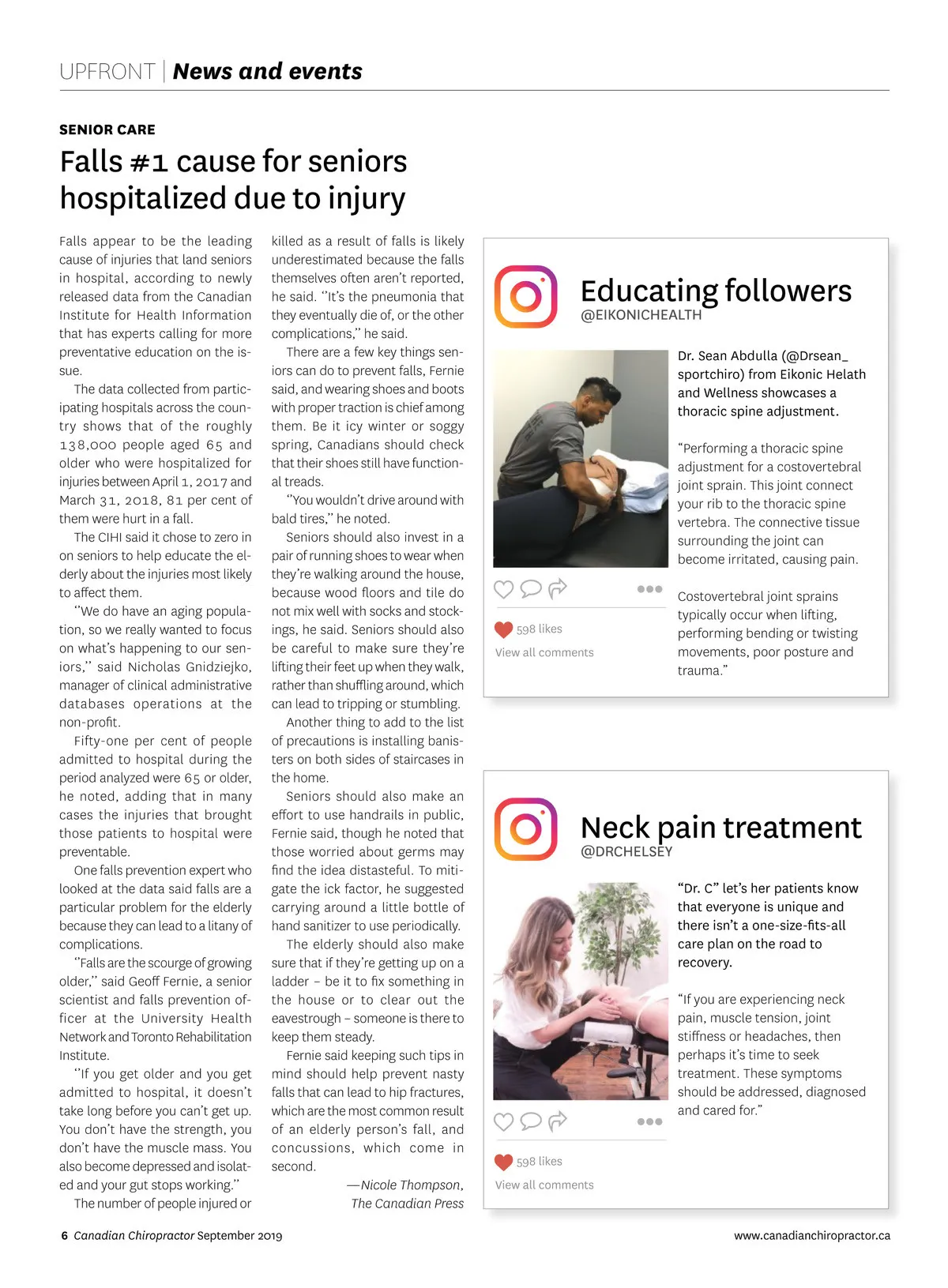
UPFRONT | News and events SPORTS BREAK Rugby-style tackling may have lower force impact RESEARCH Osteoarthritis linked to higher risk of dying from cardiovascular disease Researchers at Lund Uni-versity in Sweden have in-vestigated the link between osteoarthritis and mortality in an epidemiological study. It was shown that the risk of dying from cardiovascular disease was higher for peo-ple with osteoarthritis (OA) than for the rest of the population. Using population regis-ters, the researchers studied approximately 469,000 people living in Skåne, Swe-den, who in 2003 were be-tween 45 and 84 years old and followed them through to 2014. The group included 16,000 patients with knee arthritis, 9,000 with hip ar-thritis, 4,000 with wrist ar-thritis and 5,500 with other forms of OA. They had all been diagnosed in 2003 or before. “We looked at the cause of death for those who died between 2004 and 2014 and who had previously been diagnosed with osteoarthri-tis and compared the results with the rest of the popula-tion in the same region. The groups were not different in terms of most causes of death, but we saw the risk of mortality from cardiovascu-lar disease was higher for those with an osteoarthritis diagnosis. The risk did not increase in the short term after the osteoarthritis diag-nosis, but the longer a per-son had had osteoarthritis, the higher the risk of mortal-ity from cardiovascular dis-eases compared with the background population, e.g. if a person had a knee arthri-tis diagnosis for 9 to 11 years, the risk was 16 per cent higher”, says Martin Eng-lund, professor at Lund University and physician at Skåne University Hospital, who led the study. This means that for every 100,000 inhabitants who have had osteoarthritis for 9-11 years, 40 more die of cardiovascular diseases per year, compared with the population without osteoar-thritis (in corresponding gender and age distribution). The study did not investi-gate the mechanisms behind osteoarthritis and cardiovas-cular disease and the causal link is not fully known. However, Martin Englund has a theory on the reason behind the results. “Osteoarthritis causes pain, which often results in people not being as mobile and becoming sedentary instead. Thus, there is a risk of weight gain, which we know leads to secondary diseases, including cardio-vascular diseases,” says En-glund. “There are also other background factors in com-mon for [OA] and cardio-vascular disease. Inflamma-tion can be a contributory cause of osteoarthritis, and can also lead to an increased risk of cardiovascular dis-ease. Regardless, it’s impor-tant to be physically active and keep body weight in check. In many countries there are special education programs for those suffering from osteoarthritis where you can get information on the disease as well as help and exercise advice.” —Lund University The style of tackling used in rugby may be associated with a lower force of impact than the style used in football, according to a prelimi-nary study of college athletes. “For athletes who participate in a sport that involves a tackle or direct contact, adapting a rug-by-style tackle where the players lead with their shoulders, not their heads, could make college sports safer,” said study author Zach Garrett, DHS, of Marshall University in Huntington, W.Va. “A small num-ber of NFL teams have incorporat-ed the rugby-style tackle in an ef-fort to reduce risk of concussion.” The study measured impact data from 30 male university ath-letes during their spring practice season. Twenty of the participants were football players who had impact sensors placed in their helmets. Ten of the participants were rugby players who had mouthguards with sensors insert-ed into them. At the end of the practice sea-son, the football participants to-taled 3,921 impacts over the-course of 12 practices, compared www.canadianchiropractor.ca to 1,868 impacts over nine prac-tices received by rugby partici-pants. After researchers adjusted for other factors such as false im-pacts, different sample sizes, and practices, they found that the fre-quency of impacts was lower for the rugby players than for the football players. The research team also found that the sensors recorded lower impact forces to the head in rugby in comparison to football. Impact was measured in g-force, which is the measurement of gravity described in units of ac-celeration. Overall the rugby play-ers had impacts with an average of 21 g force. Football players had impacts with an average of 63 g-force. “Further studies with larger numbers of participants are need-ed to confirm these results and also to determine whether using a rugby-style tackle could effective-ly reduce the force of impact and potentially reduce the number or severity of concussions in college football,” said Garrett. —American Academy of Neurology September 2019 Canadian Chiropractor 7
Chiropractic + Naturopathic Doctor September 2019: Page 7