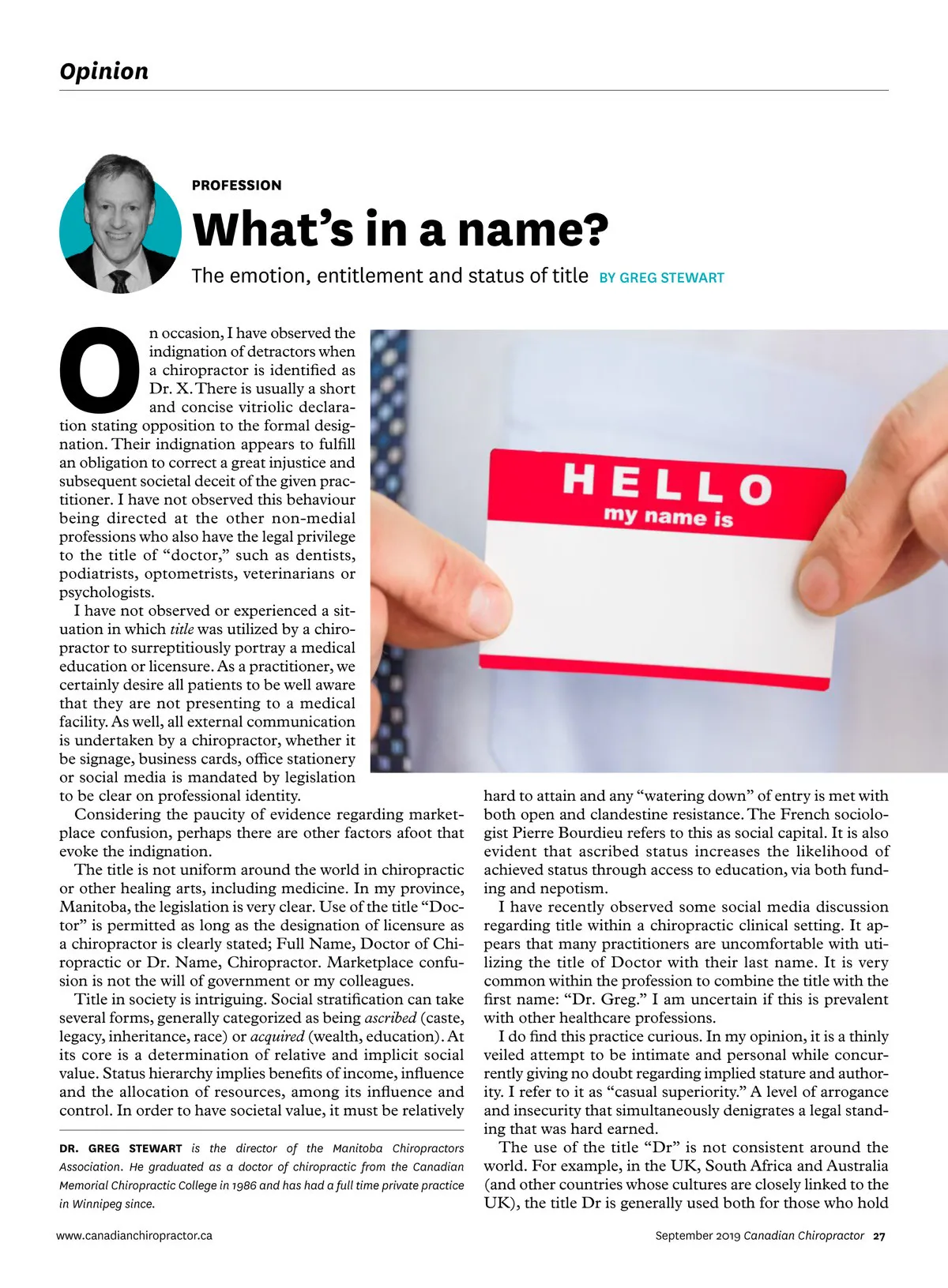
Opinion PROFESSION What’s in a name? O The emotion, entitlement and status of title BY GREG STEWART n occasion, I have observed the indignation of detractors when a chiropractor is identified as Dr. X. There is usually a short and concise vitriolic declara-tion stating opposition to the formal desig-nation. Their indignation appears to fulfill an obligation to correct a great injustice and subsequent societal deceit of the given prac-titioner. I have not observed this behaviour being directed at the other non-medial professions who also have the legal privilege to the title of “doctor,” such as dentists, podiatrists, optometrists, veterinarians or psychologists. I have not observed or experienced a sit-uation in which title was utilized by a chiro-practor to surreptitiously portray a medical education or licensure. As a practitioner, we certainly desire all patients to be well aware that they are not presenting to a medical facility. As well, all external communication is undertaken by a chiropractor, whether it be signage, business cards, office stationery or social media is mandated by legislation to be clear on professional identity. Considering the paucity of evidence regarding market-place confusion, perhaps there are other factors afoot that evoke the indignation. The title is not uniform around the world in chiropractic or other healing arts, including medicine. In my province, Manitoba, the legislation is very clear. Use of the title “Doc-tor” is permitted as long as the designation of licensure as a chiropractor is clearly stated; Full Name, Doctor of Chi-ropractic or Dr. Name, Chiropractor. Marketplace confu-sion is not the will of government or my colleagues. Title in society is intriguing. Social stratification can take several forms, generally categorized as being ascribed (caste, legacy, inheritance, race) or acquired (wealth, education). At its core is a determination of relative and implicit social value. Status hierarchy implies benefits of income, influence and the allocation of resources, among its influence and control. In order to have societal value, it must be relatively DR. GREG STEWART is the director of the Manitoba Chiropractors Association. He graduated as a doctor of chiropractic from the Canadian Memorial Chiropractic College in 1986 and has had a full time private practice in Winnipeg since. hard to attain and any “watering down” of entry is met with both open and clandestine resistance. The French sociolo-gist Pierre Bourdieu refers to this as social capital. It is also evident that ascribed status increases the likelihood of achieved status through access to education, via both fund-ing and nepotism. I have recently observed some social media discussion regarding title within a chiropractic clinical setting. It ap-pears that many practitioners are uncomfortable with uti-lizing the title of Doctor with their last name. It is very common within the profession to combine the title with the first name: “Dr. Greg.” I am uncertain if this is prevalent with other healthcare professions. I do find this practice curious. In my opinion, it is a thinly veiled attempt to be intimate and personal while concur-rently giving no doubt regarding implied stature and author-ity. I refer to it as “casual superiority.” A level of arrogance and insecurity that simultaneously denigrates a legal stand-ing that was hard earned. The use of the title “Dr” is not consistent around the world. For example, in the UK, South Africa and Australia (and other countries whose cultures are closely linked to the UK), the title Dr is generally used both for those who hold September 2019 Canadian Chiropractor 27 www.canadianchiropractor.ca
Chiropractic + Naturopathic Doctor September 2019: Page 27