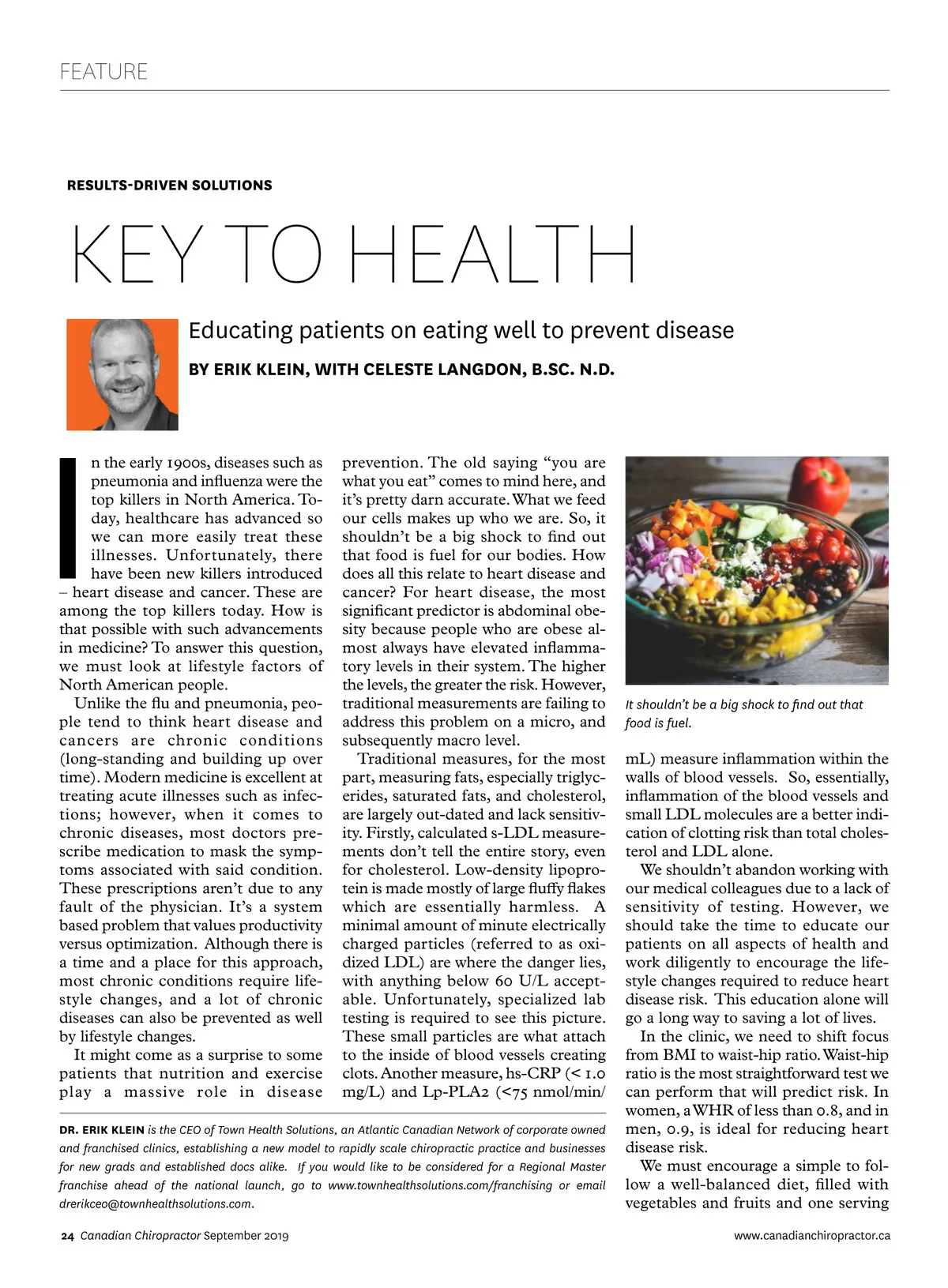
FEATURE RESULTS-DRIVEN SOLUTIONS KEY TO HEALTH Educating patients on eating well to prevent disease BY ERIK KLEIN, WITH CELESTE LANGDON, B.SC. N.D. I n the early 1900s, diseases such as pneumonia and influenza were the top killers in North America. To-day, healthcare has advanced so we can more easily treat these illnesses. Unfortunately, there have been new killers introduced – heart disease and cancer. These are among the top killers today. How is that possible with such advancements in medicine? To answer this question, we must look at lifestyle factors of North American people. Unlike the flu and pneumonia, peo-ple tend to think heart disease and cancers are chronic conditions (long-standing and building up over time). Modern medicine is excellent at treating acute illnesses such as infec-tions; however, when it comes to chronic diseases, most doctors pre-scribe medication to mask the symp-toms associated with said condition. These prescriptions aren’t due to any fault of the physician. It’s a system based problem that values productivity versus optimization. Although there is a time and a place for this approach, most chronic conditions require life-style changes, and a lot of chronic diseases can also be prevented as well by lifestyle changes. It might come as a surprise to some patients that nutrition and exercise play a massive role in disease prevention. The old saying “you are what you eat” comes to mind here, and it’s pretty darn accurate. What we feed our cells makes up who we are. So, it shouldn’t be a big shock to find out that food is fuel for our bodies. How does all this relate to heart disease and cancer? For heart disease, the most significant predictor is abdominal obe-sity because people who are obese al-most always have elevated inflamma-tory levels in their system. The higher the levels, the greater the risk. However, traditional measurements are failing to address this problem on a micro, and subsequently macro level. Traditional measures, for the most part, measuring fats, especially triglyc-erides, saturated fats, and cholesterol, are largely out-dated and lack sensitiv-ity. Firstly, calculated s-LDL measure-ments don’t tell the entire story, even for cholesterol. Low-density lipopro-tein is made mostly of large fluffy flakes which are essentially harmless. A minimal amount of minute electrically charged particles (referred to as oxi-dized LDL) are where the danger lies, with anything below 60 U/L accept-able. Unfortunately, specialized lab testing is required to see this picture. These small particles are what attach to the inside of blood vessels creating clots. Another measure, hs-CRP (< 1.0 mg/L) and Lp-PLA2 (<75 nmol/min/ It shouldn’t be a big shock to find out that food is fuel. DR. ERIK KLEIN is the CEO of Town Health Solutions, an Atlantic Canadian Network of corporate owned and franchised clinics, establishing a new model to rapidly scale chiropractic practice and businesses for new grads and established docs alike. If you would like to be considered for a Regional Master franchise ahead of the national launch, go to www.townhealthsolutions.com/franchising or email [email protected]. 24 Canadian Chiropractor September 2019 mL) measure inflammation within the walls of blood vessels. So, essentially, inflammation of the blood vessels and small LDL molecules are a better indi-cation of clotting risk than total choles-terol and LDL alone. We shouldn’t abandon working with our medical colleagues due to a lack of sensitivity of testing. However, we should take the time to educate our patients on all aspects of health and work diligently to encourage the life-style changes required to reduce heart disease risk. This education alone will go a long way to saving a lot of lives. In the clinic, we need to shift focus from BMI to waist-hip ratio. Waist-hip ratio is the most straightforward test we can perform that will predict risk. In women, a WHR of less than 0.8, and in men, 0.9, is ideal for reducing heart disease risk. We must encourage a simple to fol-low a well-balanced diet, filled with vegetables and fruits and one serving www.canadianchiropractor.ca
Chiropractic + Naturopathic Doctor September 2019: Page 24