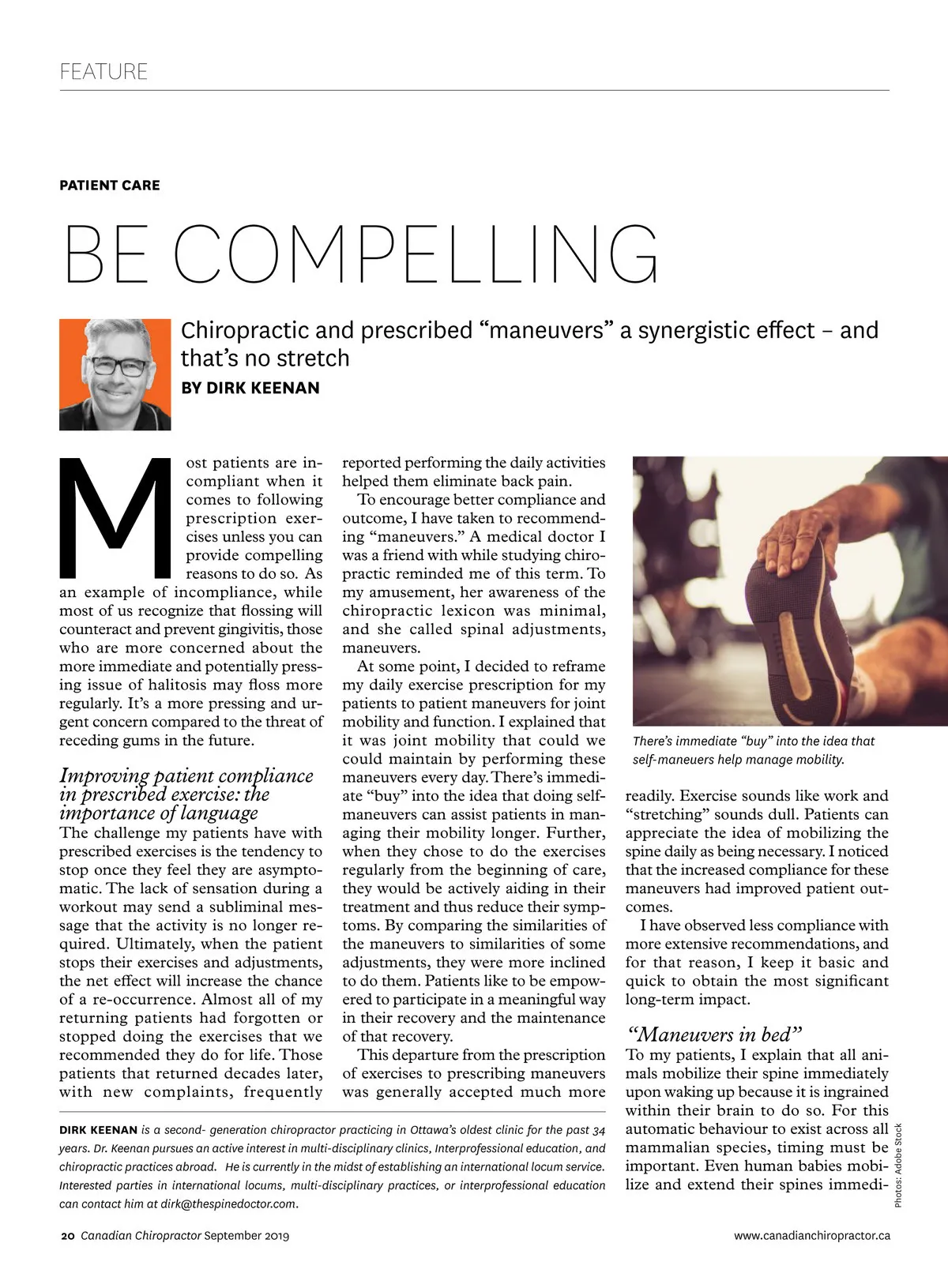
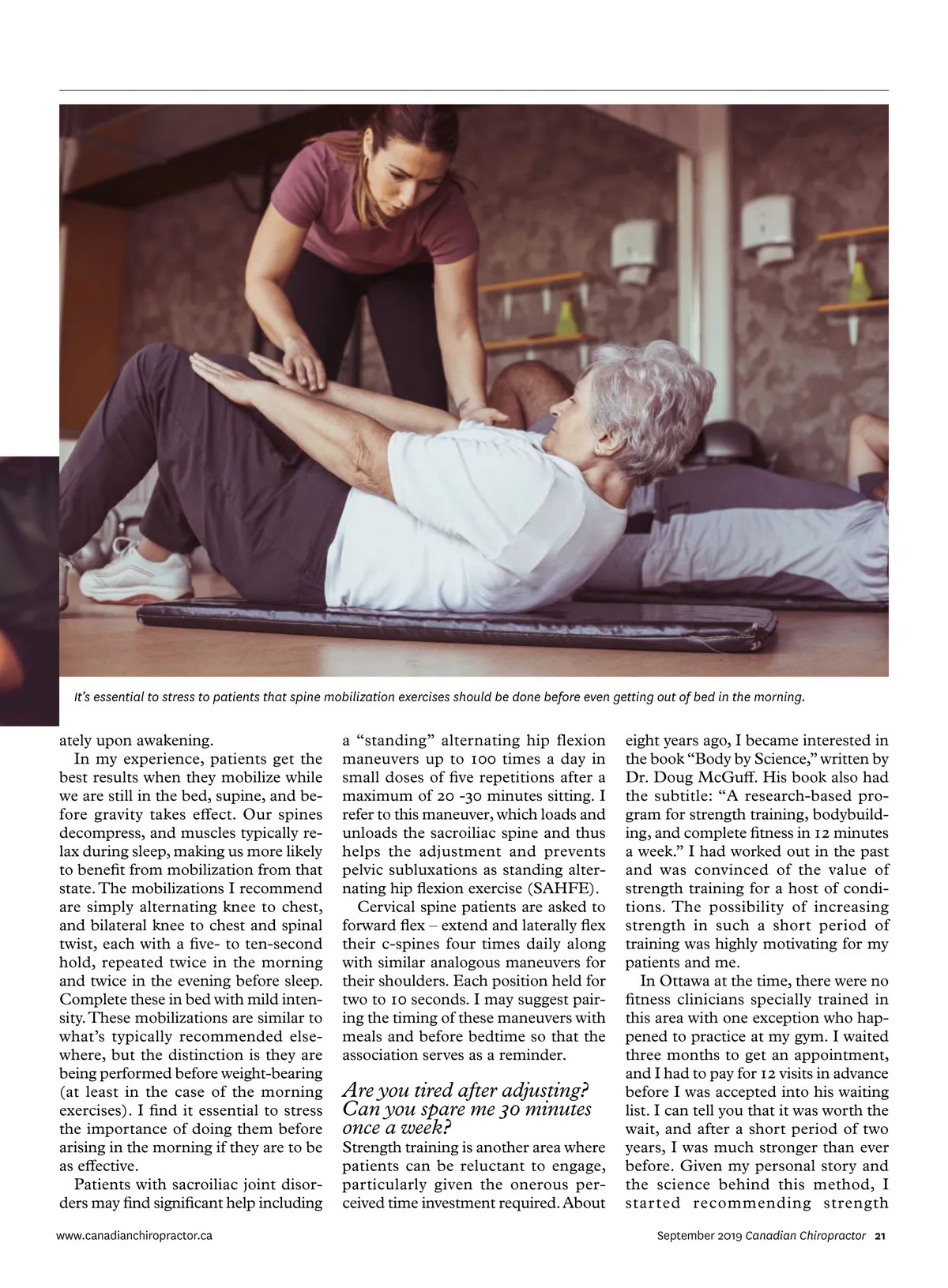
FEATURE PATIENT CARE BE COMPELLING Chiropractic and prescribed “maneuvers” a synergistic effect – and that’s no stretch M BY DIRK KEENAN ost patients are in-compliant when it comes to following prescription exer-cises unless you can provide compelling reasons to do so. As an example of incompliance, while most of us recognize that flossing will counteract and prevent gingivitis, those who are more concerned about the more immediate and potentially press-ing issue of halitosis may floss more regularly. It’s a more pressing and ur-gent concern compared to the threat of receding gums in the future. Improving patient compliance in prescribed exercise: the importance of language The challenge my patients have with prescribed exercises is the tendency to stop once they feel they are asympto-matic. The lack of sensation during a workout may send a subliminal mes-sage that the activity is no longer re-quired. Ultimately, when the patient stops their exercises and adjustments, the net effect will increase the chance of a re-occurrence. Almost all of my returning patients had forgotten or stopped doing the exercises that we recommended they do for life. Those patients that returned decades later, with new complaints, frequently reported performing the daily activities helped them eliminate back pain. To encourage better compliance and outcome, I have taken to recommend-ing “maneuvers.” A medical doctor I was a friend with while studying chiro-practic reminded me of this term. To my amusement, her awareness of the chiropractic lexicon was minimal, and she called spinal adjustments, maneuvers. At some point, I decided to reframe my daily exercise prescription for my patients to patient maneuvers for joint mobility and function. I explained that it was joint mobility that could we could maintain by performing these maneuvers every day. There’s immedi-ate “buy” into the idea that doing self-maneuvers can assist patients in man-aging their mobility longer. Further, when they chose to do the exercises regularly from the beginning of care, they would be actively aiding in their treatment and thus reduce their symp-toms. By comparing the similarities of the maneuvers to similarities of some adjustments, they were more inclined to do them. Patients like to be empow-ered to participate in a meaningful way in their recovery and the maintenance of that recovery. This departure from the prescription of exercises to prescribing maneuvers was generally accepted much more There’s immediate “buy” into the idea that self-maneuers help manage mobility. readily. Exercise sounds like work and “stretching” sounds dull. Patients can appreciate the idea of mobilizing the spine daily as being necessary. I noticed that the increased compliance for these maneuvers had improved patient out-comes. I have observed less compliance with more extensive recommendations, and for that reason, I keep it basic and quick to obtain the most significant long-term impact. “Maneuvers in bed” DIRK KEENAN is a second-generation chiropractor practicing in Ottawa’s oldest clinic for the past 34 years. Dr. Keenan pursues an active interest in multi-disciplinary clinics, Interprofessional education, and chiropractic practices abroad. He is currently in the midst of establishing an international locum service. Interested parties in international locums, multi-disciplinary practices, or interprofessional education can contact him at [email protected]. 20 Canadian Chiropractor September 2019 www.canadianchiropractor.ca Photos: Adobe Stock To my patients, I explain that all ani-mals mobilize their spine immediately upon waking up because it is ingrained within their brain to do so. For this automatic behaviour to exist across all mammalian species, timing must be important. Even human babies mobi-lize and extend their spines immedi-
Chiropractic + Naturopathic Doctor September 2019: Page 20