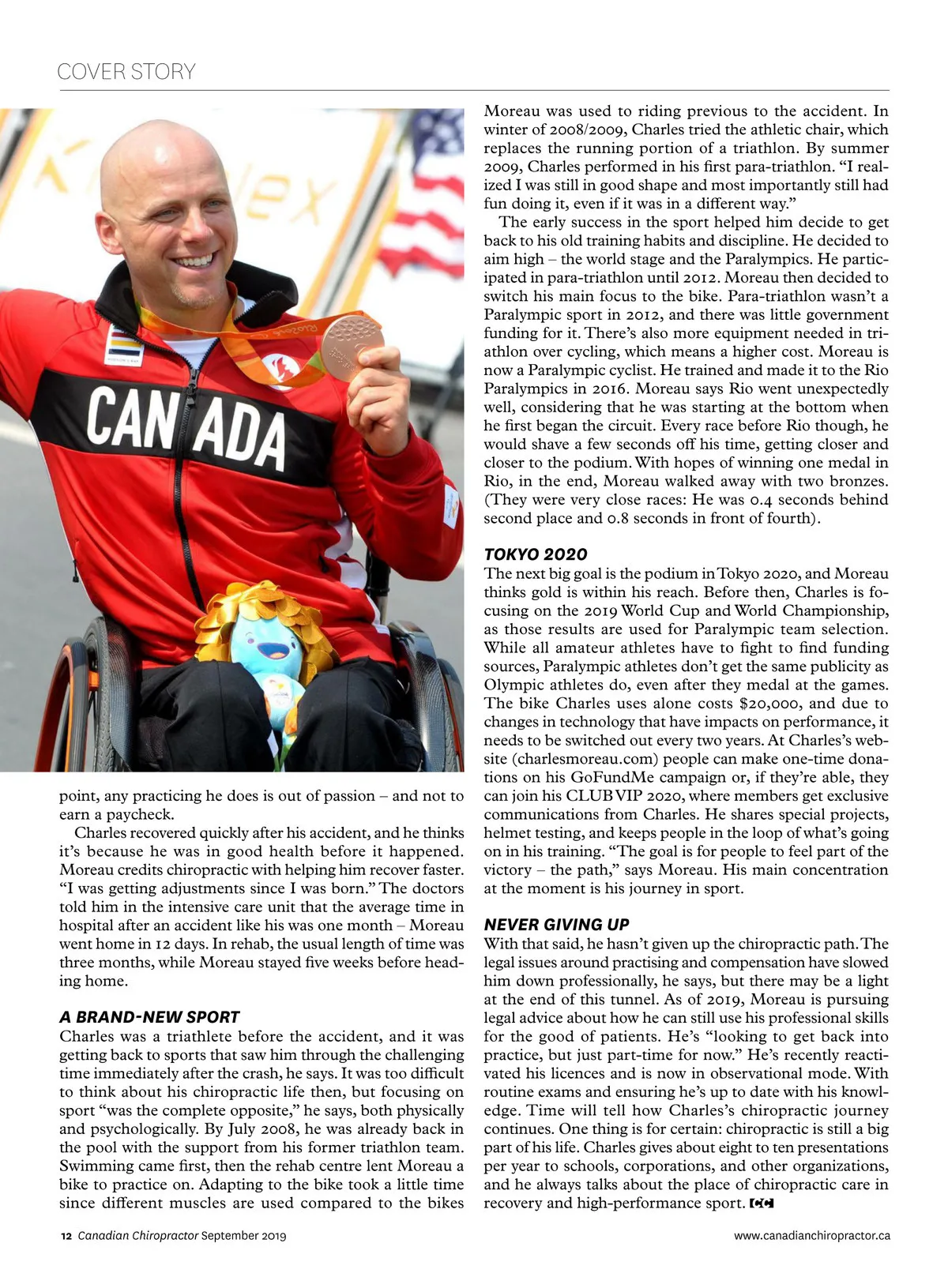
COVER STORY Moreau was used to riding previous to the accident. In winter of 2008/2009, Charles tried the athletic chair, which replaces the running portion of a triathlon. By summer 2009, Charles performed in his first para-triathlon. “I real-ized I was still in good shape and most importantly still had fun doing it, even if it was in a different way.” The early success in the sport helped him decide to get back to his old training habits and discipline. He decided to aim high – the world stage and the Paralympics. He partic-ipated in para-triathlon until 2012. Moreau then decided to switch his main focus to the bike. Para-triathlon wasn’t a Paralympic sport in 2012, and there was little government funding for it. There’s also more equipment needed in tri-athlon over cycling, which means a higher cost. Moreau is now a Paralympic cyclist. He trained and made it to the Rio Paralympics in 2016. Moreau says Rio went unexpectedly well, considering that he was starting at the bottom when he first began the circuit. Every race before Rio though, he would shave a few seconds off his time, getting closer and closer to the podium. With hopes of winning one medal in Rio, in the end, Moreau walked away with two bronzes. (They were very close races: He was 0.4 seconds behind second place and 0.8 seconds in front of fourth). TOKYO 2020 point, any practicing he does is out of passion – and not to earn a paycheck. Charles recovered quickly after his accident, and he thinks it’s because he was in good health before it happened. Moreau credits chiropractic with helping him recover faster. “I was getting adjustments since I was born.” The doctors told him in the intensive care unit that the average time in hospital after an accident like his was one month – Moreau went home in 12 days. In rehab, the usual length of time was three months, while Moreau stayed five weeks before head-ing home. The next big goal is the podium in Tokyo 2020, and Moreau thinks gold is within his reach. Before then, Charles is fo-cusing on the 2019 World Cup and World Championship, as those results are used for Paralympic team selection. While all amateur athletes have to fight to find funding sources, Paralympic athletes don’t get the same publicity as Olympic athletes do, even after they medal at the games. The bike Charles uses alone costs $20,000, and due to changes in technology that have impacts on performance, it needs to be switched out every two years. At Charles’s web-site (charlesmoreau.com) people can make one-time dona-tions on his GoFundMe campaign or, if they’re able, they can join his CLUB VIP 2020, where members get exclusive communications from Charles. He shares special projects, helmet testing, and keeps people in the loop of what’s going on in his training. “The goal is for people to feel part of the victory – the path,” says Moreau. His main concentration at the moment is his journey in sport. NEVER GIVING UP A BRAND-NEW SPORT Charles was a triathlete before the accident, and it was getting back to sports that saw him through the challenging time immediately after the crash, he says. It was too difficult to think about his chiropractic life then, but focusing on sport “was the complete opposite,” he says, both physically and psychologically. By July 2008, he was already back in the pool with the support from his former triathlon team. Swimming came first, then the rehab centre lent Moreau a bike to practice on. Adapting to the bike took a little time since different muscles are used compared to the bikes 12 Canadian Chiropractor September 2019 With that said, he hasn’t given up the chiropractic path. The legal issues around practising and compensation have slowed him down professionally, he says, but there may be a light at the end of this tunnel. As of 2019, Moreau is pursuing legal advice about how he can still use his professional skills for the good of patients. He’s “looking to get back into practice, but just part-time for now.” He’s recently reacti-vated his licences and is now in observational mode. With routine exams and ensuring he’s up to date with his knowl-edge. Time will tell how Charles’s chiropractic journey continues. One thing is for certain: chiropractic is still a big part of his life. Charles gives about eight to ten presentations per year to schools, corporations, and other organizations, and he always talks about the place of chiropractic care in recovery and high-performance sport. www.canadianchiropractor.ca
Chiropractic + Naturopathic Doctor September 2019: Page 12