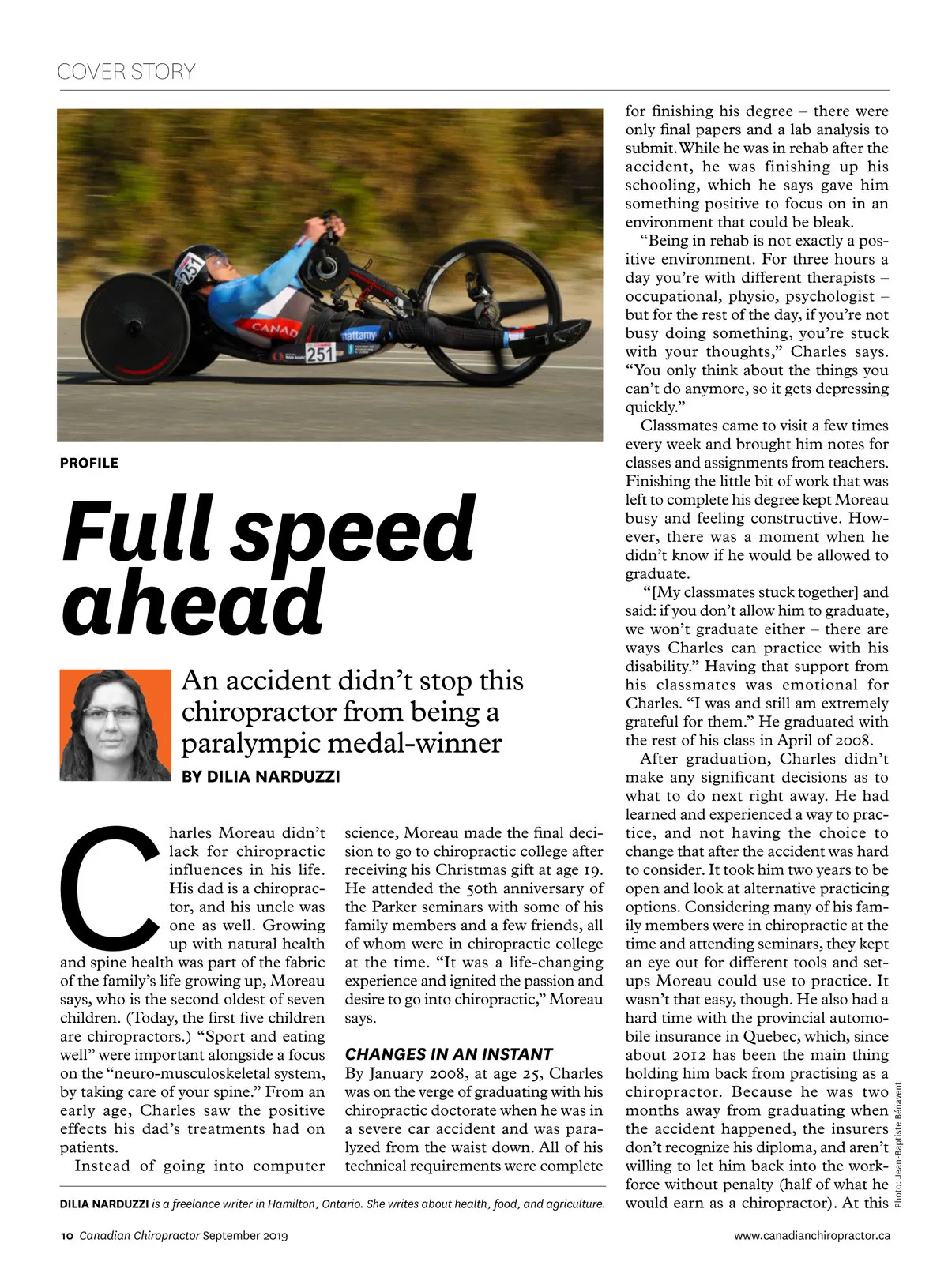
COVER STORY for finishing his degree – there were only final papers and a lab analysis to submit. While he was in rehab after the accident, he was finishing up his schooling, which he says gave him something positive to focus on in an environment that could be bleak. “Being in rehab is not exactly a pos-itive environment. For three hours a day you’re with different therapists – occupational, physio, psychologist – but for the rest of the day, if you’re not busy doing something, you’re stuck with your thoughts,” Charles says. “You only think about the things you can’t do anymore, so it gets depressing quickly.” Classmates came to visit a few times every week and brought him notes for classes and assignments from teachers. Finishing the little bit of work that was left to complete his degree kept Moreau busy and feeling constructive. How-ever, there was a moment when he didn’t know if he would be allowed to graduate. “[My classmates stuck together] and said: if you don’t allow him to graduate, we won’t graduate either – there are ways Charles can practice with his disability.” Having that support from his classmates was emotional for Charles. “I was and still am extremely grateful for them.” He graduated with the rest of his class in April of 2008. After graduation, Charles didn’t make any significant decisions as to what to do next right away. He had learned and experienced a way to prac-tice, and not having the choice to change that after the accident was hard to consider. It took him two years to be open and look at alternative practicing options. Considering many of his fam-ily members were in chiropractic at the time and attending seminars, they kept an eye out for different tools and set-ups Moreau could use to practice. It wasn’t that easy, though. He also had a hard time with the provincial automo-bile insurance in Quebec, which, since about 2012 has been the main thing holding him back from practising as a chiropractor. Because he was two months away from graduating when the accident happened, the insurers don’t recognize his diploma, and aren’t willing to let him back into the work-force without penalty (half of what he would earn as a chiropractor). At this www.canadianchiropractor.ca PROFILE Full speed ahead C An accident didn’t stop this chiropractor from being a paralympic medal-winner BY DILIA NARDUZZI science, Moreau made the final deci-sion to go to chiropractic college after receiving his Christmas gift at age 19. He attended the 50th anniversary of the Parker seminars with some of his family members and a few friends, all of whom were in chiropractic college at the time. “It was a life-changing experience and ignited the passion and desire to go into chiropractic,” Moreau says. DILIA NARDUZZI is a freelance writer in Hamilton, Ontario. She writes about health, food, and agriculture. 10 Canadian Chiropractor September 2019 Photo: Jean-Baptiste Bénavent harles Moreau didn’t lack for chiropractic influences in his life. His dad is a chiroprac-tor, and his uncle was one as well. Growing up with natural health and spine health was part of the fabric of the family’s life growing up, Moreau says, who is the second oldest of seven children. (Today, the first five children are chiropractors.) “Sport and eating well” were important alongside a focus on the “neuro-musculoskeletal system, by taking care of your spine.” From an early age, Charles saw the positive effects his dad’s treatments had on patients. Instead of going into computer CHANGES IN AN INSTANT By January 2008, at age 25, Charles was on the verge of graduating with his chiropractic doctorate when he was in a severe car accident and was para-lyzed from the waist down. All of his technical requirements were complete
Chiropractic + Naturopathic Doctor September 2019: Page 10