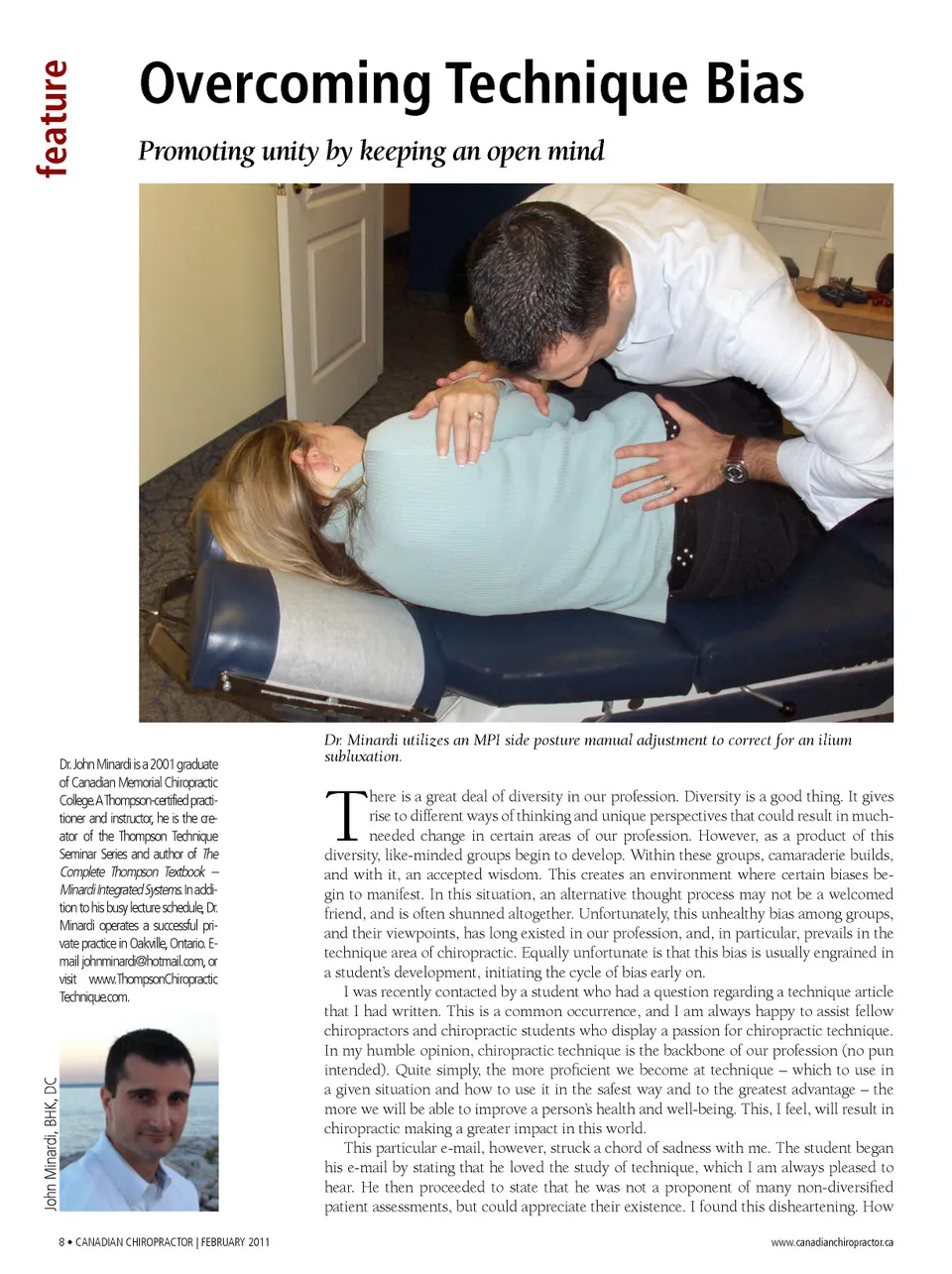
could a student, who is filled with enthu-siasm, not be a proponent of other tech-niques, and merely “appreciate the exis-tence” of adjustment protocols that our pioneers literally went to jail for? This e-mail disappointed me because this particular student, like many stu-dents, had most likely been taught this way of thinking. He certainly didn’t walk into chiropractic college with the idea that one particular assessment protocol was any better than another. (He probably had no idea that different protocols existed in the first place.) He learned this biased thought process from an individual(s), who believed this to be true, and passed it on to the student. However, whether inadvertently or not, this teaching style also encourages the negative connotation that one particular assessment protocol is “good,” or valid, and others are necessar-ily “bad,” or invalid. I remember very clearly that these same biases existed when I was a student. I remember listening to a variety of chi-ropractors state that certain assessment protocols were a “leap of faith,” and to stay away from them altogether. These individuals were presenting themselves as authorities in technique, and therefore, used their authority to influence oth-ers. Furthermore, these individuals were planting seeds of bias in students’ minds. These seeds would often grow as the stu-dent became a practising chiropractor, en-couraging further division within the pro-fession. Although it is not my intention to discredit anyone’s teaching methods or the technique systems they were trying to instil – or used in practice – it is my goal, instead, to encourage unity, in our profes-sion, by opening our collective mindset to the habit of at least hearing each other out, rather than shutting each other out for the wrong reasons. What do I mean by this? Read on and you’ll find out. WHAT DRIVES THIS BIAS? What always amazed me was that this biased mindset was often a result of ig-norance. I remember when I questioned these individuals further about the very technique they were so comfortable dis-crediting, it was revealed that these same persons knew very little of said technique. I remember one specific incident, when a friend of mine asked a chiropractor what the difference was between a NU-CCA adjustment and an HIO adjustment. www.canadianchiropractor.ca The chiropractor, who was regarded as the technique expert, confidently stated that they were the same thing – but that the NUCCA adjustment had a faster re-coil – and that it was a leap of faith to use either. First, this was an entirely incorrect answer, demonstrating that this person was ignorant of the particulars of one or both techniques. “Second, the response was filled with bias and, furthermore, was not based on fact or evidence. Often, individuals who are propo-nents of a certain protocol or technique have chosen to read very little, if any-thing, about other techniques. When asked to comment, then, rather than encourage investigation into them, they simply proceed to discredit these other techniques, but without being able to back up their statements. In my experi-ence, the vast majority of these persons have not attended a thorough seminar on the technique that they are biased against, nor have they gathered research to sub-stantiate their claims. Unfortunately, the bias often continues with insinuations that only those techniques and assessment protocols used by particular individuals are valid, and that all others are suspect at best. Does this way of thinking make sense to anyone? Hopefully, the answer that you are speaking out loud at this moment is a resounding “no.” However, this careless thinking process is exploited by many individuals in our profession – and not just instructors in college, but DCs every-where. For years, I have heard how Gon-stead practitioners disliked Thompson practitioners, who in turn detested Ap-plied Kinesiology, who in turn hated Di-versified, who in turn ostracized everyone else. I am exaggerating blanket statements concerning the aforementioned tech-niques to display a point. Certain prac-titioners believe that the technique that they are implementing is more valid than another, and will often unjustly demean or discredit other techniques. ACHIEVING UNITY THROUGH DIVERSITY? The truth of the matter is that each and every technique has its own strengths and limitations. We have to embrace this truth, and be open to learn from each technique. Once we welcome this truth, we can improve upon the techniques’ weaknesses and capitalize on their strengths, for the greater good of our patients and the profession. For the past two years, I have written a regular column for Canadian Chiropractor magazine entitled Technique Toolbox. As some of you may be aware, each of these columns explains a different technique or protocol. Some of you may also be aware that I specialize in the Thompson Tech-nique, and have spent countless hours re-searching and updating that very informa-tion. Because of this, there are those who have questioned why I spend so much time explaining other techniques in my columns, considering that I have “noth-ing to gain” by promoting these other techniques. Well, the reason for this is quite simple. It is because exposure to these techniques is needed in our profession. Exposure to different ways of thinking, various assess-ment protocols, diverse adjusting pro-cedures, and assorted tools to utilize for subluxation correction is not only needed, but should be encouraged. Even though I specialize in one technique, this does not mean that I use that technique solely. In fact, I have spent many hours in con-tinuing education courses to learn a va-riety of techniques, and strongly support the incorporation of several techniques into practice, with the intent of helping our patients. As independent minds within a profes-sion, each and every one of us may have different philosophies or diverse practice methods. However, we collectively have one overwhelmingly important trait in common. We all adjust our patients in an effort to enhance their health and well-being. So, if this is the case, why limit the very tools available to support that pro-cess? It is my vision to open the minds of all chiropractors, rid us of the negative biases that exist and unify us through our techniques. This will benefit our profes-sion and, more importantly, our patients. Unfortunately, some of our colleagues do not believe in this brand of unity, and would rather disregard or discredit tech-niques that they are not familiar with. This thinking pattern breeds an unhealthy attitude, and is the exact reason that I am writing this article. We all must do our part to overcome the bias that is present in chiropractic technique. OVERCOMING THE PROBLEM What can we do to overcome this tech-nique bias in an effort to unify? CANADiAN CHiROPRACTOR | FEBRUARY 2011 • 9
Chiropractic + Naturopathic Doctor February 2011: Page 9