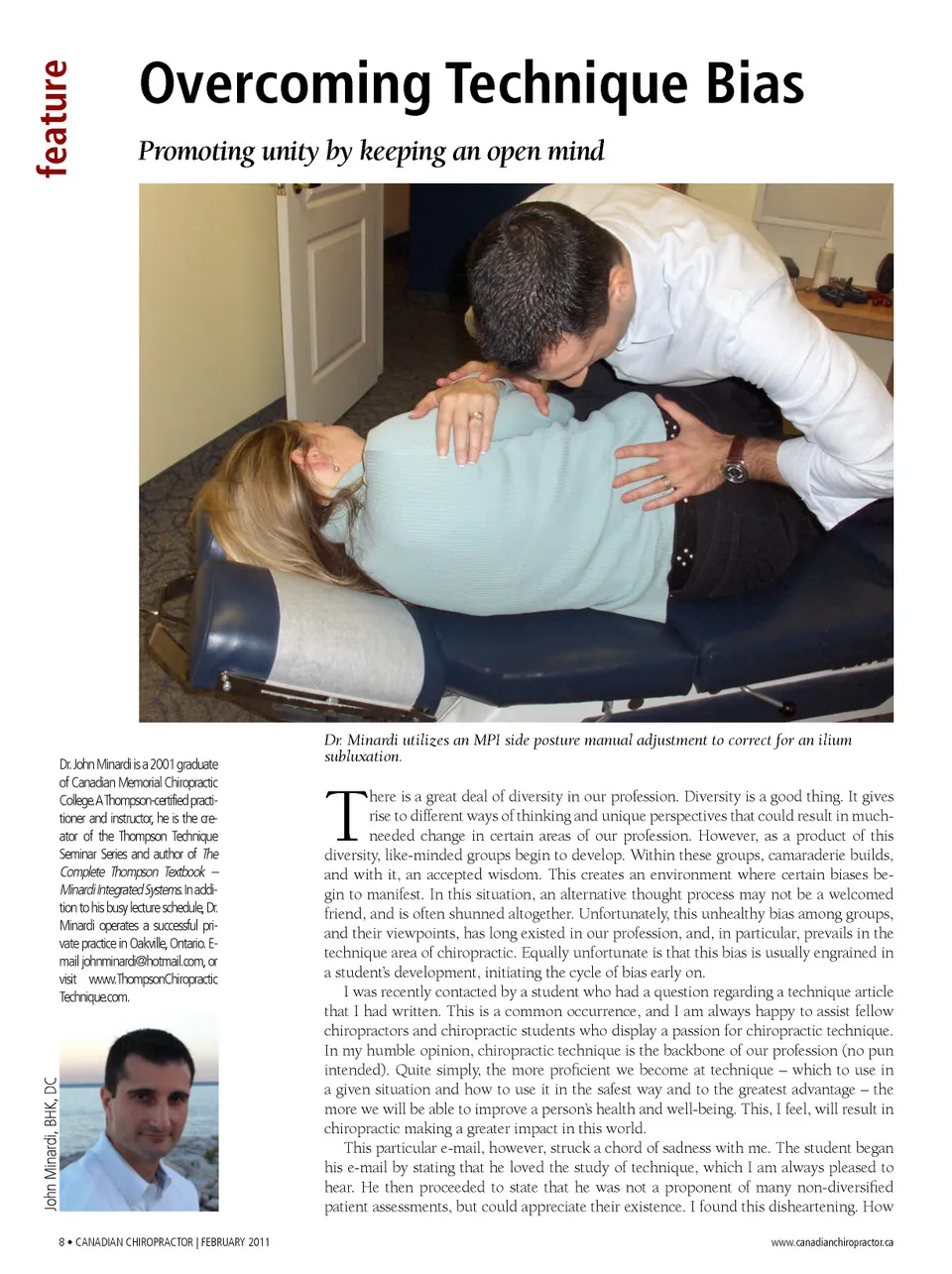
feature Overcoming Technique Bias Promoting unity by keeping an open mind Dr. John Minardi is a 2001 graduate of Canadian Memorial Chiropractic College. A Thompson-certified practi- tioner and instructor, he is the cre-ator of the Thompson Technique Seminar Series and author of The Complete Thompson Textbook – Minardi integrated Systems. in addi-tion to his busy lecture schedule, Dr. Minardi operates a successful pri-vate practice in Oakville, Ontario. E-mail [email protected], or visit www.ThompsonChiropractic Technique.com. Dr. Minardi utilizes an MPI side posture manual adjustment to correct for an ilium subluxation. T here is a great deal of diversity in our profession. Diversity is a good thing. It gives rise to different ways of thinking and unique perspectives that could result in much-needed change in certain areas of our profession. However, as a product of this diversity, like-minded groups begin to develop. Within these groups, camaraderie builds, and with it, an accepted wisdom. This creates an environment where certain biases be-gin to manifest. In this situation, an alternative thought process may not be a welcomed friend, and is often shunned altogether. Unfortunately, this unhealthy bias among groups, and their viewpoints, has long existed in our profession, and, in particular, prevails in the technique area of chiropractic. Equally unfortunate is that this bias is usually engrained in a student’s development, initiating the cycle of bias early on. I was recently contacted by a student who had a question regarding a technique article that I had written. This is a common occurrence, and I am always happy to assist fellow chiropractors and chiropractic students who display a passion for chiropractic technique. In my humble opinion, chiropractic technique is the backbone of our profession (no pun intended). Quite simply, the more proficient we become at technique – which to use in a given situation and how to use it in the safest way and to the greatest advantage – the more we will be able to improve a person’s health and well-being. This, I feel, will result in chiropractic making a greater impact in this world. This particular e-mail, however, struck a chord of sadness with me. The student began his e-mail by stating that he loved the study of technique, which I am always pleased to hear. He then proceeded to state that he was not a proponent of many non-diversified patient assessments, but could appreciate their existence. I found this disheartening. How www.canadianchiropractor.ca John Minardi, BHK, DC 8 • CANADiAN CHiROPRACTOR | FEBRUARY 2011
Chiropractic + Naturopathic Doctor February 2011: Page 8