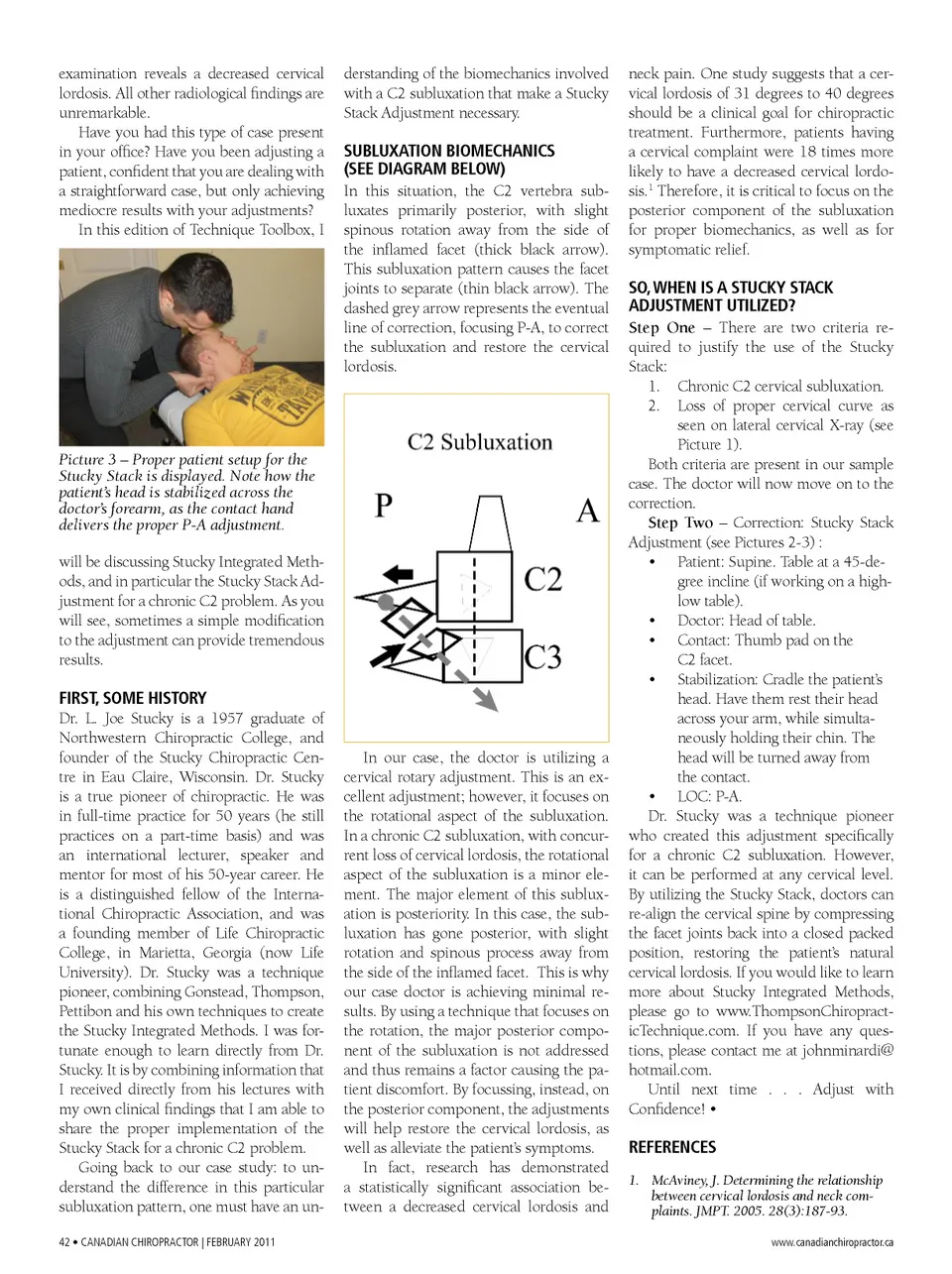
examination reveals a decreased cervical lordosis. All other radiological findings are unremarkable. Have you had this type of case present in your office? Have you been adjusting a patient, confident that you are dealing with a straightforward case, but only achieving mediocre results with your adjustments? In this edition of Technique Toolbox, I derstanding of the biomechanics involved with a C2 subluxation that make a Stucky Stack Adjustment necessary. SUBLUXATION BIOMECHANICS (SEE DIAGRAM BELOW) In this situation, the C2 vertebra sub-luxates primarily posterior, with slight spinous rotation away from the side of the inflamed facet (thick black arrow). This subluxation pattern causes the facet joints to separate (thin black arrow). The dashed grey arrow represents the eventual line of correction, focusing P-A, to correct the subluxation and restore the cervical lordosis. neck pain. One study suggests that a cer-vical lordosis of 31 degrees to 40 degrees should be a clinical goal for chiropractic treatment. Furthermore, patients having a cervical complaint were 18 times more likely to have a decreased cervical lordo-sis. 1 Therefore, it is critical to focus on the posterior component of the subluxation for proper biomechanics, as well as for symptomatic relief. Picture 3 – Proper patient setup for the Stucky Stack is displayed. Note how the patient’s head is stabilized across the doctor’s forearm, as the contact hand delivers the proper P-A adjustment. will be discussing Stucky Integrated Meth-ods, and in particular the Stucky Stack Ad-justment for a chronic C2 problem. As you will see, sometimes a simple modification to the adjustment can provide tremendous results. FIRST, SOME HISTORY Dr. L. Joe Stucky is a 1957 graduate of Northwestern Chiropractic College, and founder of the Stucky Chiropractic Cen-tre in Eau Claire, Wisconsin. Dr. Stucky is a true pioneer of chiropractic. He was in full-time practice for 50 years (he still practices on a part-time basis) and was an international lecturer, speaker and mentor for most of his 50-year career. He is a distinguished fellow of the Interna-tional Chiropractic Association, and was a founding member of Life Chiropractic College, in Marietta, Georgia (now Life University). Dr. Stucky was a technique pioneer, combining Gonstead, Thompson, Pettibon and his own techniques to create the Stucky Integrated Methods. I was for-tunate enough to learn directly from Dr. Stucky. It is by combining information that I received directly from his lectures with my own clinical findings that I am able to share the proper implementation of the Stucky Stack for a chronic C2 problem. Going back to our case study: to un-derstand the difference in this particular subluxation pattern, one must have an un-42 • CANADiAN CHiROPRACTOR | FEBRUARY 2011 In our case, the doctor is utilizing a cervical rotary adjustment. This is an ex-cellent adjustment; however, it focuses on the rotational aspect of the subluxation. In a chronic C2 subluxation, with concur-rent loss of cervical lordosis, the rotational aspect of the subluxation is a minor ele-ment. The major element of this sublux-ation is posteriority. In this case, the sub-luxation has gone posterior, with slight rotation and spinous process away from the side of the inflamed facet. This is why our case doctor is achieving minimal re-sults. By using a technique that focuses on the rotation, the major posterior compo-nent of the subluxation is not addressed and thus remains a factor causing the pa-tient discomfort. By focussing, instead, on the posterior component, the adjustments will help restore the cervical lordosis, as well as alleviate the patient’s symptoms. In fact, research has demonstrated a statistically significant association be-tween a decreased cervical lordosis and SO, WHEN IS A STUCkY STACk ADjUSTMENT UTILIZED? Step One – There are two criteria re-quired to justify the use of the Stucky Stack: 1. Chronic C2 cervical subluxation. 2. Loss of proper cervical curve as seen on lateral cervical X-ray (see Picture 1). Both criteria are present in our sample case. The doctor will now move on to the correction. Step Two – Correction: Stucky Stack Adjustment (see Pictures 2-3) : • Patient: Supine. Table at a 45-de-gree incline (if working on a high-low table). • Doctor: Head of table. • Contact: Thumb pad on the C2 facet. • Stabilization: Cradle the patient’s head. Have them rest their head across your arm, while simulta-neously holding their chin. The head will be turned away from the contact. • LOC: P-A. Dr. Stucky was a technique pioneer who created this adjustment specifically for a chronic C2 subluxation. However, it can be performed at any cervical level. By utilizing the Stucky Stack, doctors can re-align the cervical spine by compressing the facet joints back into a closed packed position, restoring the patient’s natural cervical lordosis. If you would like to learn more about Stucky Integrated Methods, please go to www.ThompsonChiropract-icTechnique.com. If you have any ques-tions, please contact me at johnminardi@ hotmail.com. Until next time . . . Adjust with Confidence! • REFERENCES 1. McAviney, J. Determining the relationship between cervical lordosis and neck com-plaints. JMPT. 2005. 28(3):187-93. www.canadianchiropractor.ca
Chiropractic + Naturopathic Doctor February 2011: Page 42