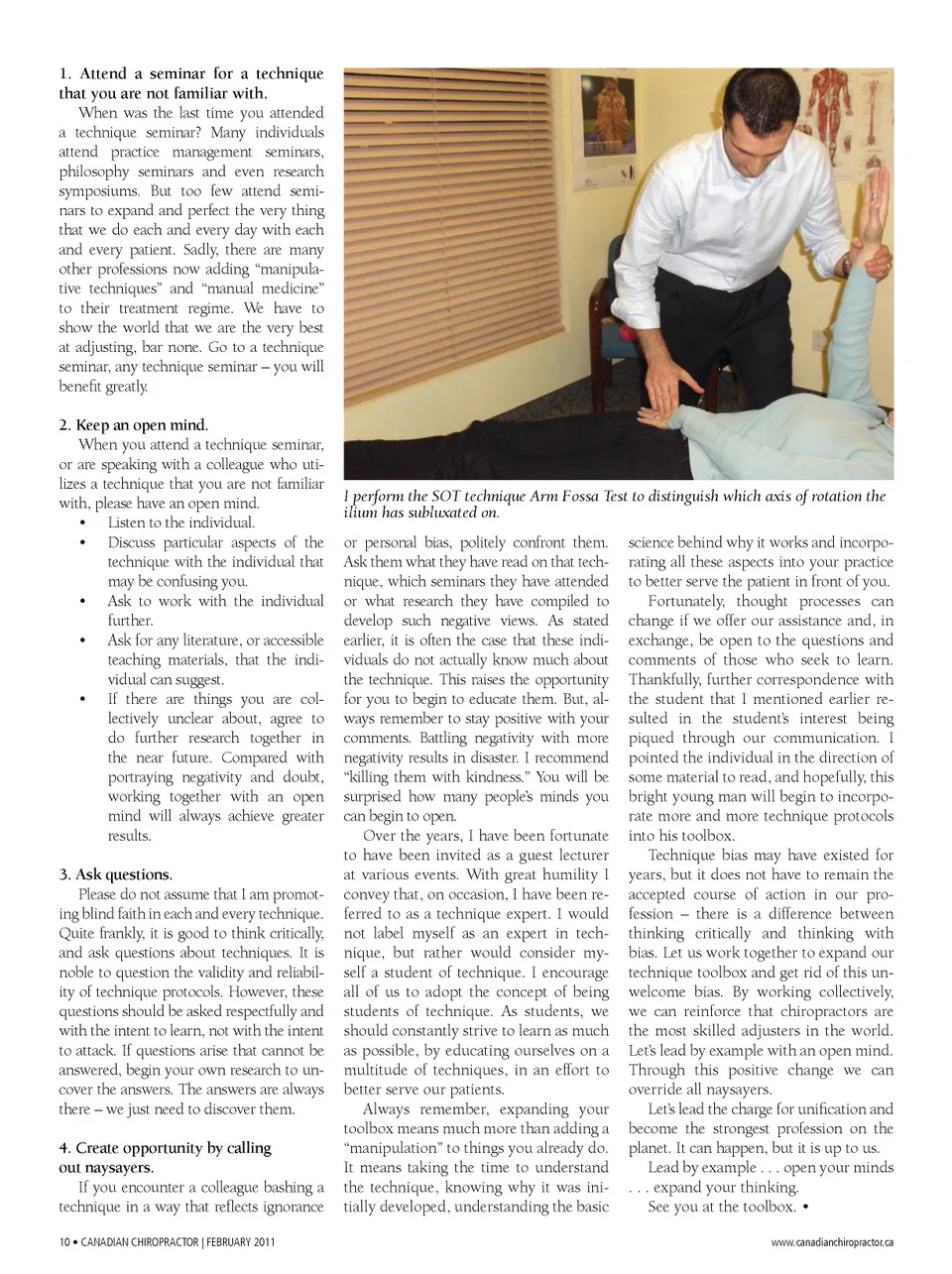
1. Attend a seminar for a technique that you are not familiar with. When was the last time you attended a technique seminar? Many individuals attend practice management seminars, philosophy seminars and even research symposiums. But too few attend semi-nars to expand and perfect the very thing that we do each and every day with each and every patient. Sadly, there are many other professions now adding “manipula-tive techniques” and “manual medicine” to their treatment regime. We have to show the world that we are the very best at adjusting, bar none. Go to a technique seminar, any technique seminar – you will benefit greatly. 2. Keep an open mind. When you attend a technique seminar, or are speaking with a colleague who uti-lizes a technique that you are not familiar with, please have an open mind. • Listen to the individual. • Discuss particular aspects of the technique with the individual that may be confusing you. • Ask to work with the individual further. • Ask for any literature, or accessible teaching materials, that the indi-vidual can suggest. • If there are things you are col-lectively unclear about, agree to do further research together in the near future. Compared with portraying negativity and doubt, working together with an open mind will always achieve greater results. 3. Ask questions. Please do not assume that I am promot-ing blind faith in each and every technique. Quite frankly, it is good to think critically, and ask questions about techniques. It is noble to question the validity and reliabil-ity of technique protocols. However, these questions should be asked respectfully and with the intent to learn, not with the intent to attack. If questions arise that cannot be answered, begin your own research to un-cover the answers. The answers are always there – we just need to discover them. 4. Create opportunity by calling out naysayers. If you encounter a colleague bashing a technique in a way that reflects ignorance 10 • CANADiAN CHiROPRACTOR | FEBRUARY 2011 I perform the SOT technique Arm Fossa Test to distinguish which axis of rotation the ilium has subluxated on. or personal bias, politely confront them. Ask them what they have read on that tech-nique, which seminars they have attended or what research they have compiled to develop such negative views. As stated earlier, it is often the case that these indi-viduals do not actually know much about the technique. This raises the opportunity for you to begin to educate them. But, al-ways remember to stay positive with your comments. Battling negativity with more negativity results in disaster. I recommend “killing them with kindness.” You will be surprised how many people’s minds you can begin to open. Over the years, I have been fortunate to have been invited as a guest lecturer at various events. With great humility I convey that, on occasion, I have been re-ferred to as a technique expert. I would not label myself as an expert in tech-nique, but rather would consider my-self a student of technique. I encourage all of us to adopt the concept of being students of technique. As students, we should constantly strive to learn as much as possible, by educating ourselves on a multitude of techniques, in an effort to better serve our patients. Always remember, expanding your toolbox means much more than adding a “manipulation” to things you already do. It means taking the time to understand the technique, knowing why it was ini-tially developed, understanding the basic science behind why it works and incorpo-rating all these aspects into your practice to better serve the patient in front of you. Fortunately, thought processes can change if we offer our assistance and, in exchange, be open to the questions and comments of those who seek to learn. Thankfully, further correspondence with the student that I mentioned earlier re-sulted in the student’s interest being piqued through our communication. I pointed the individual in the direction of some material to read, and hopefully, this bright young man will begin to incorpo-rate more and more technique protocols into his toolbox. Technique bias may have existed for years, but it does not have to remain the accepted course of action in our pro-fession – there is a difference between thinking critically and thinking with bias. Let us work together to expand our technique toolbox and get rid of this un-welcome bias. By working collectively, we can reinforce that chiropractors are the most skilled adjusters in the world. Let’s lead by example with an open mind. Through this positive change we can override all naysayers. Let’s lead the charge for unification and become the strongest profession on the planet. It can happen, but it is up to us. Lead by example . . . open your minds . . . expand your thinking. See you at the toolbox. • www.canadianchiropractor.ca
Chiropractic + Naturopathic Doctor February 2011: Page 10