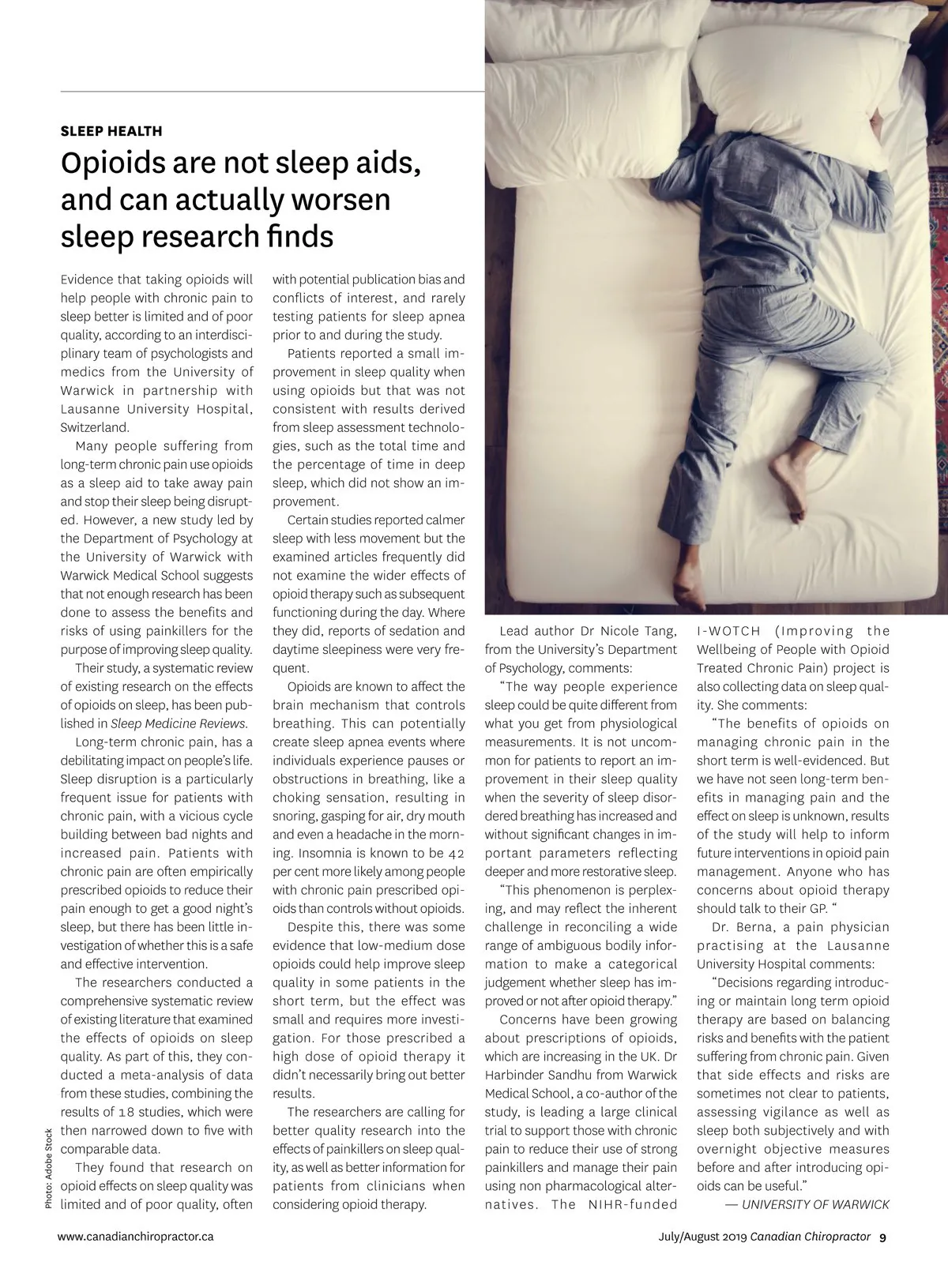
SLEEP HEALTH Opioids are not sleep aids, and can actually worsen sleep research finds Evidence that taking opioids will help people with chronic pain to sleep better is limited and of poor quality, according to an interdisci-plinary team of psychologists and medics from the University of Warwick in partnership with Lausanne University Hospital, Switzerland. Many people suffering from long-term chronic pain use opioids as a sleep aid to take away pain and stop their sleep being disrupt-ed. However, a new study led by the Department of Psychology at the University of Warwick with Warwick Medical School suggests that not enough research has been done to assess the benefits and risks of using painkillers for the purpose of improving sleep quality. Their study, a systematic review of existing research on the effects of opioids on sleep, has been pub-lished in Sleep Medicine Reviews. Long-term chronic pain, has a debilitating impact on people’s life. Sleep disruption is a particularly frequent issue for patients with chronic pain, with a vicious cycle building between bad nights and increased pain. Patients with chronic pain are often empirically prescribed opioids to reduce their pain enough to get a good night’s sleep, but there has been little in-vestigation of whether this is a safe and effective intervention. The researchers conducted a comprehensive systematic review of existing literature that examined the effects of opioids on sleep quality. As part of this, they con-ducted a meta-analysis of data from these studies, combining the results of 18 studies, which were then narrowed down to five with comparable data. They found that research on opioid effects on sleep quality was limited and of poor quality, often www.canadianchiropractor.ca with potential publication bias and conflicts of interest, and rarely testing patients for sleep apnea prior to and during the study. Patients reported a small im-provement in sleep quality when using opioids but that was not consistent with results derived from sleep assessment technolo-gies, such as the total time and the percentage of time in deep sleep, which did not show an im-provement. Certain studies reported calmer sleep with less movement but the examined articles frequently did not examine the wider effects of opioid therapy such as subsequent functioning during the day. Where they did, reports of sedation and daytime sleepiness were very fre-quent. Opioids are known to affect the brain mechanism that controls breathing. This can potentially create sleep apnea events where individuals experience pauses or obstructions in breathing, like a choking sensation, resulting in snoring, gasping for air, dry mouth and even a headache in the morn-ing. Insomnia is known to be 42 per cent more likely among people with chronic pain prescribed opi-oids than controls without opioids. Despite this, there was some evidence that low-medium dose opioids could help improve sleep quality in some patients in the short term, but the effect was small and requires more investi-gation. For those prescribed a high dose of opioid therapy it didn’t necessarily bring out better results. The researchers are calling for better quality research into the effects of painkillers on sleep qual-ity, as well as better information for patients from clinicians when considering opioid therapy. Lead author Dr Nicole Tang, from the University’s Department of Psychology, comments: “The way people experience sleep could be quite different from what you get from physiological measurements. It is not uncom-mon for patients to report an im-provement in their sleep quality when the severity of sleep disor-dered breathing has increased and without significant changes in im-portant parameters reflecting deeper and more restorative sleep. “This phenomenon is perplex-ing, and may reflect the inherent challenge in reconciling a wide range of ambiguous bodily infor-mation to make a categorical judgement whether sleep has im-proved or not after opioid therapy.” Concerns have been growing about prescriptions of opioids, which are increasing in the UK. Dr Harbinder Sandhu from Warwick Medical School, a co-author of the study, is leading a large clinical trial to support those with chronic pain to reduce their use of strong painkillers and manage their pain using non pharmacological alter-natives. The NIHR-funded I-WOTCH (Improving the Wellbeing of People with Opioid Treated Chronic Pain) project is also collecting data on sleep qual-ity. She comments: “The benefits of opioids on managing chronic pain in the short term is well-evidenced. But we have not seen long-term ben-efits in managing pain and the effect on sleep is unknown, results of the study will help to inform future interventions in opioid pain management. Anyone who has concerns about opioid therapy should talk to their GP. “ Dr. Berna, a pain physician practising at the Lausanne University Hospital comments: “Decisions regarding introduc-ing or maintain long term opioid therapy are based on balancing risks and benefits with the patient suffering from chronic pain. Given that side effects and risks are sometimes not clear to patients, assessing vigilance as well as sleep both subjectively and with overnight objective measures before and after introducing opi-oids can be useful.” — UNIVERSITY OF WARWICK Photo: Adobe Stock July/August 2019 Canadian Chiropractor 9
Chiropractic + Naturopathic Doctor JulyAugust 2019: Page 9