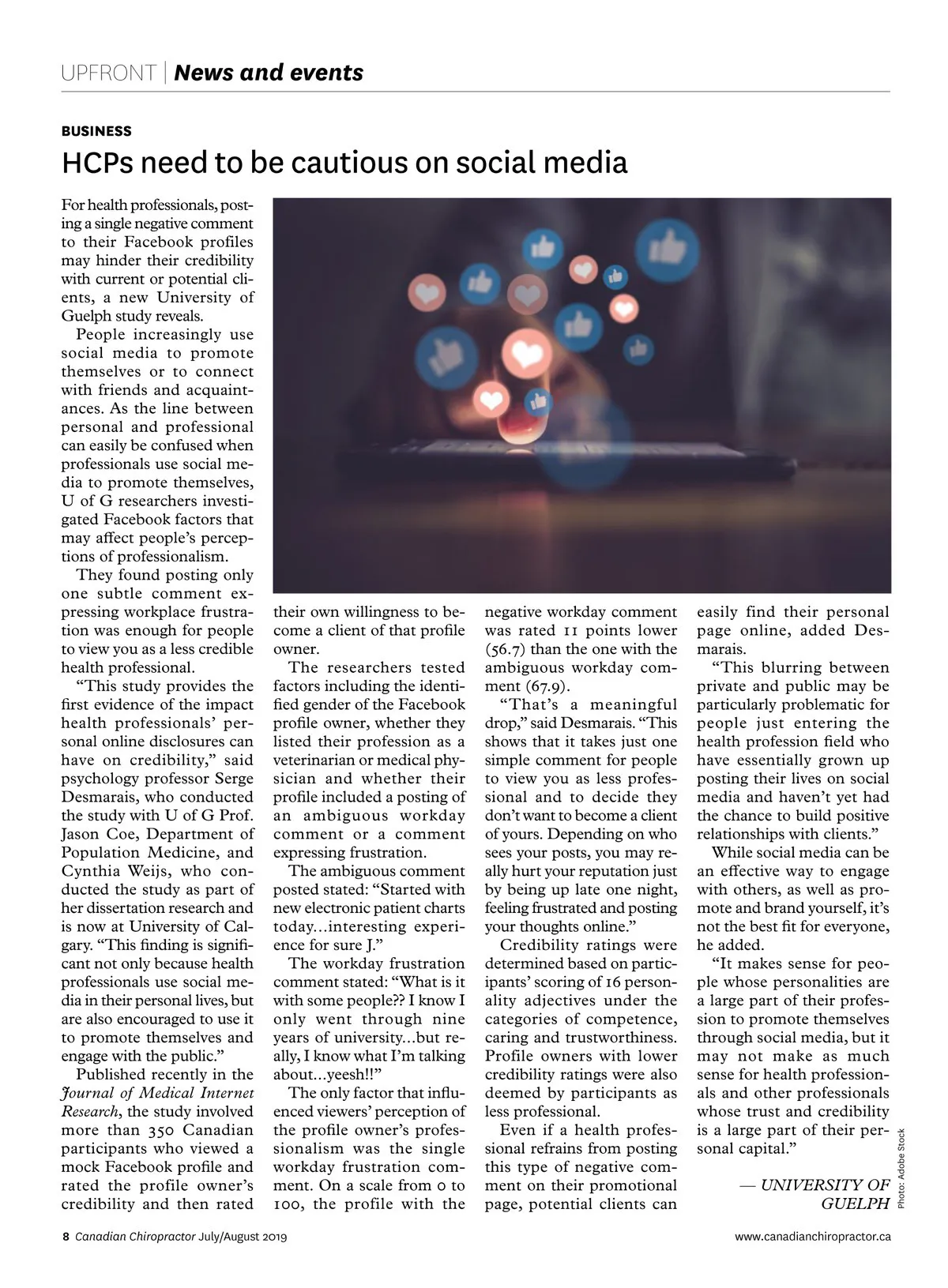
UPFRONT | News and events BUSINESS HCPs need to be cautious on social media For health professionals, post-ing a single negative comment to their Facebook profiles may hinder their credibility with current or potential cli-ents, a new University of Guelph study reveals. People increasingly use social media to promote themselves or to connect with friends and acquaint-ances. As the line between personal and professional can easily be confused when professionals use social me-dia to promote themselves, U of G researchers investi-gated Facebook factors that may affect people’s percep-tions of professionalism. They found posting only one subtle comment ex-pressing workplace frustra-tion was enough for people to view you as a less credible health professional. “This study provides the first evidence of the impact health professionals’ per-sonal online disclosures can have on credibility,” said psychology professor Serge Desmarais, who conducted the study with U of G Prof. Jason Coe, Department of Population Medicine, and Cynthia Weijs, who con-ducted the study as part of her dissertation research and is now at University of Cal-gary. “This finding is signifi-cant not only because health professionals use social me-dia in their personal lives, but are also encouraged to use it to promote themselves and engage with the public.” Published recently in the Journal of Medical Internet Research , the study involved more than 350 Canadian participants who viewed a mock Facebook profile and rated the profile owner’s credibility and then rated their own willingness to be-come a client of that profile owner. The researchers tested factors including the identi-fied gender of the Facebook profile owner, whether they listed their profession as a veterinarian or medical phy-sician and whether their profile included a posting of an ambiguous workday comment or a comment expressing frustration. The ambiguous comment posted stated: “Started with new electronic patient charts today...interesting experi-ence for sure J.” The workday frustration comment stated: “What is it with some people?? I know I only went through nine years of university...but re-ally, I know what I’m talking about...yeesh!!” The only factor that influ-enced viewers’ perception of the profile owner’s profes-sionalism was the single workday frustration com-ment. On a scale from 0 to 100, the profile with the negative workday comment was rated 11 points lower (56.7) than the one with the ambiguous workday com-ment (67.9). “That’s a meaningful drop,” said Desmarais. “This shows that it takes just one simple comment for people to view you as less profes-sional and to decide they don’t want to become a client of yours. Depending on who sees your posts, you may re-ally hurt your reputation just by being up late one night, feeling frustrated and posting your thoughts online.” Credibility ratings were determined based on partic-ipants’ scoring of 16 person-ality adjectives under the categories of competence, caring and trustworthiness. Profile owners with lower credibility ratings were also deemed by participants as less professional. Even if a health profes-sional refrains from posting this type of negative com-ment on their promotional page, potential clients can — UNIVERSITY OF GUELPH www.canadianchiropractor.ca 8 Canadian Chiropractor July/August 2019 Photo: Adobe Stock easily find their personal page online, added Des-marais. “This blurring between private and public may be particularly problematic for people just entering the health profession field who have essentially grown up posting their lives on social media and haven’t yet had the chance to build positive relationships with clients.” While social media can be an effective way to engage with others, as well as pro-mote and brand yourself, it’s not the best fit for everyone, he added. “It makes sense for peo-ple whose personalities are a large part of their profes-sion to promote themselves through social media, but it may not make as much sense for health profession-als and other professionals whose trust and credibility is a large part of their per-sonal capital.”
Chiropractic + Naturopathic Doctor JulyAugust 2019: Page 8