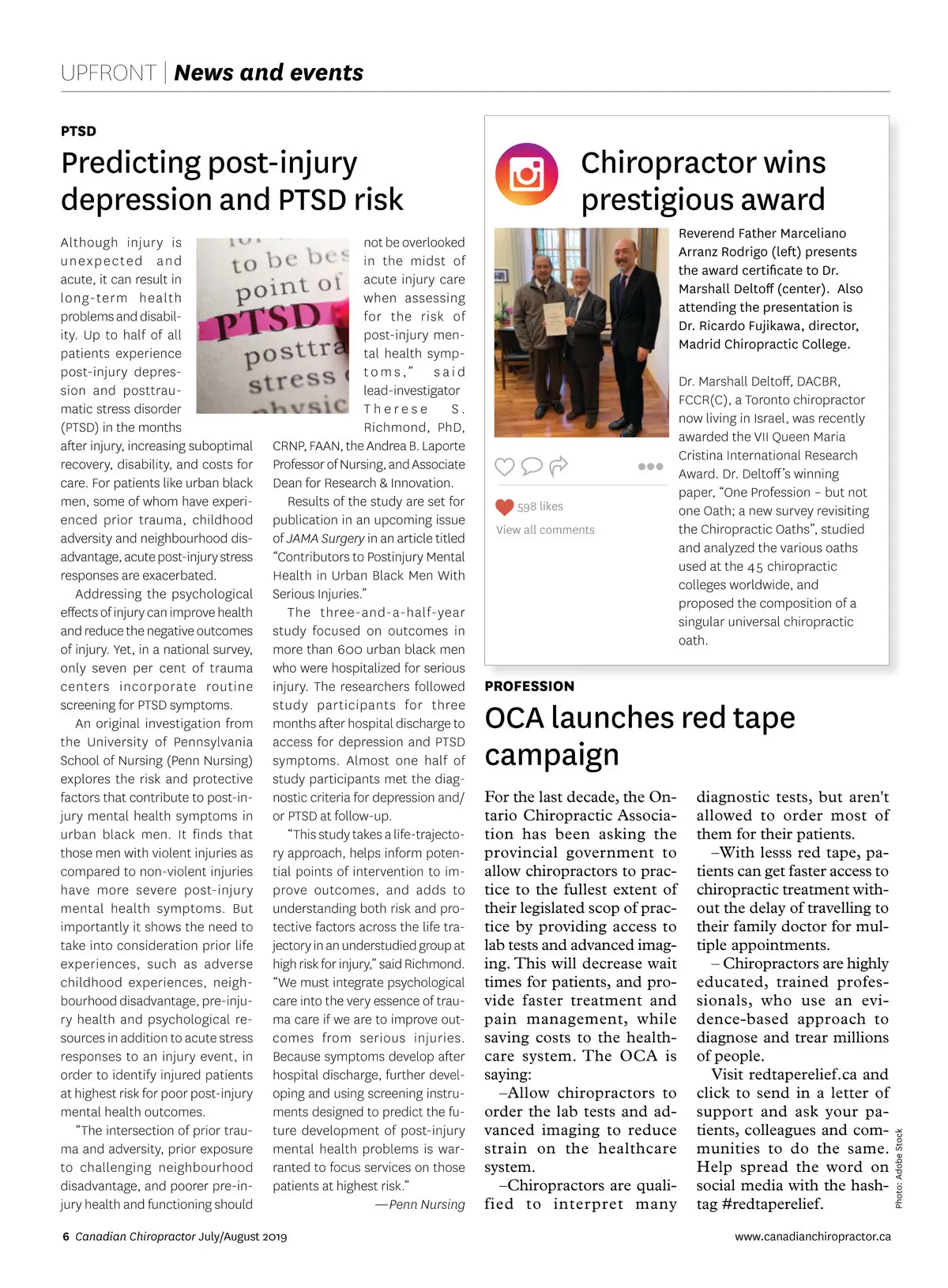
UPFRONT | News and events PTSD Predicting post-injury depression and PTSD risk Although injury is unexpected and acute, it can result in long-term health problems and disabil-ity. Up to half of all patients experience post-injury depres-sion and posttrau-matic stress disorder (PTSD) in the months after injury, increasing suboptimal recovery, disability, and costs for care. For patients like urban black men, some of whom have experi-enced prior trauma, childhood adversity and neighbourhood dis-advantage, acute post-injury stress responses are exacerbated. Addressing the psychological effects of injury can improve health and reduce the negative outcomes of injury. Yet, in a national survey, only seven per cent of trauma centers incorporate routine screening for PTSD symptoms. An original investigation from the University of Pennsylvania School of Nursing (Penn Nursing) explores the risk and protective factors that contribute to post-in-jury mental health symptoms in urban black men. It finds that those men with violent injuries as compared to non-violent injuries have more severe post-injury mental health symptoms. But importantly it shows the need to take into consideration prior life experiences, such as adverse childhood experiences, neigh-bourhood disadvantage, pre-inju-ry health and psychological re-sources in addition to acute stress responses to an injury event, in order to identify injured patients at highest risk for poor post-injury mental health outcomes. “The intersection of prior trau-ma and adversity, prior exposure to challenging neighbourhood disadvantage, and poorer pre-in-jury health and functioning should not be overlooked in the midst of acute injury care when assessing for the risk of post-injury men-tal health symp-toms,” said lead-investigator Therese S. Richmond, PhD, CRNP, FAAN, the Andrea B. Laporte Professor of Nursing, and Associate Dean for Research & Innovation. Results of the study are set for publication in an upcoming issue of JAMA Surgery in an article titled “Contributors to Postinjury Mental Health in Urban Black Men With Serious Injuries.” The three-and-a-half-year study focused on outcomes in more than 600 urban black men who were hospitalized for serious injury. The researchers followed study participants for three months after hospital discharge to access for depression and PTSD symptoms. Almost one half of study participants met the diag-nostic criteria for depression and/ or PTSD at follow-up. “This study takes a life-trajecto-ry approach, helps inform poten-tial points of intervention to im-prove outcomes, and adds to understanding both risk and pro-tective factors across the life tra-jectory in an understudied group at high risk for injury,” said Richmond. “We must integrate psychological care into the very essence of trau-ma care if we are to improve out-comes from serious injuries. Because symptoms develop after hospital discharge, further devel-oping and using screening instru-ments designed to predict the fu-ture development of post-injury mental health problems is war-ranted to focus services on those patients at highest risk.” —Penn Nursing Chiropractor wins prestigious award Reverend Father Marceliano Arranz Rodrigo (left) presents the award certificate to Dr. Marshall Deltoff (center). Also attending the presentation is Dr. Ricardo Fujikawa, director, Madrid Chiropractic College. Dr. Marshall Deltoff, DACBR, FCCR(C), a Toronto chiropractor now living in Israel, was recently awarded the VII Queen Maria Cristina International Research Award. Dr. Deltoff’s winning paper, “One Profession – but not one Oath; a new survey revisiting the Chiropractic Oaths”, studied and analyzed the various oaths used at the 45 chiropractic colleges worldwide, and proposed the composition of a singular universal chiropractic oath. 598 likes View all comments PROFESSION OCA launches red tape campaign For the last decade, the On-tario Chiropractic Associa-tion has been asking the provincial government to allow chiropractors to prac-tice to the fullest extent of their legislated scop of prac-tice by providing access to lab tests and advanced imag-ing. This will decrease wait times for patients, and pro-vide faster treatment and pain management, while saving costs to the health-care system. The OCA is saying: –Allow chiropractors to order the lab tests and ad-vanced imaging to reduce strain on the healthcare system. –Chiropractors are quali-fied to interpret many diagnostic tests, but aren't allowed to order most of them for their patients. –With lesss red tape, pa-tients can get faster access to chiropractic treatment with-out the delay of travelling to their family doctor for mul-tiple appointments. – Chiropractors are highly educated, trained profes-sionals, who use an evi-dence-based approach to diagnose and trear millions of people. Visit redtaperelief.ca and click to send in a letter of support and ask your pa-tients, colleagues and com-munities to do the same. Help spread the word on social media with the hash-tag #redtaperelief. www.canadianchiropractor.ca 6 Canadian Chiropractor July/August 2019 Photo: Adobe Stock
Chiropractic + Naturopathic Doctor JulyAugust 2019: Page 6