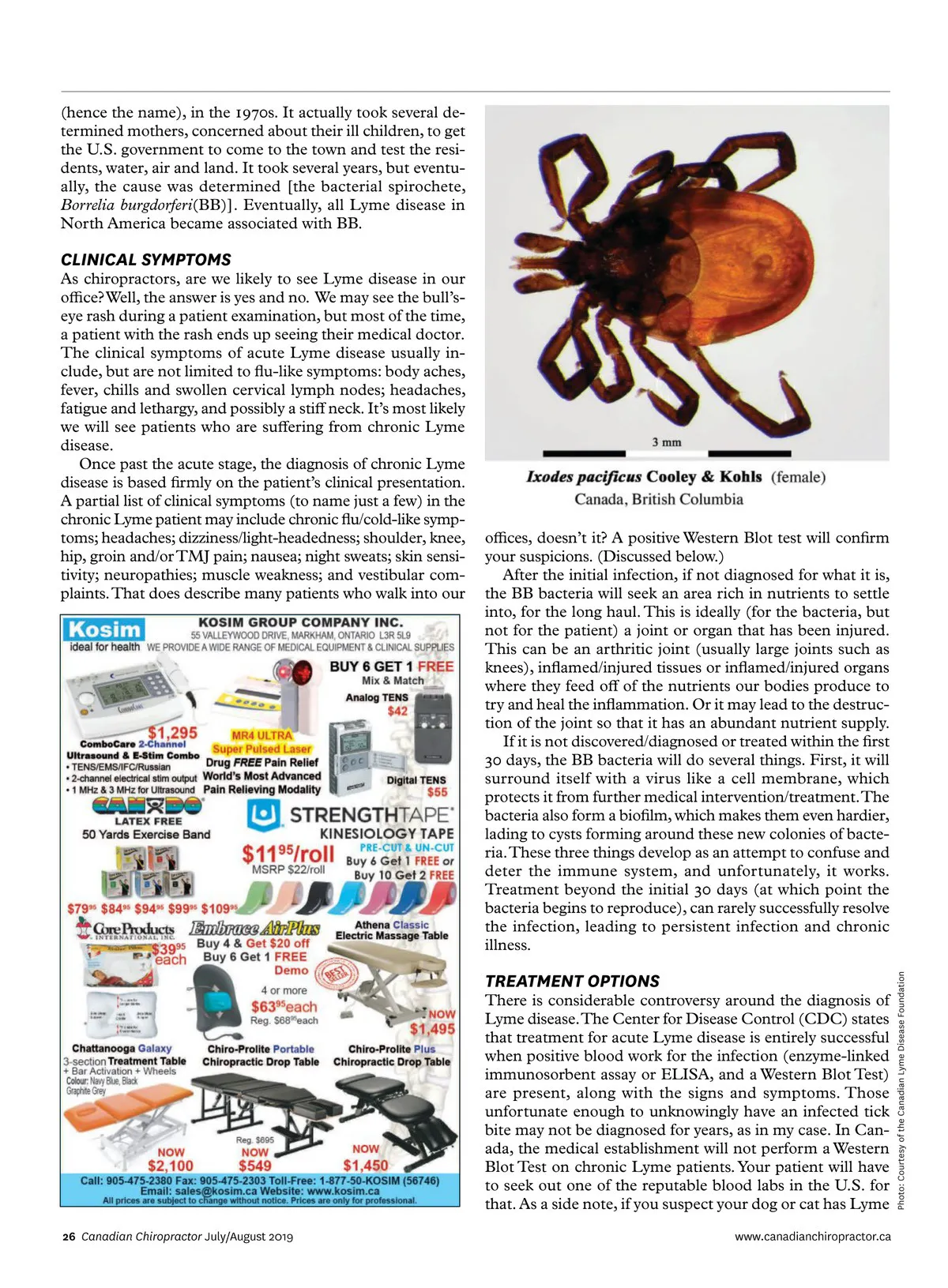
disease you can take them to any veterinary doctor in Can-ada, and they will perform a Western Blot test for Lyme disease, but humans still can’t be tested here. The main reason that the Canadian medical establishment doesn’t currently acknowledge chronic Lyme disease is that the CMA follows the CDC guidelines that state that chronic Lyme disease is rare, though the American College of Rheumatol-ogy refers to chronic/persistent Lyme disease as post Lyme disease syndrome (or PLDS), suggesting that it presents with its own array of complications. Literature in the medical realm indicates that long-term antibiotic use for PLDS is unwise and puts the patient at risk for superbugs. The treatment for persistent Lyme is as diverse and varied as the treatment for migraines is in our chiropractic offices. At last count, I have consulted 15 different practitioners in an attempt to treat my persistent Lyme disease. I have followed each protocol, with little success. Rather than list the treatment alternatives available for chronic Lyme, I would direct you to the treatment guidelines for chronic/persistent Lyme found on the International Lyme and Associated Disorders website (ILADS.org). ILADS takes issues with the CDC stand on persistent Lyme and educates practitioners in this field, pro-ducing specialists called Lyme literate MDs (LLMD) and Lyme literate NDs (LLND). I recommend that ALL ticks be removed from two-legged (or four-legged, in my case) patients be sent away for testing. Most of us have read at least a little about the prevention of “The treatment for persistent Lyme is as diverse as the treatment for migraines is in our [offices]” Lyme disease, which in general refers to avoiding areas in-habited by ticks, like areas with tall grasses and brush. Prevention also lists the use of deet insecticides, wearing light coloured clothing, long sleeves and tucking your pants into your socks when outdoors. In reality, ticks can be any-where – even letting your grass grow too long in your back-yard and having several bird feeders (since migrating birds are the source of southern infected ticks) puts you at a higher risk for a tick bite. It’s also been said that Lyme disease is the next epidemic. In a 2005 study published in Ecohealth , researchers examined the effects of climate change and Lyme disease risk. They determined that black-legged ticks (which transmit Lyme disease) would see a 213 per cent increase in suitable habitats in Canada by the 2080s. Let’s see if we can change this Lyme disease risk. CHIROPRACTIC TECHNIQUE: PRINCIPLES AND PROCEDURES, 3RD ED. _buoru-1ࢼ1$;1_mbt;ĶƐu7�b;7bࢼom l-h;v;vv;mঞ-Ѵruo1;7u;v;-v|o m7 m uv| m7; |-m7 m7 7 -m7ruob7;v-u-ঞom-Ѵ;=ou|_;buv;ĺ )ub;m0$_ol-v�d;ĺ;u]l-mmķ ķ�d;ķ-m7 -b7�f;ĺe;;|;uvomķ ķ --m m7 m 7 0-1h;70|_;Ѵ-|;v|u;v;-u1_v|7b;vķ|_bv0;v|v;ѴѴ;u7;v1ub0;v|_;0-vb1r ru ub bm1brѴ Ѵ;v m;;7;7|o;-Ѵ-|;ķv;Ѵ;1|ķ-m7-rrѴvr;1bC1-7fvঞ;ruo1;7u;vĺ )b|_-u;b;o=1_buoru-1ঞ1_bv|ouķ7;|-bѴ;77;v1ubrঞomvo=fobm|;-lbm m--ঞom m -m7-7fvঞ;|;1_mbt;v=ou|_;vrbm;ķr;Ѵbvķ-m7;|u;lbঞ;vķ-m7-1ol ol l r-m r bo om �b;oѴ;;0vb|;b|__oŊ|ob7;ovķ|_bv0oohbv-lv|Ŋ_-;u;=;u;m1; ;= =o ou v|7;m|v -m7 1Ѵbmb1b-mvĺ ŪƑƑƓĺƖƔ|;lŲƏƒƑƒƏƓƖѵƖѵ Ѷƕƕ҃Ƒѵƕ҃ƒƓƕƒ annexbookstore.com www.canadianchiropractor.ca July/August 2019 Canadian Chiropractor 27
Chiropractic + Naturopathic Doctor JulyAugust 2019: Page 27