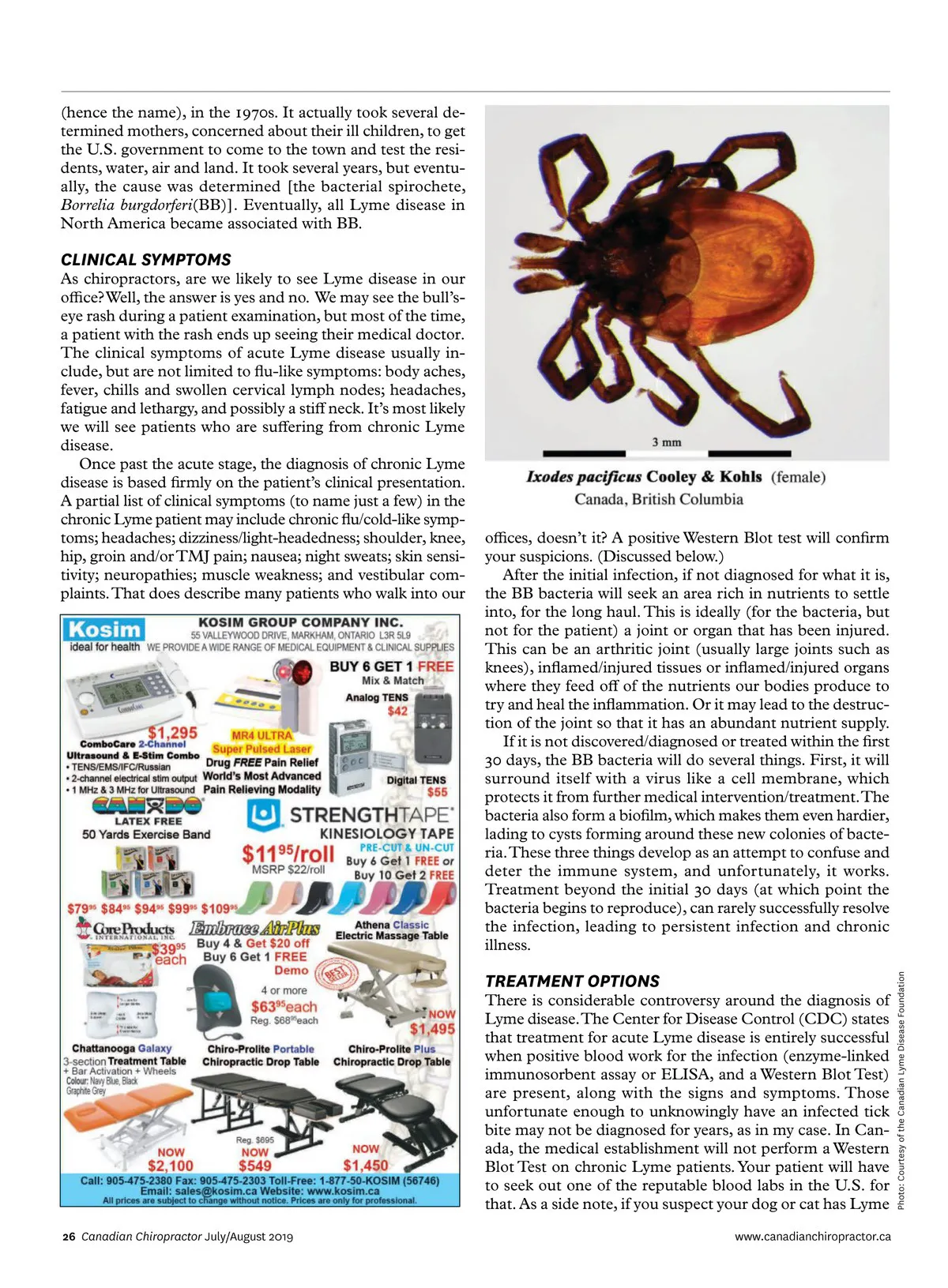
(hence the name), in the 1970s. It actually took several de-termined mothers, concerned about their ill children, to get the U.S. government to come to the town and test the resi-dents, water, air and land. It took several years, but eventu-ally, the cause was determined [the bacterial spirochete, Borrelia burgdorferi (BB)]. Eventually, all Lyme disease in North America became associated with BB. CLINICAL SYMPTOMS As chiropractors, are we likely to see Lyme disease in our office? Well, the answer is yes and no. We may see the bull’s-eye rash during a patient examination, but most of the time, a patient with the rash ends up seeing their medical doctor. The clinical symptoms of acute Lyme disease usually in-clude, but are not limited to flu-like symptoms: body aches, fever, chills and swollen cervical lymph nodes; headaches, fatigue and lethargy, and possibly a stiff neck. It’s most likely we will see patients who are suffering from chronic Lyme disease. Once past the acute stage, the diagnosis of chronic Lyme disease is based firmly on the patient’s clinical presentation. A partial list of clinical symptoms (to name just a few) in the chronic Lyme patient may include chronic flu/cold-like symp-toms; headaches; dizziness/light-headedness; shoulder, knee, hip, groin and/or TMJ pain; nausea; night sweats; skin sensi-tivity; neuropathies; muscle weakness; and vestibular com-plaints. That does describe many patients who walk into our offices, doesn’t it? A positive Western Blot test will confirm your suspicions. (Discussed below.) After the initial infection, if not diagnosed for what it is, the BB bacteria will seek an area rich in nutrients to settle into, for the long haul. This is ideally (for the bacteria, but not for the patient) a joint or organ that has been injured. This can be an arthritic joint (usually large joints such as knees), inflamed/injured tissues or inflamed/injured organs where they feed off of the nutrients our bodies produce to try and heal the inflammation. Or it may lead to the destruc-tion of the joint so that it has an abundant nutrient supply. If it is not discovered/diagnosed or treated within the first 30 days, the BB bacteria will do several things. First, it will surround itself with a virus like a cell membrane, which protects it from further medical intervention/treatment. The bacteria also form a biofilm, which makes them even hardier, lading to cysts forming around these new colonies of bacte-ria. These three things develop as an attempt to confuse and deter the immune system, and unfortunately, it works. Treatment beyond the initial 30 days (at which point the bacteria begins to reproduce), can rarely successfully resolve the infection, leading to persistent infection and chronic illness. There is considerable controversy around the diagnosis of Lyme disease. The Center for Disease Control (CDC) states that treatment for acute Lyme disease is entirely successful when positive blood work for the infection (enzyme-linked immunosorbent assay or ELISA, and a Western Blot Test) are present, along with the signs and symptoms. Those unfortunate enough to unknowingly have an infected tick bite may not be diagnosed for years, as in my case. In Can-ada, the medical establishment will not perform a Western Blot Test on chronic Lyme patients. Your patient will have to seek out one of the reputable blood labs in the U.S. for that. As a side note, if you suspect your dog or cat has Lyme Photo: Courtesy of the Canadian Lyme Disease Foundation TREATMENT OPTIONS 26 Canadian Chiropractor July/August 2019 CC_Kosim_April19_CSA.indd 1 2019-03-06 10:07 AM www.canadianchiropractor.ca
Chiropractic + Naturopathic Doctor JulyAugust 2019: Page 26