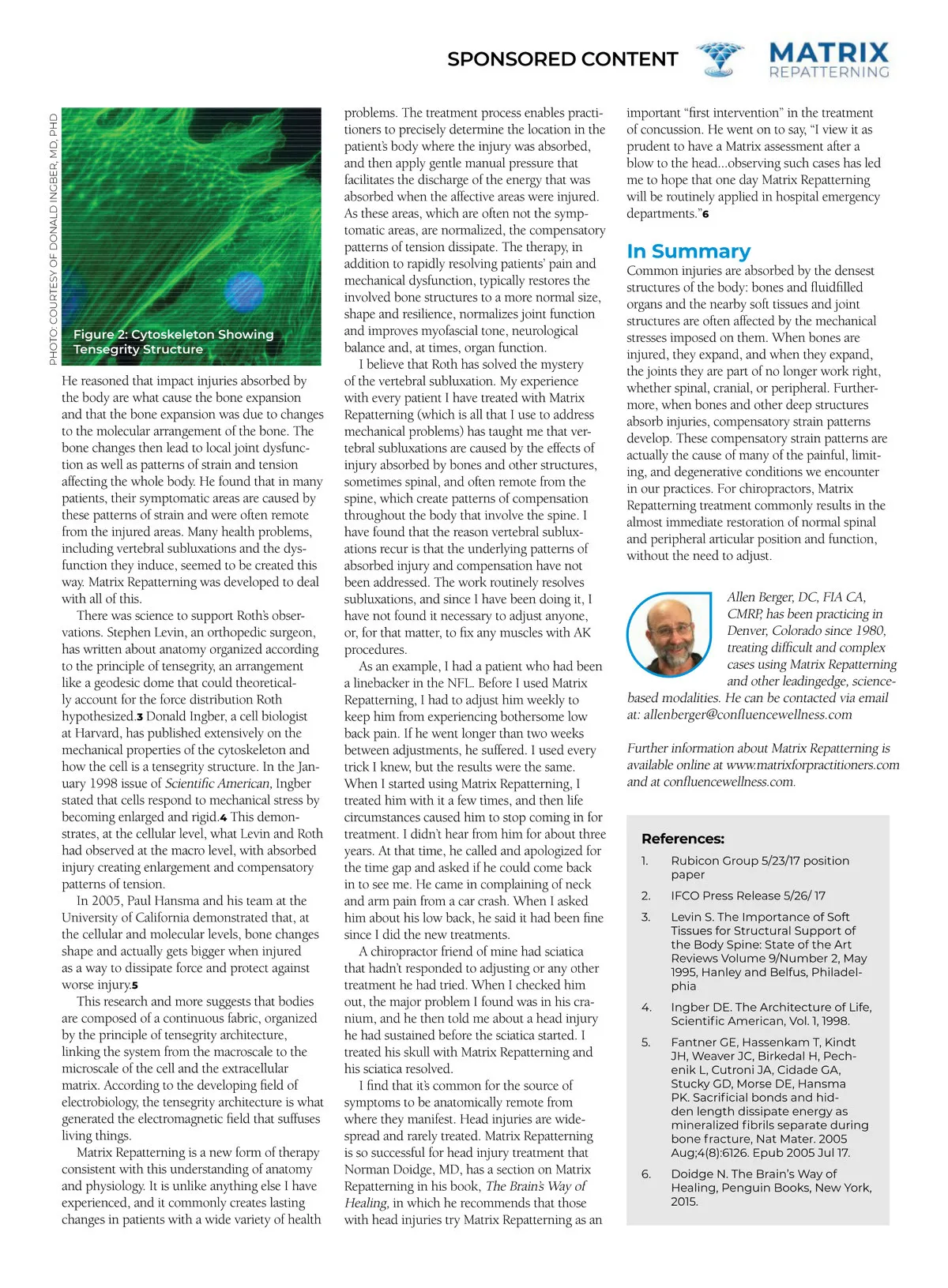
SPONSORED CONTENT problems. The treatment process enables practi-tioners to precisely determine the location in the patient’s body where the injury was absorbed, and then apply gentle manual pressure that facilitates the discharge of the energy that was absorbed when the affective areas were injured. As these areas, which are often not the symp-tomatic areas, are normalized, the compensatory patterns of tension dissipate. The therapy, in addition to rapidly resolving patients’ pain and mechanical dysfunction, typically restores the involved bone structures to a more normal size, shape and resilience, normalizes joint function and improves myofascial tone, neurological balance and, at times, organ function. I believe that Roth has solved the mystery of the vertebral subluxation. My experience with every patient I have treated with Matrix Repatterning (which is all that I use to address mechanical problems) has taught me that ver-tebral subluxations are caused by the effects of injury absorbed by bones and other structures, sometimes spinal, and often remote from the spine, which create patterns of compensation throughout the body that involve the spine. I have found that the reason vertebral sublux-ations recur is that the underlying patterns of absorbed injury and compensation have not been addressed. The work routinely resolves subluxations, and since I have been doing it, I have not found it necessary to adjust anyone, or, for that matter, to fix any muscles with AK procedures. As an example, I had a patient who had been a linebacker in the NFL. Before I used Matrix Repatterning, I had to adjust him weekly to keep him from experiencing bothersome low back pain. If he went longer than two weeks between adjustments, he suffered. I used every trick I knew, but the results were the same. When I started using Matrix Repatterning, I treated him with it a few times, and then life circumstances caused him to stop coming in for treatment. I didn’t hear from him for about three years. At that time, he called and apologized for the time gap and asked if he could come back in to see me. He came in complaining of neck and arm pain from a car crash. When I asked him about his low back, he said it had been fine since I did the new treatments. A chiropractor friend of mine had sciatica that hadn’t responded to adjusting or any other treatment he had tried. When I checked him out, the major problem I found was in his cra-nium, and he then told me about a head injury he had sustained before the sciatica started. I treated his skull with Matrix Repatterning and his sciatica resolved. I find that it’s common for the source of symptoms to be anatomically remote from where they manifest. Head injuries are wide-spread and rarely treated. Matrix Repatterning is so successful for head injury treatment that Norman Doidge, MD, has a section on Matrix Repatterning in his book, The Brain’s Way of Healing, in which he recommends that those with head injuries try Matrix Repatterning as an PHOTO: COURTESY OF DONALD INGBER, MD, PHD important “first intervention” in the treatment of concussion. He went on to say, “I view it as prudent to have a Matrix assessment after a blow to the head...observing such cases has led me to hope that one day Matrix Repatterning will be routinely applied in hospital emergency departments.” 6 In Summary Figure 2: Cytoskeleton Showing Tensegrity Structure He reasoned that impact injuries absorbed by the body are what cause the bone expansion and that the bone expansion was due to changes to the molecular arrangement of the bone. The bone changes then lead to local joint dysfunc-tion as well as patterns of strain and tension affecting the whole body. He found that in many patients, their symptomatic areas are caused by these patterns of strain and were often remote from the injured areas. Many health problems, including vertebral subluxations and the dys-function they induce, seemed to be created this way. Matrix Repatterning was developed to deal with all of this. There was science to support Roth’s obser-vations. Stephen Levin, an orthopedic surgeon, has written about anatomy organized according to the principle of tensegrity, an arrangement like a geodesic dome that could theoretical-ly account for the force distribution Roth hypothesized. 3 Donald Ingber, a cell biologist at Harvard, has published extensively on the mechanical properties of the cytoskeleton and how the cell is a tensegrity structure. In the Jan-uary 1998 issue of Scientific American, Ingber stated that cells respond to mechanical stress by becoming enlarged and rigid. 4 This demon-strates, at the cellular level, what Levin and Roth had observed at the macro level, with absorbed injury creating enlargement and compensatory patterns of tension. In 2005, Paul Hansma and his team at the University of California demonstrated that, at the cellular and molecular levels, bone changes shape and actually gets bigger when injured as a way to dissipate force and protect against worse injury. 5 This research and more suggests that bodies are composed of a continuous fabric, organized by the principle of tensegrity architecture, linking the system from the macroscale to the microscale of the cell and the extracellular matrix. According to the developing field of electrobiology, the tensegrity architecture is what generated the electromagnetic field that suffuses living things. Matrix Repatterning is a new form of therapy consistent with this understanding of anatomy and physiology. It is unlike anything else I have experienced, and it commonly creates lasting changes in patients with a wide variety of health Common injuries are absorbed by the densest structures of the body: bones and fluidfilled organs and the nearby soft tissues and joint structures are often affected by the mechanical stresses imposed on them. When bones are injured, they expand, and when they expand, the joints they are part of no longer work right, whether spinal, cranial, or peripheral. Further-more, when bones and other deep structures absorb injuries, compensatory strain patterns develop. These compensatory strain patterns are actually the cause of many of the painful, limit-ing, and degenerative conditions we encounter in our practices. For chiropractors, Matrix Repatterning treatment commonly results in the almost immediate restoration of normal spinal and peripheral articular position and function, without the need to adjust. Allen Berger, DC, FIA CA, CMRP, has been practicing in Denver, Colorado since 1980, treating difficult and complex cases using Matrix Repatterning and other leading edge, science-based modalities. He can be contacted via email at: [email protected] Further information about Matrix Repatterning is available online at www.matrixforpractitioners.com and at confluencewellness.com. References: 1. 2. 3. Rubicon Group 5/23/17 position paper IFCO Press Release 5/26/ 17 Levin S. The Importance of Soft Tissues for Structural Sup port of the Body Spine: State of the Art Reviews Volume 9/Number 2, May 1995, Hanley and Belfus, Philadel-phia Ingber DE. The Architecture of Life, Scientific American, Vol. 1, 1998. Fantner GE, Hassenkam T, Kindt JH, Weaver JC, Birkedal H, Pech-enik L, Cutroni JA, Cidade GA, Stucky GD, Morse DE, Hansma PK. Sacrificial bonds and hid -den length dissi pate energy as mineralized fibrils separate during bone frac ture, Nat Mater. 2005 Aug;4(8):612 6. Epub 2005 Jul 17. Doidge N. The Brain’s Way of Healing, Penguin Books, New York, 2015. 4. 5. 6.
Chiropractic + Naturopathic Doctor JulyAugust 2019: Page 21