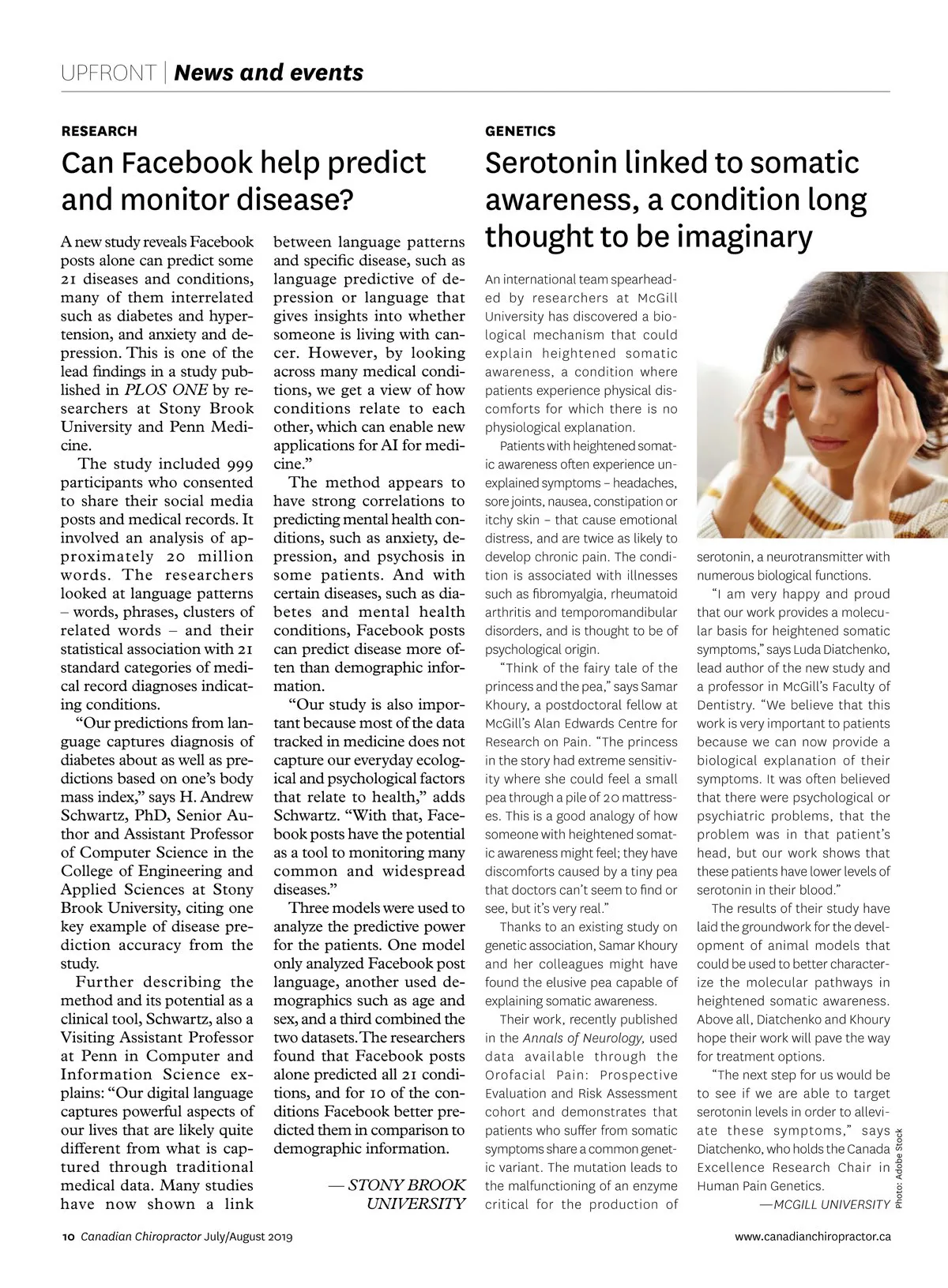
UPFRONT | News and events RESEARCH Can Facebook help predict and monitor disease? A new study reveals Facebook posts alone can predict some 21 diseases and conditions, many of them interrelated such as diabetes and hyper-tension, and anxiety and de-pression. This is one of the lead findings in a study pub-lished in PLOS ONE by re-searchers at Stony Brook University and Penn Medi-cine. The study included 999 participants who consented to share their social media posts and medical records. It involved an analysis of ap-proximately 20 million words. The researchers looked at language patterns – words, phrases, clusters of related words – and their statistical association with 21 standard categories of medi-cal record diagnoses indicat-ing conditions. “Our predictions from lan-guage captures diagnosis of diabetes about as well as pre-dictions based on one’s body mass index,” says H. Andrew Schwartz, PhD, Senior Au-thor and Assistant Professor of Computer Science in the College of Engineering and Applied Sciences at Stony Brook University, citing one key example of disease pre-diction accuracy from the study. Further describing the method and its potential as a clinical tool, Schwartz, also a Visiting Assistant Professor at Penn in Computer and Information Science ex-plains: “Our digital language captures powerful aspects of our lives that are likely quite different from what is cap-tured through traditional medical data. Many studies have now shown a link between language patterns and specific disease, such as language predictive of de-pression or language that gives insights into whether someone is living with can-cer. However, by looking across many medical condi-tions, we get a view of how conditions relate to each other, which can enable new applications for AI for medi-cine.” The method appears to have strong correlations to predicting mental health con-ditions, such as anxiety, de-pression, and psychosis in some patients. And with certain diseases, such as dia-betes and mental health conditions, Facebook posts can predict disease more of-ten than demographic infor-mation. “Our study is also impor-tant because most of the data tracked in medicine does not capture our everyday ecolog-ical and psychological factors that relate to health,” adds Schwartz. “With that, Face-book posts have the potential as a tool to monitoring many common and widespread diseases.” Three models were used to analyze the predictive power for the patients. One model only analyzed Facebook post language, another used de-mographics such as age and sex, and a third combined the two datasets. The researchers found that Facebook posts alone predicted all 21 condi-tions, and for 10 of the con-ditions Facebook better pre-dicted them in comparison to demographic information. — STONY BROOK UNIVERSITY GENETICS Serotonin linked to somatic awareness, a condition long thought to be imaginary An international team spearhead-ed by researchers at McGill University has discovered a bio-logical mechanism that could explain heightened somatic awareness, a condition where patients experience physical dis-comforts for which there is no physiological explanation. Patients with heightened somat-ic awareness often experience un-explained symptoms – headaches, sore joints, nausea, constipation or itchy skin – that cause emotional distress, and are twice as likely to develop chronic pain. The condi-tion is associated with illnesses such as fibromyalgia, rheumatoid arthritis and temporomandibular disorders, and is thought to be of psychological origin. “Think of the fairy tale of the princess and the pea,” says Samar Khoury, a postdoctoral fellow at McGill’s Alan Edwards Centre for Research on Pain. “The princess in the story had extreme sensitiv-ity where she could feel a small pea through a pile of 20 mattress-es. This is a good analogy of how someone with heightened somat-ic awareness might feel; they have discomforts caused by a tiny pea that doctors can’t seem to find or see, but it’s very real.” Thanks to an existing study on genetic association, Samar Khoury and her colleagues might have found the elusive pea capable of explaining somatic awareness. Their work, recently published in the Annals of Neurology, used data available through the Orofacial Pain: Prospective Evaluation and Risk Assessment cohort and demonstrates that patients who suffer from somatic symptoms share a common genet-ic variant. The mutation leads to the malfunctioning of an enzyme critical for the production of serotonin, a neurotransmitter with numerous biological functions. “I am very happy and proud that our work provides a molecu-lar basis for heightened somatic symptoms,” says Luda Diatchenko, lead author of the new study and a professor in McGill’s Faculty of Dentistry. “We believe that this work is very important to patients because we can now provide a biological explanation of their symptoms. It was often believed that there were psychological or psychiatric problems, that the problem was in that patient’s head, but our work shows that these patients have lower levels of serotonin in their blood.” The results of their study have laid the groundwork for the devel-opment of animal models that could be used to better character-ize the molecular pathways in heightened somatic awareness. Above all, Diatchenko and Khoury hope their work will pave the way for treatment options. “The next step for us would be to see if we are able to target serotonin levels in order to allevi-ate these symptoms,” says Diatchenko, who holds the Canada Excellence Research Chair in Human Pain Genetics. —MCGILL UNIVERSITY www.canadianchiropractor.ca 10 Canadian Chiropractor July/August 2019 Photo: Adobe Stock
Chiropractic + Naturopathic Doctor JulyAugust 2019: Page 10