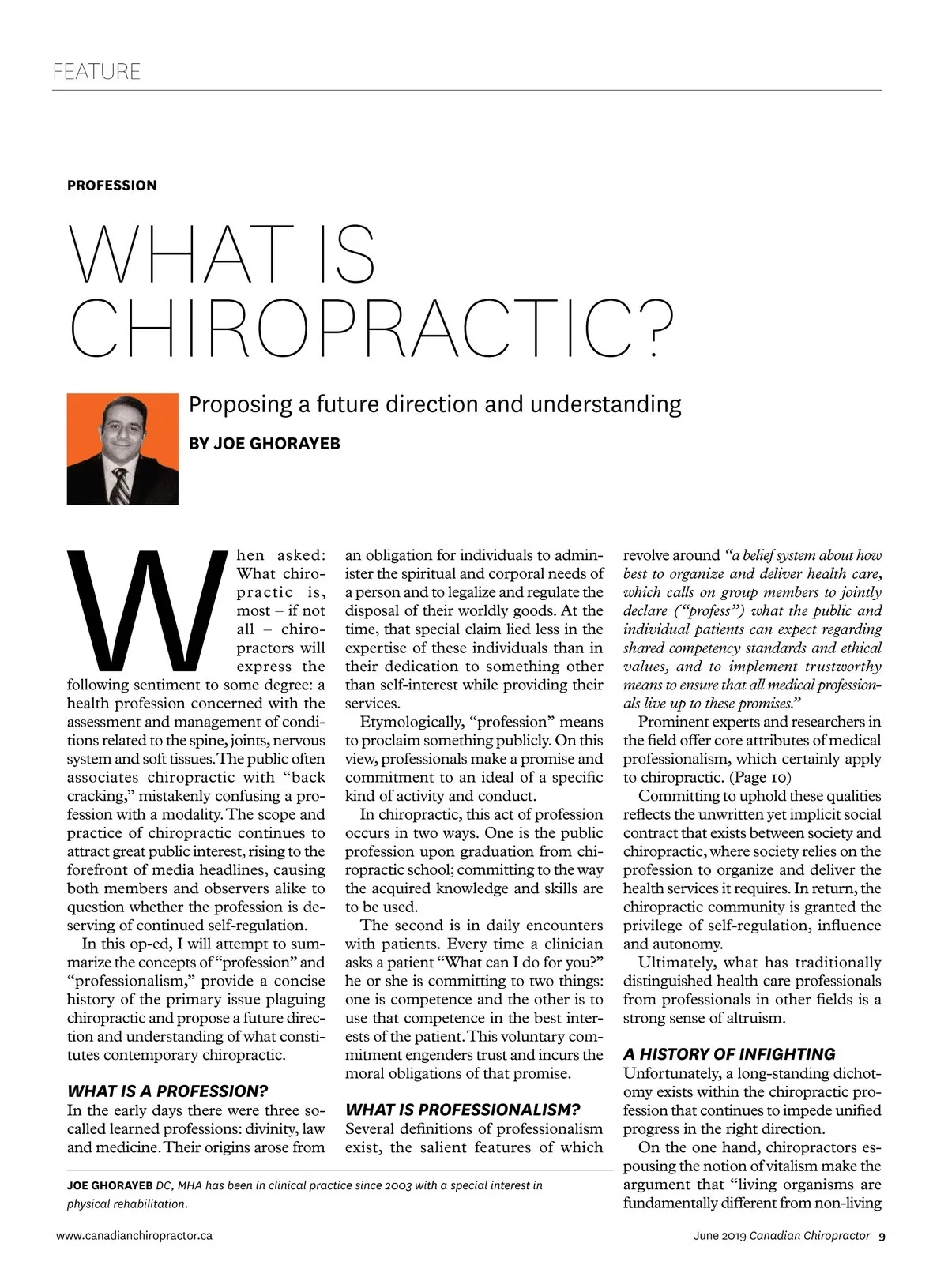
FEATURE PROFESSION WHAT IS CHIROPRACTIC? Proposing a future direction and understanding BY JOE GHORAYEB W www.canadianchiropractor.ca hen asked: What chiro-practic is, most – if not all – chiro-practors will express the following sentiment to some degree: a health profession concerned with the assessment and management of condi-tions related to the spine, joints, nervous system and soft tissues. The public often associates chiropractic with “back cracking,” mistakenly confusing a pro-fession with a modality. The scope and practice of chiropractic continues to attract great public interest, rising to the forefront of media headlines, causing both members and observers alike to question whether the profession is de-serving of continued self-regulation. In this op-ed, I will attempt to sum-marize the concepts of “profession” and “professionalism,” provide a concise history of the primary issue plaguing chiropractic and propose a future direc-tion and understanding of what consti-tutes contemporary chiropractic. WHAT IS A PROFESSION? an obligation for individuals to admin-ister the spiritual and corporal needs of a person and to legalize and regulate the disposal of their worldly goods. At the time, that special claim lied less in the expertise of these individuals than in their dedication to something other than self-interest while providing their services. Etymologically, “profession” means to proclaim something publicly. On this view, professionals make a promise and commitment to an ideal of a specific kind of activity and conduct. In chiropractic, this act of profession occurs in two ways. One is the public profession upon graduation from chi-ropractic school; committing to the way the acquired knowledge and skills are to be used. The second is in daily encounters with patients. Every time a clinician asks a patient “What can I do for you?” he or she is committing to two things: one is competence and the other is to use that competence in the best inter-ests of the patient. This voluntary com-mitment engenders trust and incurs the moral obligations of that promise. revolve around “a belief system about how best to organize and deliver health care, which calls on group members to jointly declare (“profess”) what the public and individual patients can expect regarding shared competency standards and ethical values, and to implement trustworthy means to ensure that all medical profession-als live up to these promises. ” Prominent experts and researchers in the field offer core attributes of medical professionalism, which certainly apply to chiropractic. (Page 10) Committing to uphold these qualities reflects the unwritten yet implicit social contract that exists between society and chiropractic, where society relies on the profession to organize and deliver the health services it requires. In return, the chiropractic community is granted the privilege of self-regulation, influence and autonomy. Ultimately, what has traditionally distinguished health care professionals from professionals in other fields is a strong sense of altruism. A HISTORY OF INFIGHTING In the early days there were three so-called learned professions: divinity, law and medicine. Their origins arose from WHAT IS PROFESSIONALISM? Several definitions of professionalism exist, the salient features of which JOE GHORAYEB DC, MHA has been in clinical practice since 2003 with a special interest in physical rehabilitation. Unfortunately, a long-standing dichot-omy exists within the chiropractic pro-fession that continues to impede unified progress in the right direction. On the one hand, chiropractors es-pousing the notion of vitalism make the argument that “living organisms are fundamentally different from non-living June 2019 Canadian Chiropractor 9
Chiropractic + Naturopathic Doctor June 2019: Page 9