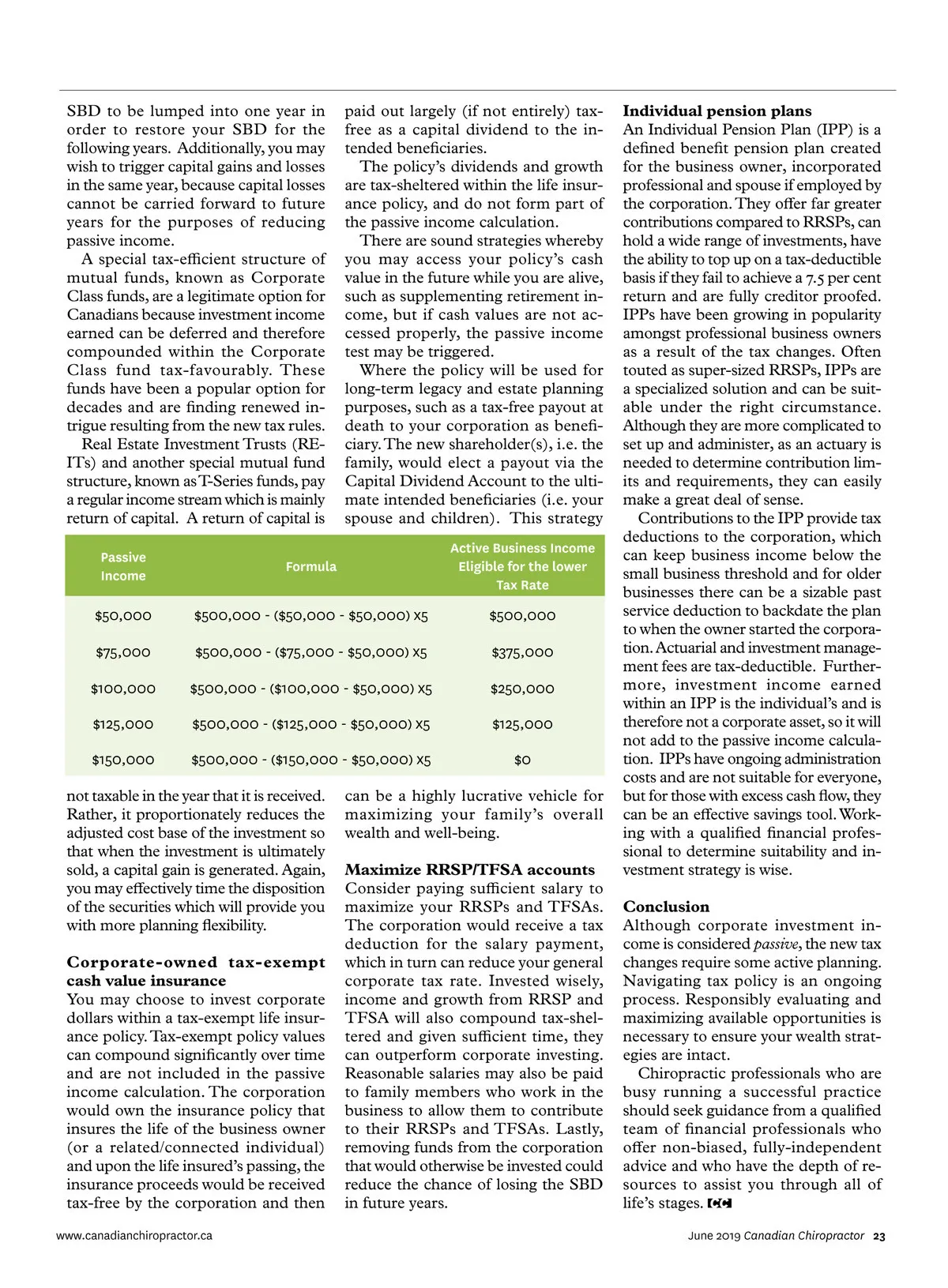
FEATURE FINANCE Be active for passive income T How to plan around the new small business tax changes BY MIKE MAGREEHAN he government enacted a number of new tax changes last year that could dra-matically impact the bot-tom line of many Canadian businesses, including incorporated professionals – chiropractors, doc-tors, lawyers and accountants. In this article, we will examine an area that has received considerable attention from small businesses and industry groups: the potential loss of some (or all) of the small business deduction (SBD). Although we are well into 2019, there are some legitimate tax plan-ning opportunities worthy of consid-eration now that may lessen or even eliminate the negative impact of these tax changes on you going forward. After salaries, dividends and ex-penses have been paid, incorporated professionals have enjoyed investing their retained earnings tax-efficiently inside their corporation. If you are going to withdraw the earnings each year to fund current lifestyle needs, then the loss of the SBD may not be material. However, professionals electing to invest inside their corpo-ration could enjoy a significant tax deferral by simply leaving funds in their corporation for investment purposes. The old rules allowed a lower tax rate on the first $500,000 of passive investment income, but along with a host of other new tax measures, one aspect of particular concern is the gradual loss of the SBD, as the $500,000 limit no longer fully applies. The changes are meant to eliminate tax benefits achieved when active business income is taxed at low rates and reinvested passively within a Passive investing – Planning corporation. From the government’s strategies with your corpo-perspective, an unfair tax advantage rate investment portfolio existed for business owners. Since If you maintain an investment portfo-corporations generally have access to lio within your corporation and you greater pools of after-tax capital, the are nearing or exceeding the $50,000 corporation could invest those dollars passive income threshold, enacting and earn passive investment income strategies to intentionally reduce pas-and compound those pools of capital sive income within your corporation in order to withdraw them tax-effi-may lessen the impact of the changes ciently in the future. on you. Let’s face it, you work hard for Under the new rules, passive in-your patients, your family and your come earned inside a corporation can money. There are several ways to do lower a corporation’s SBD limit. This this and the following strategies are reduction begins when a corporation considerations to help you reduce the earns $50,000 of passive income in negative consequences to your SBD the prior year. Specifically, the SBD limit in 2019 and beyond. will be reduced by $5 for every $1 of investment income above the $50,000 Investment strategies threshold. As such, the SBD would be Capital gains continue to be one of the completely eliminated if the com-most tax-advantaged ways to invest, bined investment income of your both personally and corporately. Com-corporation (and associated corpora-pared to ordinary investment income tions) for the taxation years that that is fully included in the passive in-ended in the preceding calendar year come calculation, only half of realized is over $150,000. capital gains are included. So, it would To illustrate, if your corporation take $100,000 of realized capital gains to generate $50,000 of passive earned at least $50,000 of income that could be counted passive income last year, toward the SBD test. then some (or all) of the The small You might decide to invest income that would have business qualified for the low SBD deduction will corporate dollars in growth corporate tax rate (12.5 per be reduced by stocks or funds, where interest cent for Ontario) would be $5 for every $1 and dividend income are neg-ligible, that will have a smaller taxed at the higher, general of investment impact on the SBD limit. As corporate tax rate this year (26.5 per cent in Ontario). income above those securities appreciate As you can see, losing the the $50,000 over time, you may then time threshold. profit-taking in a year where it SBD is a tax to the business is most favourable for you – owner, as this means higher i.e. when passive income is taxes which translates into less capital to invest. The impact of below the $50,000 threshold. Like-these measures will only compound wise, if your current year’s passive in-come is high enough that it will fully over time. eliminate next year’s SBD, consider MIKE MAGREEHAN, is BBA (Hon), CFP® is an Investment and Insurance Advisor with Canaccord Genuity crystalizing additional capital gains Wealth Management in Waterloo, ON. Mike welcomes your comments and questions at 1-800-495-8071 now, which may allow the negative or [email protected]. Visit LMwealth.com impact of realized capital gains on the www.canadianchiropractor.ca 22 Canadian Chiropractor June 2019
Chiropractic + Naturopathic Doctor June 2019: Page 22