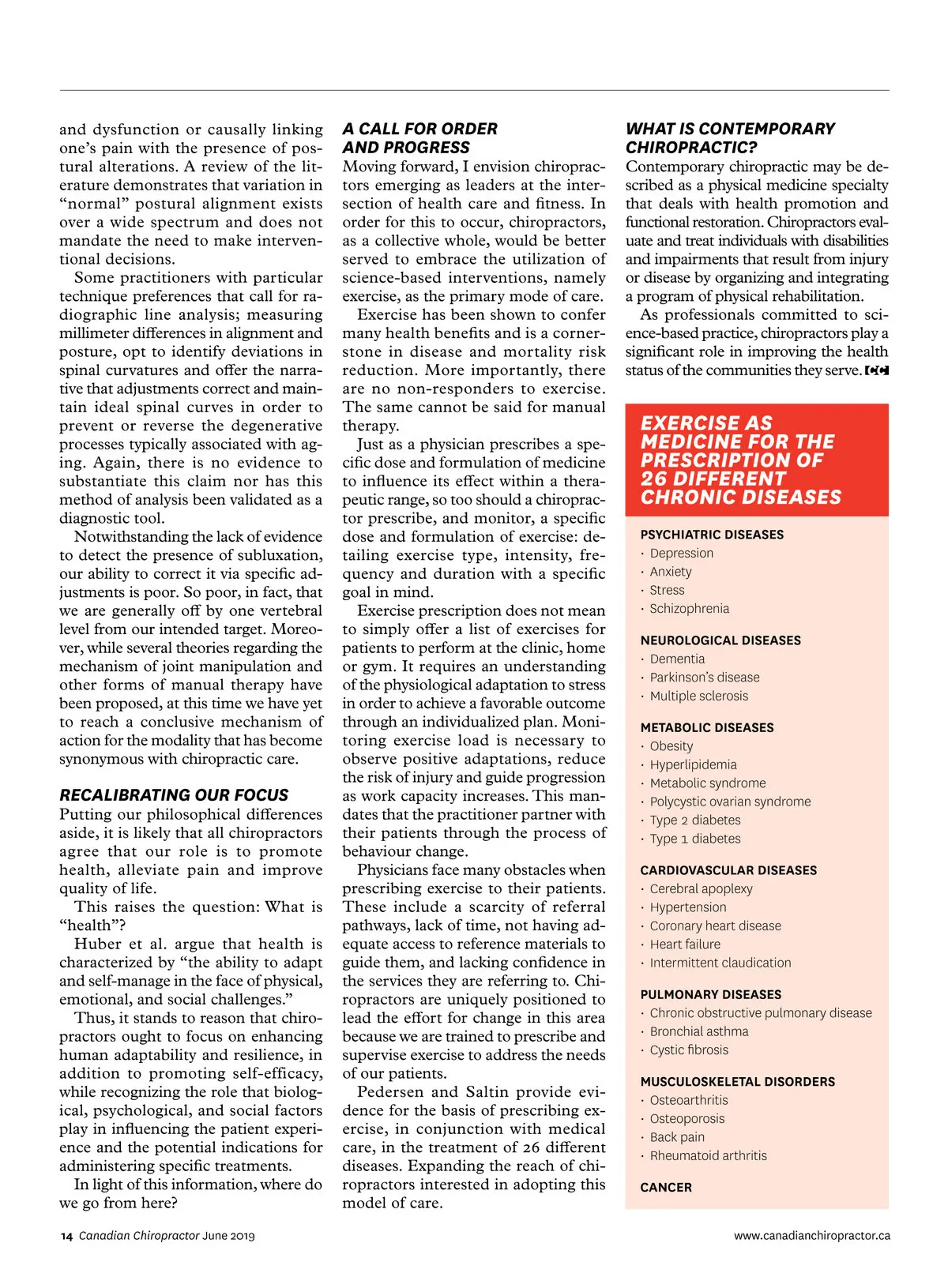
and dysfunction or causally linking one’s pain with the presence of pos-tural alterations. A review of the lit-erature demonstrates that variation in “normal” postural alignment exists over a wide spectrum and does not mandate the need to make interven-tional decisions. Some practitioners with particular technique preferences that call for ra-diographic line analysis; measuring millimeter differences in alignment and posture, opt to identify deviations in spinal curvatures and offer the narra-tive that adjustments correct and main-tain ideal spinal curves in order to prevent or reverse the degenerative processes typically associated with ag-ing. Again, there is no evidence to substantiate this claim nor has this method of analysis been validated as a diagnostic tool. Notwithstanding the lack of evidence to detect the presence of subluxation, our ability to correct it via specific ad-justments is poor. So poor, in fact, that we are generally off by one vertebral level from our intended target. Moreo-ver, while several theories regarding the mechanism of joint manipulation and other forms of manual therapy have been proposed, at this time we have yet to reach a conclusive mechanism of action for the modality that has become synonymous with chiropractic care. Putting our philosophical differences aside, it is likely that all chiropractors agree that our role is to promote health, alleviate pain and improve quality of life. This raises the question: What is “health”? Huber et al. argue that health is characterized by “the ability to adapt and self-manage in the face of physical, emotional, and social challenges.” Thus, it stands to reason that chiro-practors ought to focus on enhancing human adaptability and resilience, in addition to promoting self-efficacy, while recognizing the role that biolog-ical, psychological, and social factors play in influencing the patient experi-ence and the potential indications for administering specific treatments. In light of this information, where do we go from here? 14 Canadian Chiropractor June 2019 RECALIBRATING OUR FOCUS Moving forward, I envision chiroprac-tors emerging as leaders at the inter-section of health care and fitness. In order for this to occur, chiropractors, as a collective whole, would be better served to embrace the utilization of science-based interventions, namely exercise, as the primary mode of care. Exercise has been shown to confer many health benefits and is a corner-stone in disease and mortality risk reduction. More importantly, there are no non-responders to exercise. The same cannot be said for manual therapy. Just as a physician prescribes a spe-cific dose and formulation of medicine to influence its effect within a thera-peutic range, so too should a chiroprac-tor prescribe, and monitor, a specific dose and formulation of exercise: de-tailing exercise type, intensity, fre-quency and duration with a specific goal in mind. Exercise prescription does not mean to simply offer a list of exercises for patients to perform at the clinic, home or gym. It requires an understanding of the physiological adaptation to stress in order to achieve a favorable outcome through an individualized plan. Moni-toring exercise load is necessary to observe positive adaptations, reduce the risk of injury and guide progression as work capacity increases. This man-dates that the practitioner partner with their patients through the process of behaviour change. Physicians face many obstacles when prescribing exercise to their patients. These include a scarcity of referral pathways, lack of time, not having ad-equate access to reference materials to guide them, and lacking confidence in the services they are referring to. Chi-ropractors are uniquely positioned to lead the effort for change in this area because we are trained to prescribe and supervise exercise to address the needs of our patients. Pedersen and Saltin provide evi-dence for the basis of prescribing ex-ercise, in conjunction with medical care, in the treatment of 26 different diseases. Expanding the reach of chi-ropractors interested in adopting this model of care. A CALL FOR ORDER AND PROGRESS WHAT IS CONTEMPORARY CHIROPRACTIC? Contemporary chiropractic may be de-scribed as a physical medicine specialty that deals with health promotion and functional restoration. Chiropractors eval-uate and treat individuals with disabilities and impairments that result from injury or disease by organizing and integrating a program of physical rehabilitation. As professionals committed to sci-ence-based practice, chiropractors play a significant role in improving the health status of the communities they serve. EXERCISE AS MEDICINE FOR THE PRESCRIPTION OF 26 DIFFERENT CHRONIC DISEASES PSYCHIATRIC DISEASES • Depression • Anxiety • Stress • Schizophrenia NEUROLOGICAL DISEASES • Dementia • Parkinson’s disease • Multiple sclerosis METABOLIC DISEASES • Obesity • Hyperlipidemia • Metabolic syndrome • Polycystic ovarian syndrome • Type 2 diabetes • Type 1 diabetes CARDIOVASCULAR DISEASES • Cerebral apoplexy • Hypertension • Coronary heart disease • Heart failure • Intermittent claudication PULMONARY DISEASES • Chronic obstructive pulmonary disease • Bronchial asthma • Cystic fibrosis MUSCULOSKELETAL DISORDERS • Osteoarthritis • Osteoporosis • Back pain • Rheumatoid arthritis CANCER www.canadianchiropractor.ca
Chiropractic + Naturopathic Doctor June 2019: Page 14