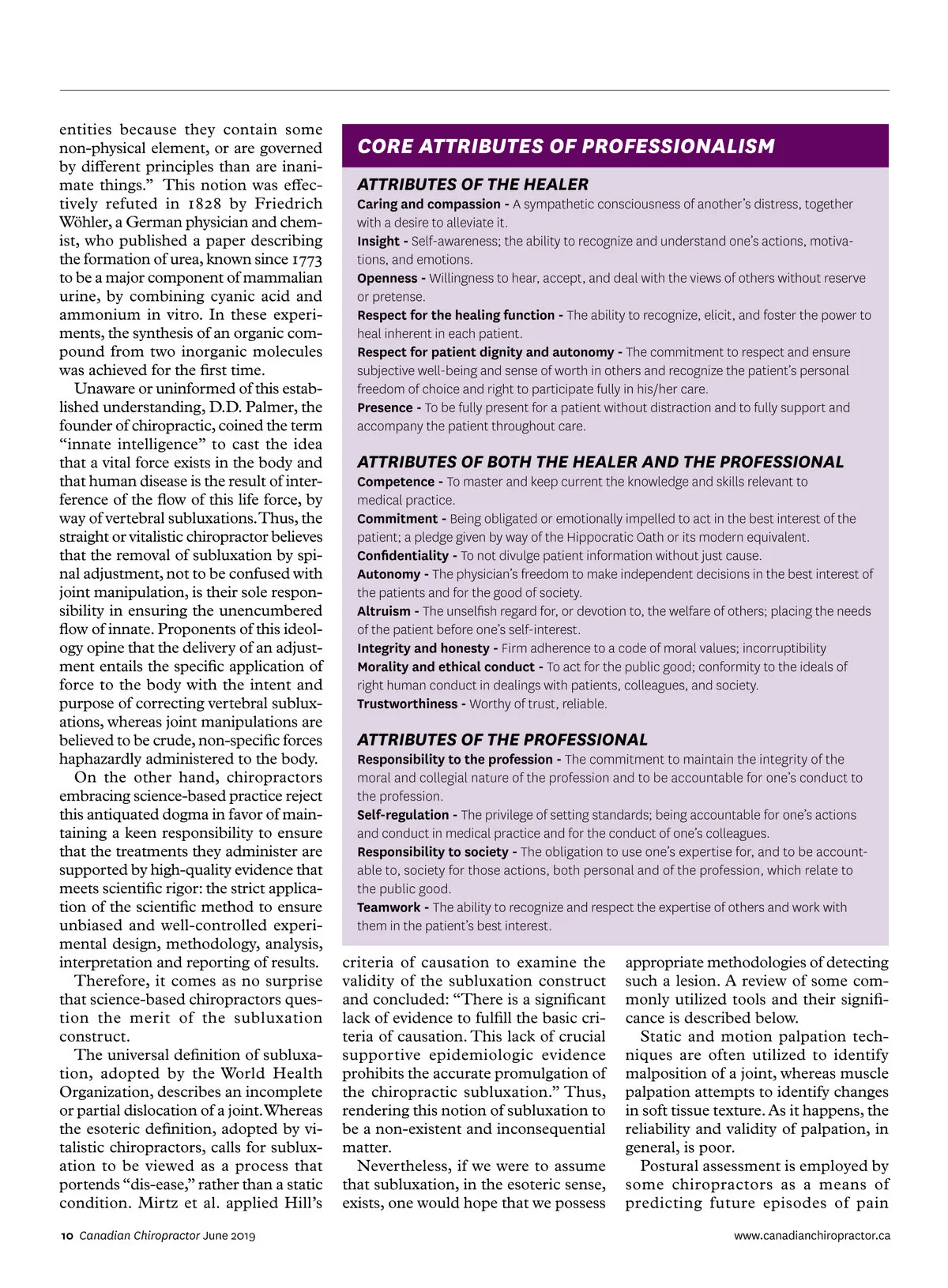
entities because they contain some non-physical element, or are governed by different principles than are inani-mate things.” This notion was effec-tively refuted in 1828 by Friedrich Wöhler, a German physician and chem-ist, who published a paper describing the formation of urea, known since 1773 to be a major component of mammalian urine, by combining cyanic acid and ammonium in vitro. In these experi-ments, the synthesis of an organic com-pound from two inorganic molecules was achieved for the first time. Unaware or uninformed of this estab-lished understanding, D.D. Palmer, the founder of chiropractic, coined the term “innate intelligence” to cast the idea that a vital force exists in the body and that human disease is the result of inter-ference of the flow of this life force, by way of vertebral subluxations. Thus, the straight or vitalistic chiropractor believes that the removal of subluxation by spi-nal adjustment, not to be confused with joint manipulation, is their sole respon-sibility in ensuring the unencumbered flow of innate. Proponents of this ideol-ogy opine that the delivery of an adjust-ment entails the specific application of force to the body with the intent and purpose of correcting vertebral sublux-ations, whereas joint manipulations are believed to be crude, non-specific forces haphazardly administered to the body. On the other hand, chiropractors embracing science-based practice reject this antiquated dogma in favor of main-taining a keen responsibility to ensure that the treatments they administer are supported by high-quality evidence that meets scientific rigor: the strict applica-tion of the scientific method to ensure unbiased and well-controlled experi-mental design, methodology, analysis, interpretation and reporting of results. Therefore, it comes as no surprise that science-based chiropractors ques-tion the merit of the subluxation construct. The universal definition of subluxa-tion, adopted by the World Health Organization, describes an incomplete or partial dislocation of a joint. Whereas the esoteric definition, adopted by vi-talistic chiropractors, calls for sublux-ation to be viewed as a process that portends “dis-ease,” rather than a static condition. Mirtz et al. applied Hill’s 10 Canadian Chiropractor June 2019 CORE ATTRIBUTES OF PROFESSIONALISM ATTRIBUTES OF THE HEALER Caring and compassion -A sympathetic consciousness of another’s distress, together with a desire to alleviate it. Insight -Self-awareness; the ability to recognize and understand one’s actions, motiva-tions, and emotions. Openness -Willingness to hear, accept, and deal with the views of others without reserve or pretense. Respect for the healing function -The ability to recognize, elicit, and foster the power to heal inherent in each patient. Respect for patient dignity and autonomy -The commitment to respect and ensure subjective well-being and sense of worth in others and recognize the patient’s personal freedom of choice and right to participate fully in his/her care. Presence -To be fully present for a patient without distraction and to fully support and accompany the patient throughout care. ATTRIBUTES OF BOTH THE HEALER AND THE PROFESSIONAL Competence -To master and keep current the knowledge and skills relevant to medical practice. Commitment -Being obligated or emotionally impelled to act in the best interest of the patient; a pledge given by way of the Hippocratic Oath or its modern equivalent. Confidentiality -To not divulge patient information without just cause. Autonomy -The physician’s freedom to make independent decisions in the best interest of the patients and for the good of society. Altruism -The unselfish regard for, or devotion to, the welfare of others; placing the needs of the patient before one’s self-interest. Integrity and honesty -Firm adherence to a code of moral values; incorruptibility Morality and ethical conduct -To act for the public good; conformity to the ideals of right human conduct in dealings with patients, colleagues, and society. Trustworthiness -Worthy of trust, reliable. ATTRIBUTES OF THE PROFESSIONAL Responsibility to the profession -The commitment to maintain the integrity of the moral and collegial nature of the profession and to be accountable for one’s conduct to the profession. Self-regulation -The privilege of setting standards; being accountable for one’s actions and conduct in medical practice and for the conduct of one’s colleagues. Responsibility to society -The obligation to use one’s expertise for, and to be account-able to, society for those actions, both personal and of the profession, which relate to the public good. Teamwork -The ability to recognize and respect the expertise of others and work with them in the patient’s best interest. criteria of causation to examine the validity of the subluxation construct and concluded: “There is a significant lack of evidence to fulfill the basic cri-teria of causation. This lack of crucial supportive epidemiologic evidence prohibits the accurate promulgation of the chiropractic subluxation.” Thus, rendering this notion of subluxation to be a non-existent and inconsequential matter. Nevertheless, if we were to assume that subluxation, in the esoteric sense, exists, one would hope that we possess appropriate methodologies of detecting such a lesion. A review of some com-monly utilized tools and their signifi-cance is described below. Static and motion palpation tech-niques are often utilized to identify malposition of a joint, whereas muscle palpation attempts to identify changes in soft tissue texture. As it happens, the reliability and validity of palpation, in general, is poor. Postural assessment is employed by some chiropractors as a means of predicting future episodes of pain www.canadianchiropractor.ca
Chiropractic + Naturopathic Doctor June 2019: Page 10