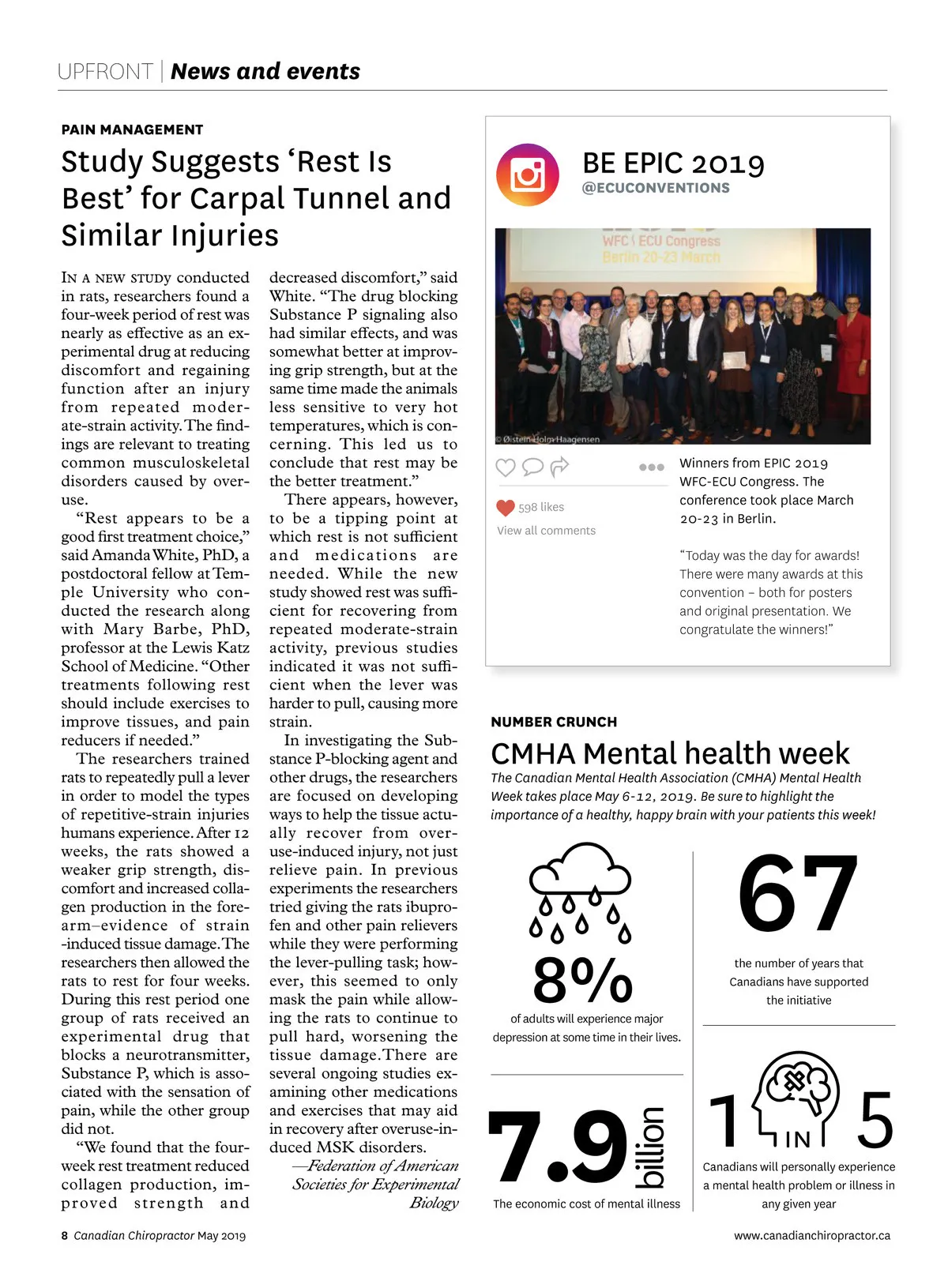
UPFRONT | News and events PAIN MANAGEMENT Study Suggests ‘Rest Is Best’ for Carpal Tunnel and Similar Injuries In a new study conducted in rats, researchers found a four-week period of rest was nearly as effective as an ex-perimental drug at reducing discomfort and regaining function after an injury from repeated moder-ate-strain activity. The find-ings are relevant to treating common musculoskeletal disorders caused by over-use. “Rest appears to be a good first treatment choice,” said Amanda White, PhD, a postdoctoral fellow at Tem-ple University who con-ducted the research along with Mary Barbe, PhD, professor at the Lewis Katz School of Medicine. “Other treatments following rest should include exercises to improve tissues, and pain reducers if needed.” The researchers trained rats to repeatedly pull a lever in order to model the types of repetitive-strain injuries humans experience. After 12 weeks, the rats showed a weaker grip strength, dis-comfort and increased colla-gen production in the fore-arm–evidence of strain -induced tissue damage. The researchers then allowed the rats to rest for four weeks. During this rest period one group of rats received an experimental drug that blocks a neurotransmitter, Substance P, which is asso-ciated with the sensation of pain, while the other group did not. “We found that the four-week rest treatment reduced collagen production, im-proved strength and 8 Canadian Chiropractor May 2019 BE EPIC 2019 @ECUCONVENTIONS decreased discomfort,” said White. “The drug blocking Substance P signaling also had similar effects, and was somewhat better at improv-ing grip strength, but at the same time made the animals less sensitive to very hot temperatures, which is con-cerning. This led us to conclude that rest may be the better treatment.” There appears, however, to be a tipping point at which rest is not sufficient and medications are needed. While the new study showed rest was suffi-cient for recovering from repeated moderate-strain activity, previous studies indicated it was not suffi-cient when the lever was harder to pull, causing more strain. In investigating the Sub-stance P-blocking agent and other drugs, the researchers are focused on developing ways to help the tissue actu-ally recover from over-use-induced injury, not just relieve pain. In previous experiments the researchers tried giving the rats ibupro-fen and other pain relievers while they were performing the lever-pulling task; how-ever, this seemed to only mask the pain while allow-ing the rats to continue to pull hard, worsening the tissue damage.There are several ongoing studies ex-amining other medications and exercises that may aid in recovery after overuse-in-duced MSK disorders. —Federation of American Societies for Experimental Biology 598 likes View all comments Winners from EPIC 2019 WFC-ECU Congress. The conference took place March 20-23 in Berlin. “Today was the day for awards! There were many awards at this convention – both for posters and original presentation. We congratulate the winners!” NUMBER CRUNCH CMHA Mental health week The Canadian Mental Health Association (CMHA) Mental Health Week takes place May 6-12, 2019. Be sure to highlight the importance of a healthy, happy brain with your patients this week! of adults will experience major depression at some time in their lives. 8% the number of years that Canadians have supported the initiative 67 in 1 7.9 billion The economic cost of mental illness Canadians will personally experience a mental health problem or illness in any given year www.canadianchiropractor.ca 5
Chiropractic + Naturopathic Doctor May 2019: Page 8