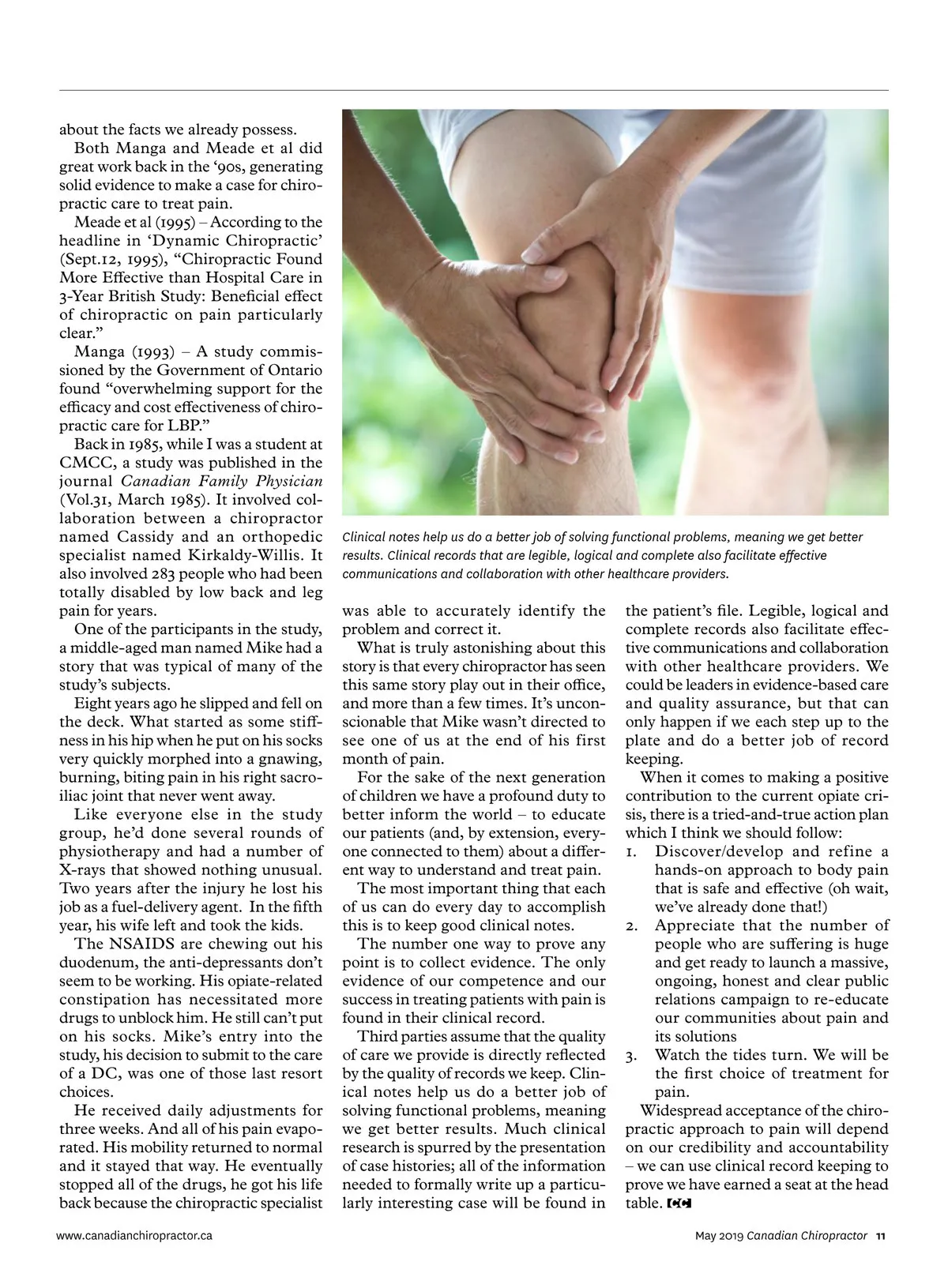
about the facts we already possess. Both Manga and Meade et al did great work back in the ‘90s, generating solid evidence to make a case for chiro-practic care to treat pain. Meade et al (1995) – According to the headline in ‘Dynamic Chiropractic’ (Sept.12, 1995), “Chiropractic Found More Effective than Hospital Care in 3-Year British Study: Beneficial effect of chiropractic on pain particularly clear.” Manga (1993) – A study commis-sioned by the Government of Ontario found “overwhelming support for the efficacy and cost effectiveness of chiro-practic care for LBP.” Back in 1985, while I was a student at CMCC, a study was published in the journal Canadian Family Physician (Vol.31, March 1985). It involved col-laboration between a chiropractor named Cassidy and an orthopedic specialist named Kirkaldy-Willis. It also involved 283 people who had been totally disabled by low back and leg pain for years. One of the participants in the study, a middle-aged man named Mike had a story that was typical of many of the study’s subjects. Eight years ago he slipped and fell on the deck. What started as some stiff-ness in his hip when he put on his socks very quickly morphed into a gnawing, burning, biting pain in his right sacro-iliac joint that never went away. Like everyone else in the study group, he’d done several rounds of physiotherapy and had a number of X-rays that showed nothing unusual. Two years after the injury he lost his job as a fuel-delivery agent. In the fifth year, his wife left and took the kids. The NSAIDS are chewing out his duodenum, the anti-depressants don’t seem to be working. His opiate-related constipation has necessitated more drugs to unblock him. He still can’t put on his socks. Mike’s entry into the study, his decision to submit to the care of a DC, was one of those last resort choices. He received daily adjustments for three weeks. And all of his pain evapo-rated. His mobility returned to normal and it stayed that way. He eventually stopped all of the drugs, he got his life back because the chiropractic specialist www.canadianchiropractor.ca Clinical notes help us do a better job of solving functional problems, meaning we get better results. Clinical records that are legible, logical and complete also facilitate effective communications and collaboration with other healthcare providers. was able to accurately identify the problem and correct it. What is truly astonishing about this story is that every chiropractor has seen this same story play out in their office, and more than a few times. It’s uncon-scionable that Mike wasn’t directed to see one of us at the end of his first month of pain. For the sake of the next generation of children we have a profound duty to better inform the world – to educate our patients (and, by extension, every-one connected to them) about a differ-ent way to understand and treat pain. The most important thing that each of us can do every day to accomplish this is to keep good clinical notes. The number one way to prove any point is to collect evidence. The only evidence of our competence and our success in treating patients with pain is found in their clinical record. Third parties assume that the quality of care we provide is directly reflected by the quality of records we keep. Clin-ical notes help us do a better job of solving functional problems, meaning we get better results. Much clinical research is spurred by the presentation of case histories; all of the information needed to formally write up a particu-larly interesting case will be found in the patient’s file. Legible, logical and complete records also facilitate effec-tive communications and collaboration with other healthcare providers. We could be leaders in evidence-based care and quality assurance, but that can only happen if we each step up to the plate and do a better job of record keeping. When it comes to making a positive contribution to the current opiate cri-sis, there is a tried-and-true action plan which I think we should follow: 1. Discover/develop and refine a hands-on approach to body pain that is safe and effective (oh wait, we’ve already done that!) 2. Appreciate that the number of people who are suffering is huge and get ready to launch a massive, ongoing, honest and clear public relations campaign to re-educate our communities about pain and its solutions 3. Watch the tides turn. We will be the first choice of treatment for pain. Widespread acceptance of the chiro-practic approach to pain will depend on our credibility and accountability – we can use clinical record keeping to prove we have earned a seat at the head table. May 2019 Canadian Chiropractor 11
Chiropractic + Naturopathic Doctor May 2019: Page 11