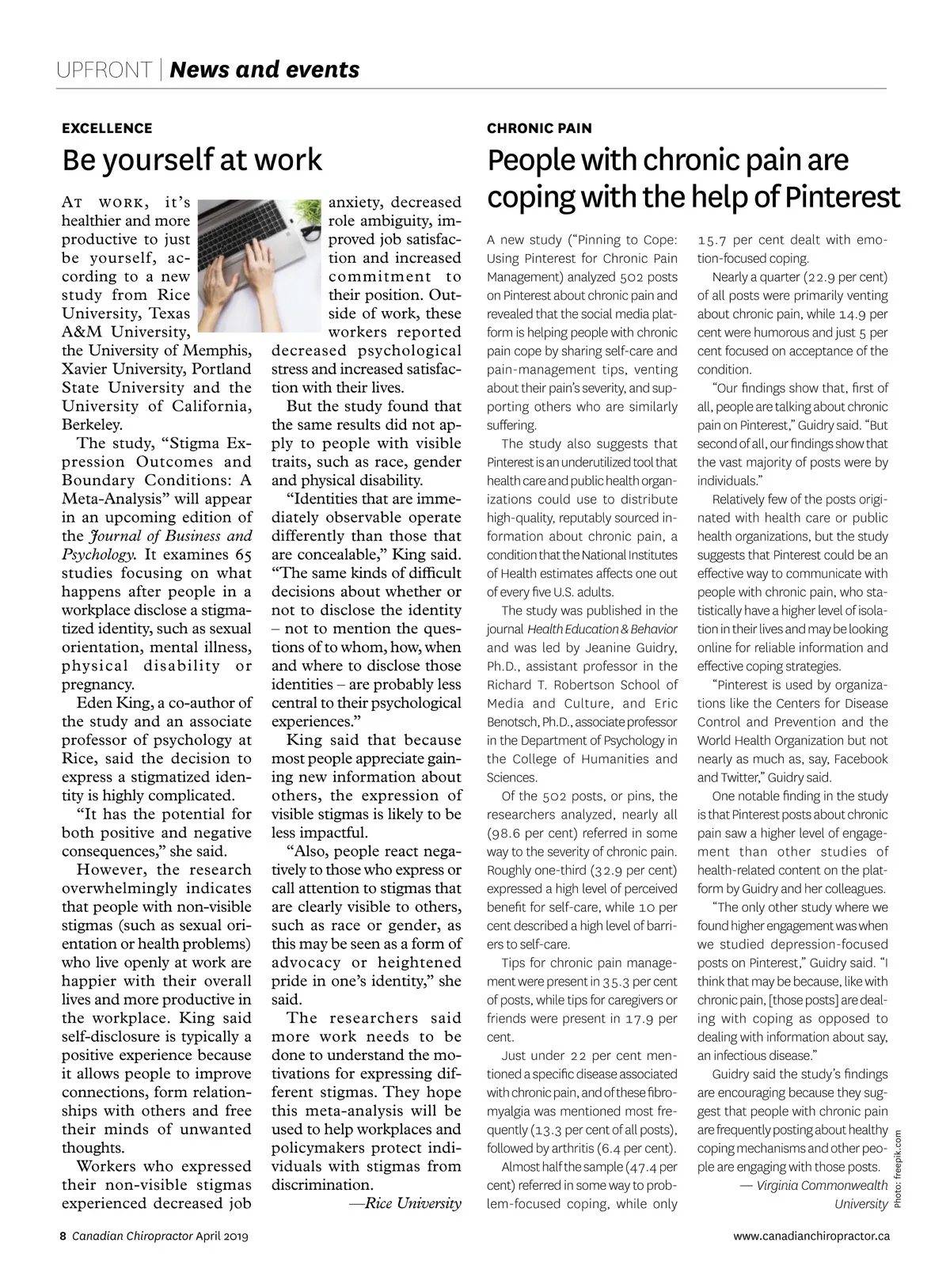
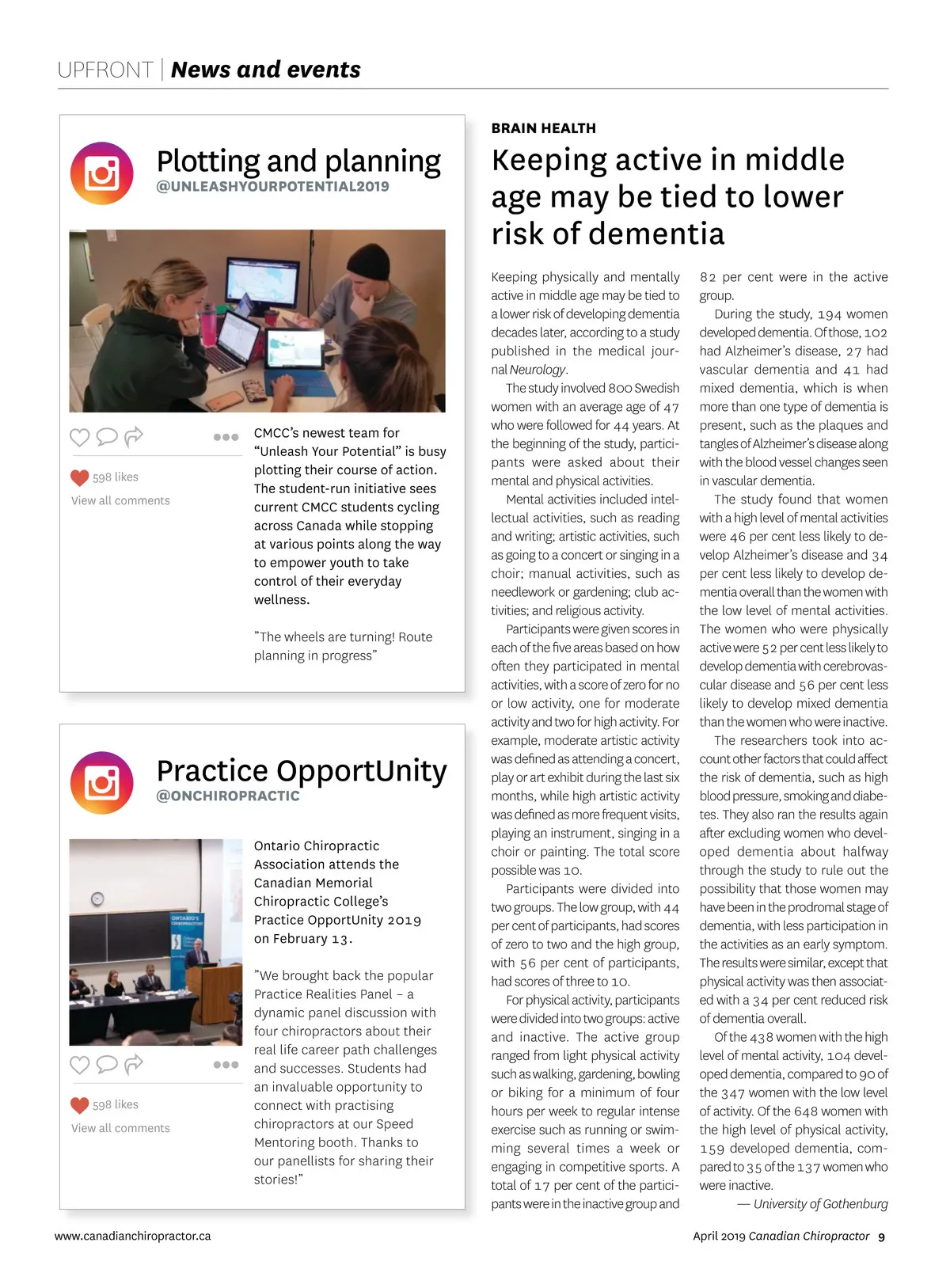
UPFRONT | News and events BRAIN HEALTH Plotting and planning @UNLEASHYOURPOTENTIAL2019 Keeping active in middle age may be tied to lower risk of dementia Keeping physically and mentally active in middle age may be tied to a lower risk of developing dementia decades later, according to a study published in the medical jour-nal Neurology . The study involved 800 Swedish women with an average age of 47 who were followed for 44 years. At the beginning of the study, partici-pants were asked about their mental and physical activities. Mental activities included intel-lectual activities, such as reading and writing; artistic activities, such as going to a concert or singing in a choir; manual activities, such as needlework or gardening; club ac-tivities; and religious activity. Participants were given scores in each of the five areas based on how often they participated in mental activities, with a score of zero for no or low activity, one for moderate activity and two for high activity. For example, moderate artistic activity was defined as attending a concert, play or art exhibit during the last six months, while high artistic activity was defined as more frequent visits, playing an instrument, singing in a choir or painting. The total score possible was 10. Participants were divided into two groups. The low group, with 44 per cent of participants, had scores of zero to two and the high group, with 56 per cent of participants, had scores of three to 10. For physical activity, participants were divided into two groups: active and inactive. The active group ranged from light physical activity such as walking, gardening, bowling or biking for a minimum of four hours per week to regular intense exercise such as running or swim-ming several times a week or engaging in competitive sports. A total of 17 per cent of the partici-pants were in the inactive group and 82 per cent were in the active group. During the study, 194 women developed dementia. Of those, 102 had Alzheimer’s disease, 27 had vascular dementia and 41 had mixed dementia, which is when more than one type of dementia is present, such as the plaques and tangles of Alzheimer’s disease along with the blood vessel changes seen in vascular dementia. The study found that women with a high level of mental activities were 46 per cent less likely to de-velop Alzheimer’s disease and 34 per cent less likely to develop de-mentia overall than the women with the low level of mental activities. The women who were physically active were 52 per cent less likely to develop dementia with cerebrovas-cular disease and 56 per cent less likely to develop mixed dementia than the women who were inactive. The researchers took into ac-count other factors that could affect the risk of dementia, such as high blood pressure, smoking and diabe-tes. They also ran the results again after excluding women who devel-oped dementia about halfway through the study to rule out the possibility that those women may have been in the prodromal stage of dementia, with less participation in the activities as an early symptom. The results were similar, except that physical activity was then associat-ed with a 34 per cent reduced risk of dementia overall. Of the 438 women with the high level of mental activity, 104 devel-oped dementia, compared to 90 of the 347 women with the low level of activity. Of the 648 women with the high level of physical activity, 159 developed dementia, com-pared to 35 of the 137 women who were inactive. — University of Gothenburg April 2019 Canadian Chiropractor 9 598 likes View all comments CMCC’s newest team for “Unleash Your Potential” is busy plotting their course of action. The student-run initiative sees current CMCC students cycling across Canada while stopping at various points along the way to empower youth to take control of their everyday wellness. ”The wheels are turning! Route planning in progress” Practice OpportUnity @ONCHIROPRACTIC Ontario Chiropractic Association attends the Canadian Memorial Chiropractic College’s Practice OpportUnity 2019 on February 13. ”We brought back the popular Practice Realities Panel – a dynamic panel discussion with four chiropractors about their real life career path challenges and successes. Students had an invaluable opportunity to connect with practising chiropractors at our Speed Mentoring booth. Thanks to our panellists for sharing their stories!” 598 likes View all comments www.canadianchiropractor.ca
Chiropractic + Naturopathic Doctor April 2019: Page 9