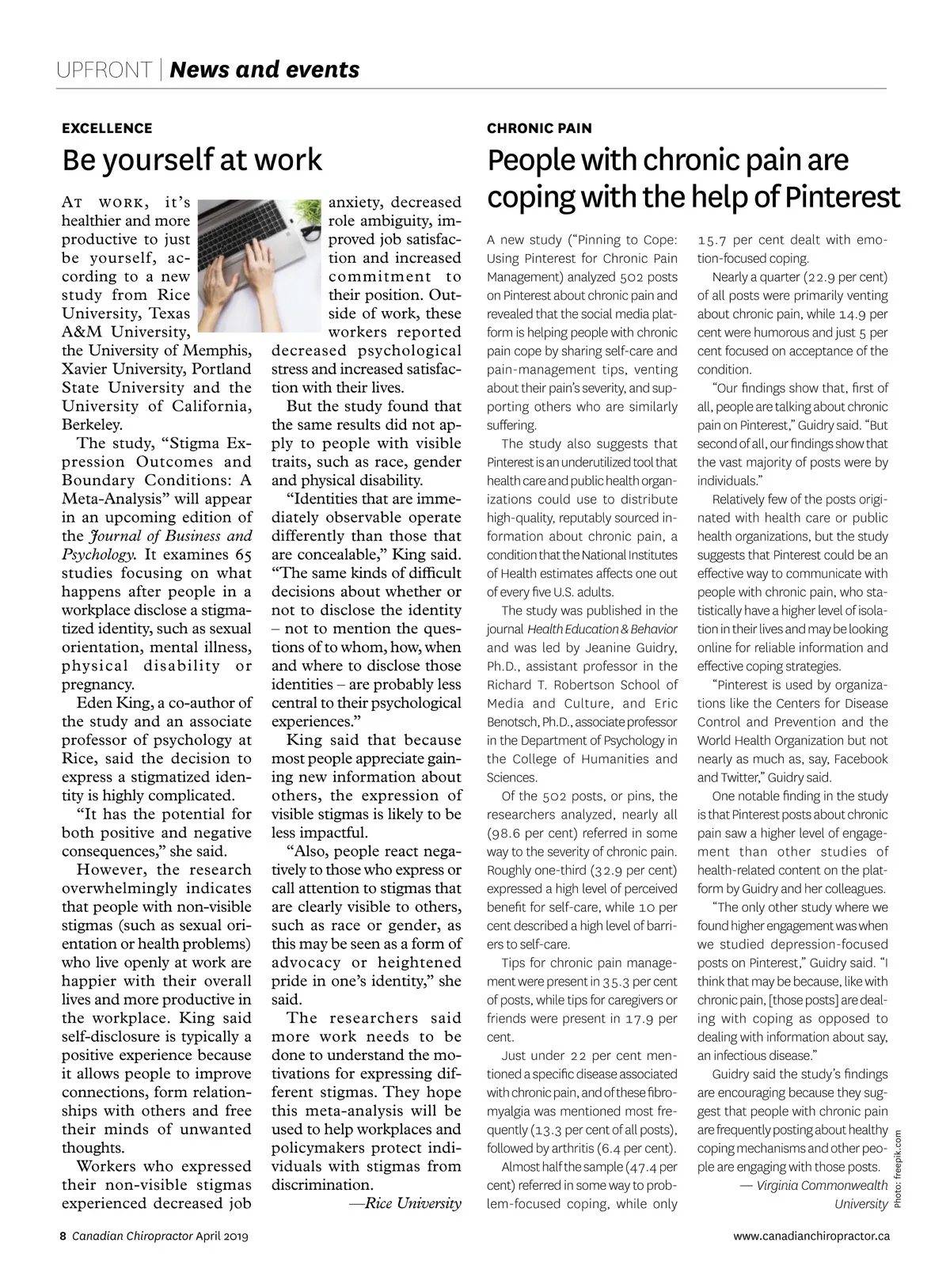
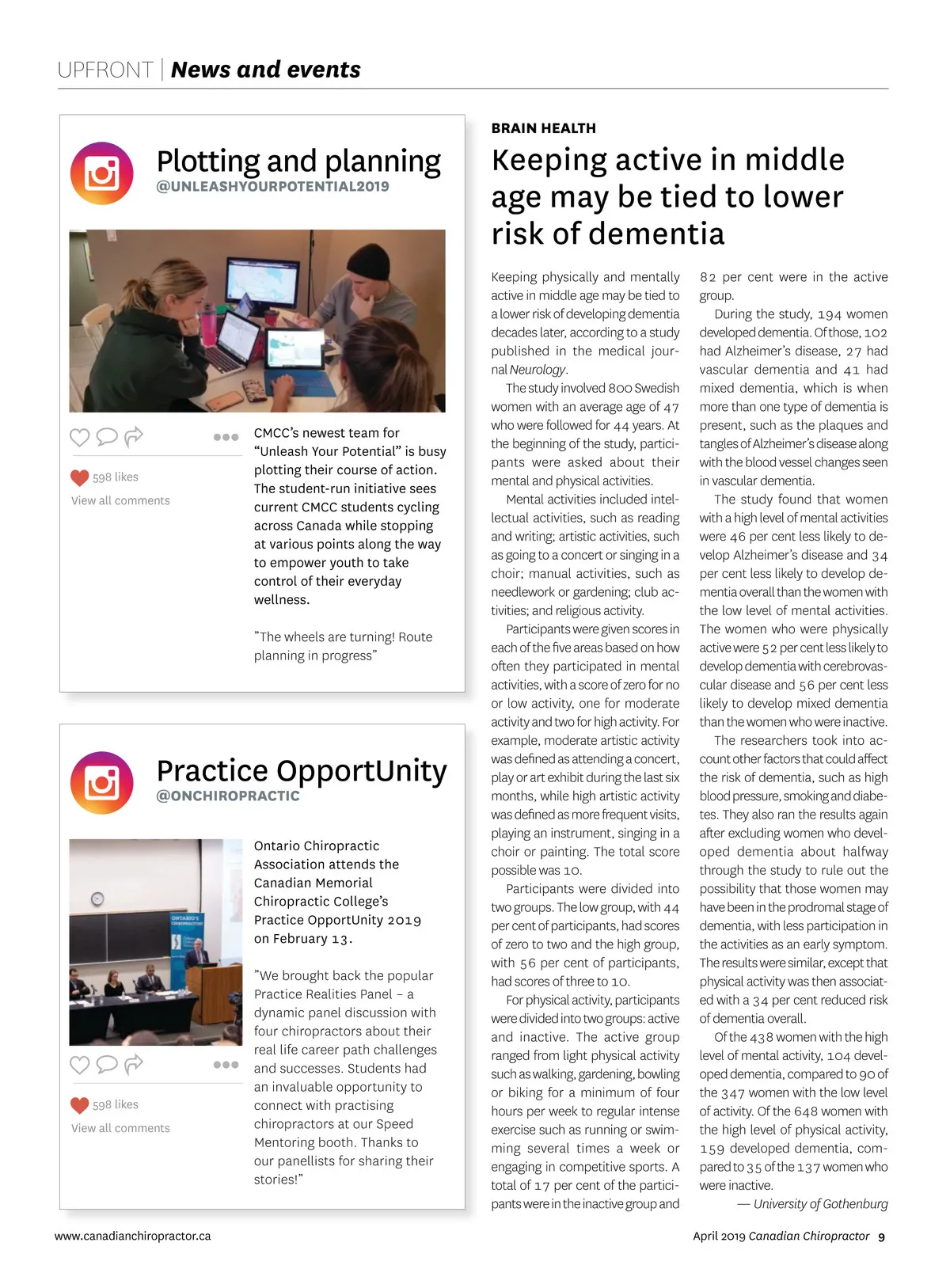
UPFRONT | News and events EXCELLENCE Be yourself at work At work, it’s healthier and more productive to just be yourself, ac-cording to a new study from Rice University, Texas A&M University, the University of Memphis, Xavier University, Portland State University and the University of California, Berkeley. The study, “Stigma Ex-pression Outcomes and Boundary Conditions: A Meta-Analysis” will appear in an upcoming edition of the Journal of Business and Psychology. It examines 65 studies focusing on what happens after people in a workplace disclose a stigma-tized identity, such as sexual orientation, mental illness, physical disability or pregnancy. Eden King, a co-author of the study and an associate professor of psychology at Rice, said the decision to express a stigmatized iden-tity is highly complicated. “It has the potential for both positive and negative consequences,” she said. However, the research overwhelmingly indicates that people with non-visible stigmas (such as sexual ori-entation or health problems) who live openly at work are happier with their overall lives and more productive in the workplace. King said self-disclosure is typically a positive experience because it allows people to improve connections, form relation-ships with others and free their minds of unwanted thoughts. Workers who expressed their non-visible stigmas experienced decreased job 8 Canadian Chiropractor April 2019 anxiety, decreased role ambiguity, im-proved job satisfac-tion and increased commitment to their position. Out-side of work, these workers reported decreased psychological stress and increased satisfac-tion with their lives. But the study found that the same results did not ap-ply to people with visible traits, such as race, gender and physical disability. “Identities that are imme-diately observable operate differently than those that are concealable,” King said. “The same kinds of difficult decisions about whether or not to disclose the identity – not to mention the ques-tions of to whom, how, when and where to disclose those identities – are probably less central to their psychological experiences.” King said that because most people appreciate gain-ing new information about others, the expression of visible stigmas is likely to be less impactful. “Also, people react nega-tively to those who express or call attention to stigmas that are clearly visible to others, such as race or gender, as this may be seen as a form of advocacy or heightened pride in one’s identity,” she said. The researchers said more work needs to be done to understand the mo-tivations for expressing dif-ferent stigmas. They hope this meta-analysis will be used to help workplaces and policymakers protect indi-viduals with stigmas from discrimination. —Rice University People with chronic pain are coping with the help of Pinterest A new study (“Pinning to Cope: Using Pinterest for Chronic Pain Management) analyzed 502 posts on Pinterest about chronic pain and revealed that the social media plat-form is helping people with chronic pain cope by sharing self-care and pain-management tips, venting about their pain’s severity, and sup-porting others who are similarly suffering. The study also suggests that Pinterest is an underutilized tool that health care and public health organ-izations could use to distribute high-quality, reputably sourced in-formation about chronic pain, a condition that the National Institutes of Health estimates affects one out of every five U.S. adults. The study was published in the journal Health Education & Behavior and was led by Jeanine Guidry, Ph.D., assistant professor in the Richard T. Robertson School of Media and Culture, and Eric Benotsch, Ph.D., associate professor in the Department of Psychology in the College of Humanities and Sciences. Of the 502 posts, or pins, the researchers analyzed, nearly all (98.6 per cent) referred in some way to the severity of chronic pain. Roughly one-third (32.9 per cent) expressed a high level of perceived benefit for self-care, while 10 per cent described a high level of barri-ers to self-care. Tips for chronic pain manage-ment were present in 35.3 per cent of posts, while tips for caregivers or friends were present in 17.9 per cent. Just under 22 per cent men-tioned a specific disease associated with chronic pain, and of these fibro-myalgia was mentioned most fre-quently (13.3 per cent of all posts), followed by arthritis (6.4 per cent). Almost half the sample (47.4 per cent) referred in some way to prob-lem-focused coping, while only 15.7 per cent dealt with emo-tion-focused coping. Nearly a quarter (22.9 per cent) of all posts were primarily venting about chronic pain, while 14.9 per cent were humorous and just 5 per cent focused on acceptance of the condition. “Our findings show that, first of all, people are talking about chronic pain on Pinterest,” Guidry said. “But second of all, our findings show that the vast majority of posts were by individuals.” Relatively few of the posts origi-nated with health care or public health organizations, but the study suggests that Pinterest could be an effective way to communicate with people with chronic pain, who sta-tistically have a higher level of isola-tion in their lives and may be looking online for reliable information and effective coping strategies. “Pinterest is used by organiza-tions like the Centers for Disease Control and Prevention and the World Health Organization but not nearly as much as, say, Facebook and Twitter,” Guidry said. One notable finding in the study is that Pinterest posts about chronic pain saw a higher level of engage-ment than other studies of health-related content on the plat-form by Guidry and her colleagues. “The only other study where we found higher engagement was when we studied depression-focused posts on Pinterest,” Guidry said. “I think that may be because, like with chronic pain, [those posts] are deal-ing with coping as opposed to dealing with information about say, an infectious disease.” Guidry said the study’s findings are encouraging because they sug-gest that people with chronic pain are frequently posting about healthy coping mechanisms and other peo-ple are engaging with those posts. — Virginia Commonwealth University www.canadianchiropractor.ca CHRONIC PAIN Photo: freepik.com
Chiropractic + Naturopathic Doctor April 2019: Page 8