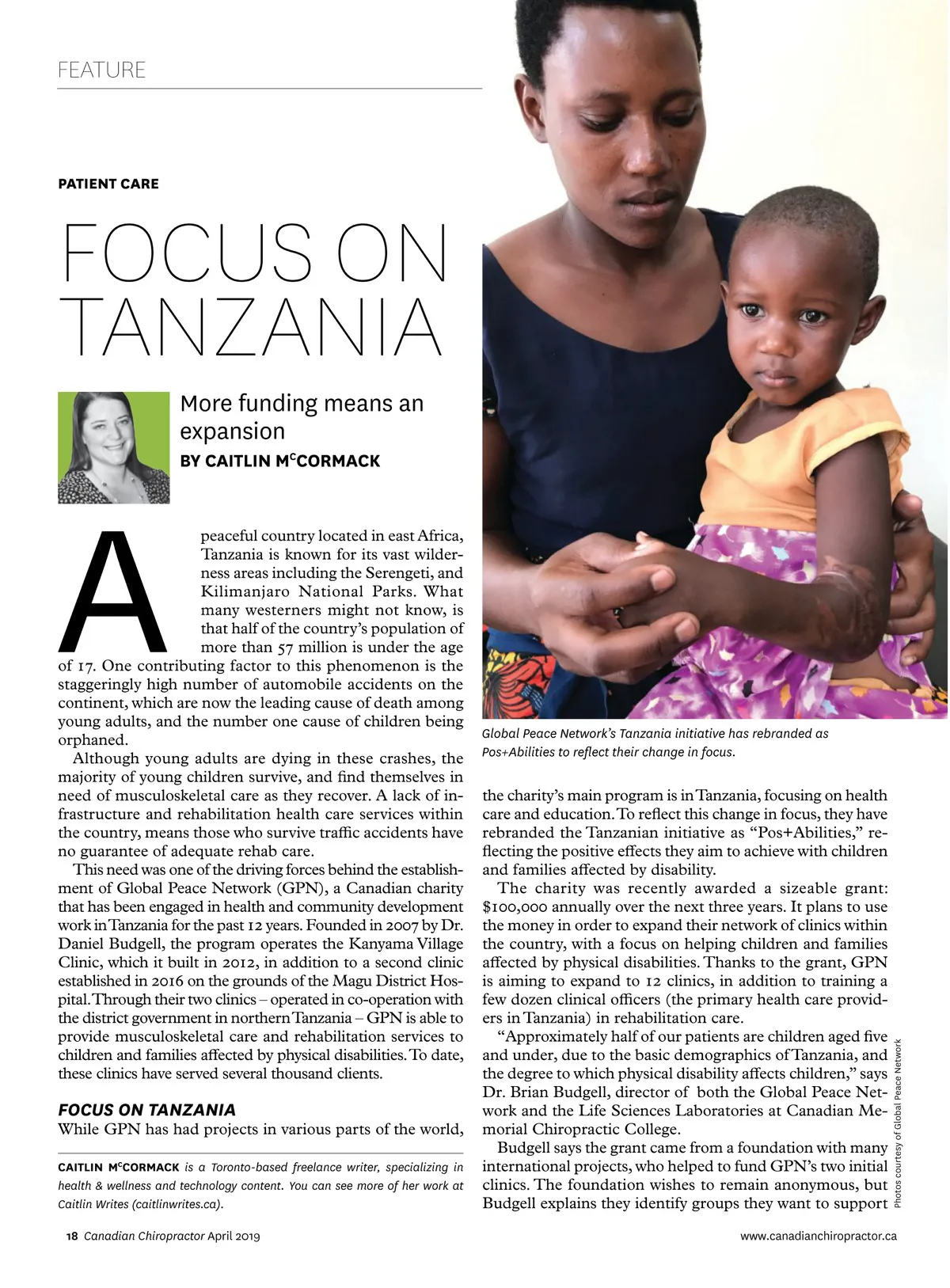
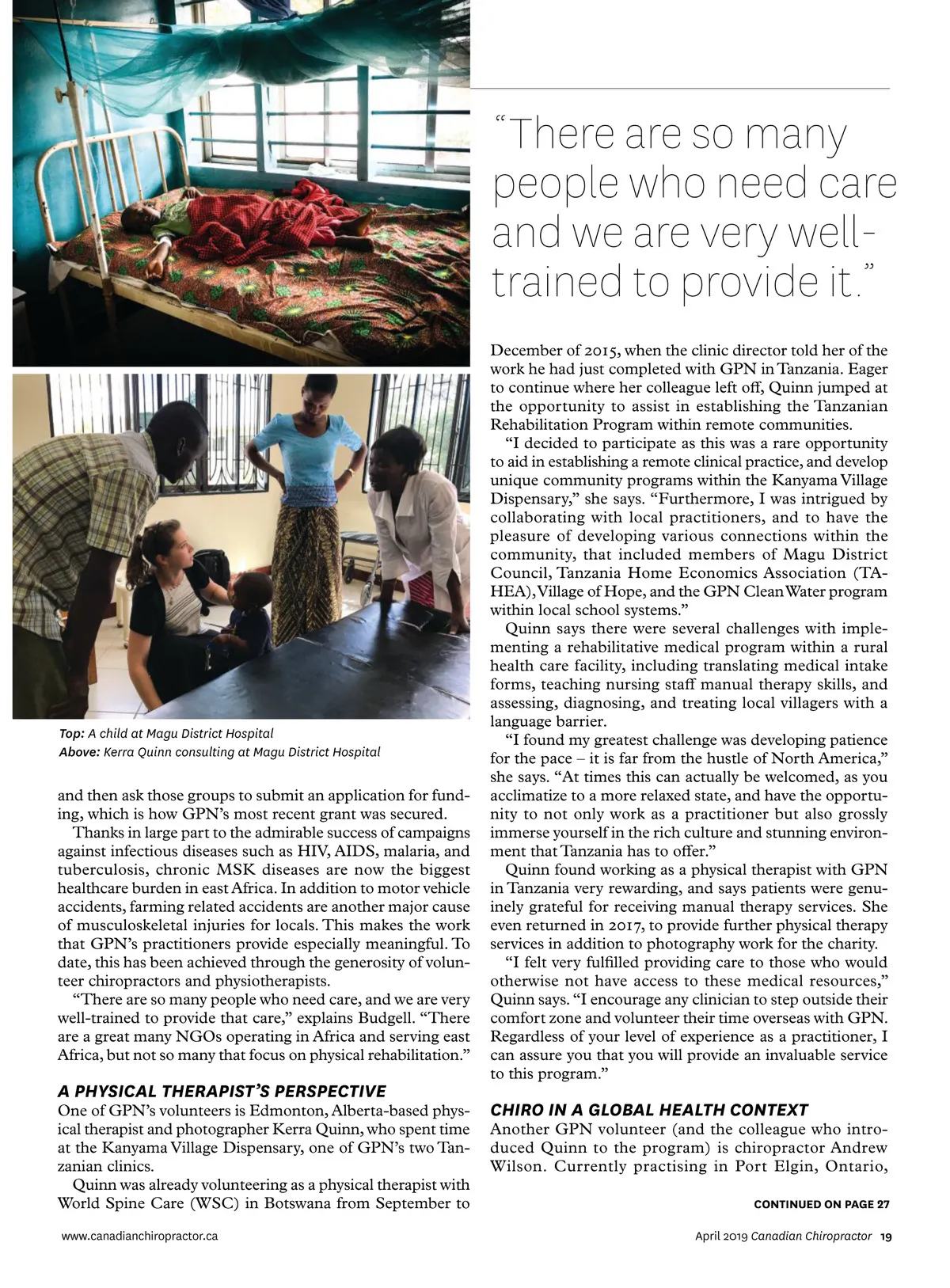
“There are so many people who need care and we are very well-trained to provide it.” December of 2015, when the clinic director told her of the work he had just completed with GPN in Tanzania. Eager to continue where her colleague left off, Quinn jumped at the opportunity to assist in establishing the Tanzanian Rehabilitation Program within remote communities. “I decided to participate as this was a rare opportunity to aid in establishing a remote clinical practice, and develop unique community programs within the Kanyama Village Dispensary,” she says. “Furthermore, I was intrigued by collaborating with local practitioners, and to have the pleasure of developing various connections within the community, that included members of Magu District Council, Tanzania Home Economics Association (TA-HEA), Village of Hope, and the GPN Clean Water program within local school systems.” Quinn says there were several challenges with imple-menting a rehabilitative medical program within a rural health care facility, including translating medical intake forms, teaching nursing staff manual therapy skills, and assessing, diagnosing, and treating local villagers with a language barrier. “I found my greatest challenge was developing patience for the pace – it is far from the hustle of North America,” she says. “At times this can actually be welcomed, as you acclimatize to a more relaxed state, and have the opportu-nity to not only work as a practitioner but also grossly immerse yourself in the rich culture and stunning environ-ment that Tanzania has to offer.” Quinn found working as a physical therapist with GPN in Tanzania very rewarding, and says patients were genu-inely grateful for receiving manual therapy services. She even returned in 2017, to provide further physical therapy services in addition to photography work for the charity. “I felt very fulfilled providing care to those who would otherwise not have access to these medical resources,” Quinn says. “I encourage any clinician to step outside their comfort zone and volunteer their time overseas with GPN. Regardless of your level of experience as a practitioner, I can assure you that you will provide an invaluable service to this program.” Top: A child at Magu District Hospital Above: Kerra Quinn consulting at Magu District Hospital and then ask those groups to submit an application for fund-ing, which is how GPN’s most recent grant was secured. Thanks in large part to the admirable success of campaigns against infectious diseases such as HIV, AIDS, malaria, and tuberculosis, chronic MSK diseases are now the biggest healthcare burden in east Africa. In addition to motor vehicle accidents, farming related accidents are another major cause of musculoskeletal injuries for locals. This makes the work that GPN’s practitioners provide especially meaningful. To date, this has been achieved through the generosity of volun-teer chiropractors and physiotherapists. “There are so many people who need care, and we are very well-trained to provide that care,” explains Budgell. “There are a great many NGOs operating in Africa and serving east Africa, but not so many that focus on physical rehabilitation.” A PHYSICAL THERAPIST’S PERSPECTIVE One of GPN’s volunteers is Edmonton, Alberta-based phys-ical therapist and photographer Kerra Quinn, who spent time at the Kanyama Village Dispensary, one of GPN’s two Tan-zanian clinics. Quinn was already volunteering as a physical therapist with World Spine Care (WSC) in Botswana from September to www.canadianchiropractor.ca CHIRO IN A GLOBAL HEALTH CONTEXT Another GPN volunteer (and the colleague who intro-duced Quinn to the program) is chiropractor Andrew Wilson. Currently practising in Port Elgin, Ontario, CONTINUED ON PAGE 27 April 2019 Canadian Chiropractor 19
Chiropractic + Naturopathic Doctor April 2019: Page 19